The work
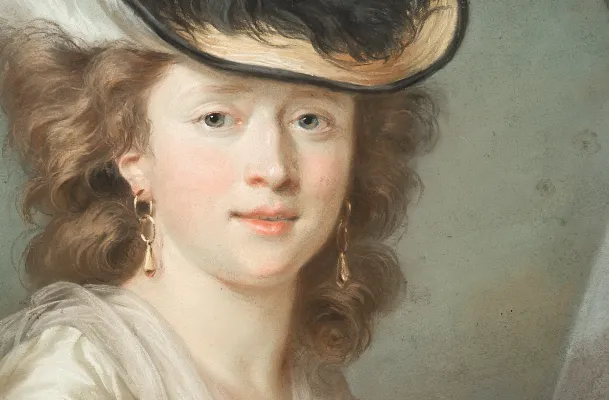
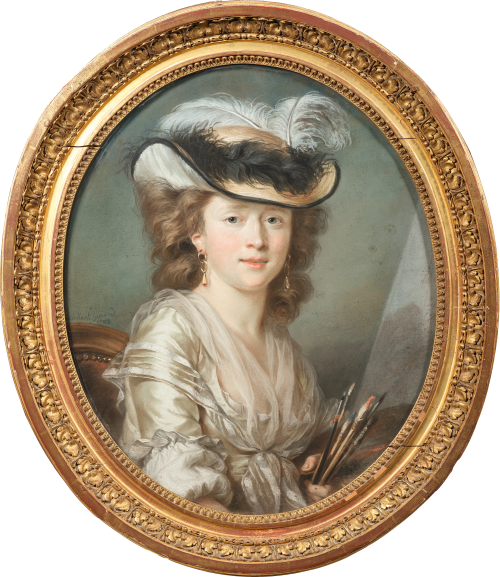
Signed and dated 1782, this pastel portrait predates the 1785 self-portrait (New York, Metropolitan Museum of Art), undoubtedly Adélaïde Labille-Guiard’s masterpiece, in which she depicted herself full-length at her easel, accompanied by her two pupils, Marie-Gabrielle Capet and Carraux de Rosemond. From one work to the other, the artist’s features are easily recognizable.
First exhibited at the Salon de la Correspondance, the pastel now acquired was received with enthusiasm. A journalist was moved to write: "the portrait of the author is so striking that resounding applause was heard all around."
The young woman exhibited it again at the Salon of 1782, alongside several portraits of academicians, and above all Élisabeth Vigée Le Brun’s famous Self-Portrait with a Straw Hat (London, National Gallery). That year, both painters became members of the Académie, and they were placed in rivalry. One reads in L’Année littéraire : "This portrait seems to me inferior to all those she has exhibited at the Salon, whereas Madame Vigée Le Brun’s, on the contrary, surpasses her other works. These two ladies have both painted themselves with a palette in hand; but Madame Guiard is very lifelike, and Madame Le Brun is so little so that one has difficulty recognizing her."
© Studio Sebert pour Tajan
This sublime self-portrait is essential to Adélaïde Labille-Guiard’s career. She presents herself as a an accomplished and recognized artist, on an equal footing with her colleague Élisabeth Vigée Le Brun, but above all on equal footing with her male peers. she depicts herself not outdoors, as Vigée Le Brun did, but in her studio, with a canvas beside her, brushes and palette in hand, following the established model of Académie painters, ready to begin the portrait of a new sitter.
It bears witness to her complete mastery of pastel: a touch that is lighter or more assertive depending on the areas, more blended and worked on the face, swifter on the fabrics; a delicate chromatic range, in tones from white to hazelnut, with a few highlights of red on the brush, the lips, or the armchair; the effects of transparency in the muslins; the airy softness of the feathers; the brillance of the earrings; the naturalness of her expression and the depth of her gaze.
a major acquisition for the french national collections
Long known to the château’s curatorial team, which is preparing a monographic exhibition devoted to the artist, the self-portrait is essential to the collections of Versailles. It joins a unique ensemble of portraits of members of the Royal Academy of Painting and Sculpture, in which only a few women are represented.
Painter to Mesdames, daughters of Louis XV, Adélaïde Labille-Guiard privileged relationships with those portraits she executed, in oil or pastel, which are among her most remarkable works. Her self-portrait aptly rzcalls the artist’s place within the circle of painters to the royal family. After portraying Mesdames, she subsequently produced several portraits of the Comte de Provence.
Above all, this pastel highlights the personality, career, and talent of a woman who is now indespensable to the history of eighteenth-century art. Following the recent acquisition of the pastel portrait of the Comte de Provence - the first royal commission received by Madame Vigée Le Brun - Labille-Guiard’s work serves as reminder that there was another virtuoso of portraiture, less celebrated today but no less brillant.
This masterpiece of pastel, of self-portraiture, of artist’s portraits, and of the female portrait could not fail to enter the national collections.
Communiqué de presse

16.37 MB
Visual
Pastel sur papier
Ovale. H. 62 ; L. 51 cm / H. 78 ; L. 68 cm (encadré) signé et daté en bas à gauche : « Labille F. Guiard 1782 »
Cadre ancien (d’origine ?) en bois sculpté et doré
© Studio Sebert pour Tajan