
A complex history reflecting taste and use in the gardens of Versailles
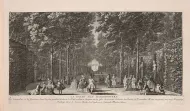
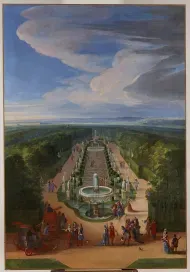
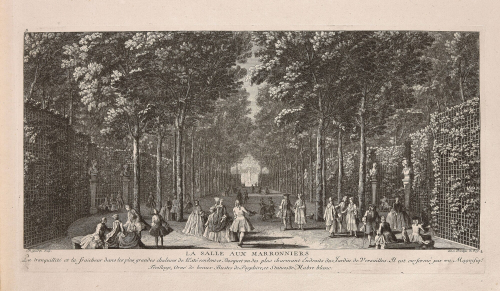
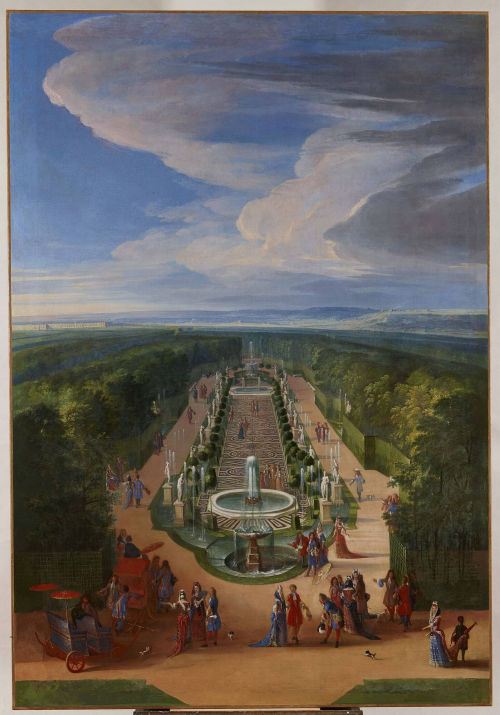
The grove took the name Salle des Marronniers only in 1704, following its transformation by Jules Hardouin-Mansart. Originally designed by André Le Nôtre as early as 1678, it was first known as the Galerie d'Eau, before becoming the Galerie des Antiques in 1680, when copies of antique sculptures were installed there. Several plans, paintings and engravings attest to the richness of the grove between the 1670s and 1704: a central island decorated with a polychrome marble pavement at its centre, surrounded by a canal in which water jets alternated with sculptures set on pedestals. A "gouffre" - a spiral-shaped water outlet - was located at one end of the grove, returning the water to the Basin of Apollo's Chariot, slightly below. Finally, two bronze groups adorned the fountains of the central island's basins: two Amours by Jean-Baptiste Tuby (one melted, the other sent to Trianon in 1707) and two dolphins by Jacques Houzeau, now lost. All of this decoration disappeared during the redesign carried out by Hardouin-Mansart in 1704.
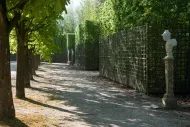
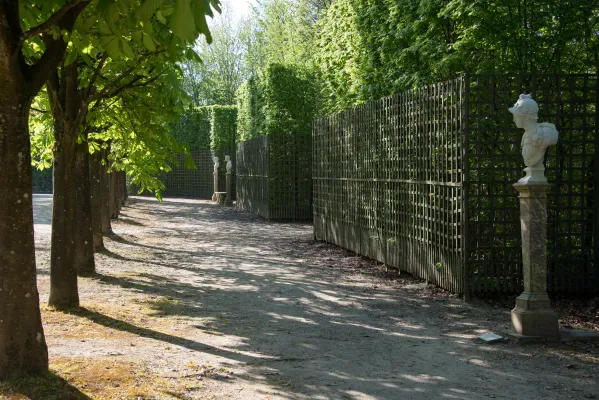
The grove was then simplified by the King's architect. It retained its long, narrow layout and its tall trelliswork, and was fitted with six niches set into the trellis, each housing a statue. Its semicircular ends were occupied by two large basins surmounted by marble vases. The canal, polychrome marble decoration, bronzes and water features disappeared.
© Château de Versailles, Dist. RMN / © Christophe Fouin
With regard to sculpture, a new decorative scheme composed of eight marble busts on terms, arranged in four lateral niches, replaced the antique statuary, of which only two figures remained. Marble benches were added. The two vases at either end were also originally adorned with sculptural elements that disappeared in 1795. Two alignments of chestnut trees finally replaced the central island.
The trellis palisade, restored in 1915-1916 in a low form, was reinstated in 1989 according to the 1704 state, with its height increased in accordance with an eighteenth-century engraving chosen as the reference.
© Château de Versailles, Dist. RMN / © Christophe Fouin
A degrading condition requiring comprehensive restoration
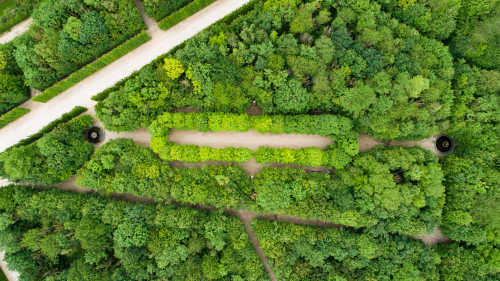
Prior to the start of the restoration, the Chestnut grove was in a severely degraded condition, affecting the ground surfaces, plantings, trelliswork, basins, sculpture and furnishings alike. The ground surfaces were heavily eroded by runoff, with exposed foundations, loss of level and visible roots, making circulation difficult and compromising the stabilty of the layouts.
The plantings - particularly the alignment of chestnut trees and the hornbeam hedges - were in an advanced state of decline, showing widespread degeneration, in some cases irreversible for the hornbeam hedges.
The built and decorative elements (trelliswork, basins, sculpture, benches) were also extensively deteriorated: trelliswork at the end of its life, fractured basins, undermining and damage to marble elements, weakened statue plinths and terms, oxidised metal supports, and soiled and degraded furnishings.
© Château de Versailles / T. Garnier
A complete and coherent restoration was therefore essential and will be carried out in three phases: the landscape composition, including both the regrading of the ground surfaces and the replacement or appropriate pruning of plant elements; the trelliswork, which will be entirely replaced; and the masonry and marble works.
The reopening of the Chestnut Grove is scheduled for summer 2026. This restoration forms part of the broader programme for the recomposition of the gardens of Versailles undertaken since the 1990s.
patrons
This restoration has been made possible through the support of the Philanthropia Foundation, the Maison Hennessy, and the generosity of Madame Marie-Catherine Anouilh.
Press Release
34.9 MB
Visuels