
gardens of illusion
The exhibition traces the early development of the landscape garden, pleasure garden or picturesque garden, a fashion that emerged in England in the 1730s and reflected a new way of thinking about the garden. Far removed from the geometric layout of the French formal garden, gardeners and architects devised winding paths that appeared natural and spontaneous, yet were carefully orchestrated. Within these designs, rolling terrain, streams, grottos, and ornamental follies created a miniature world. These landscape compositions were commonly referred to as « Anglo-Chinese gardens » or « English gardens ». Paintings by Hubert Robert invite visitors to immerse themselves in these evocative settings, designed to inspire emotion, surprise, and contemplation.
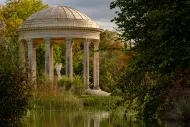
These landscapes were conceived as spaces of travel and discovery. References to Antiquity, the Orient, European cultures, and distant civilizations shaped a richly evocative stage setting. Historic models in the form of pyramids, temples, and Chinese pagodas will illustrate the multitude of worlds brought together within a single site.
Through decorative objects, drawings, and plans inspired by the Orient, visitors will gain insight into the profound influence of distant cultures on the imagination of eighteenth-century society.
Reflecting the ideas of the Enlightenment, gardens also embodied a new relationship to the world and to nature. The influence of Jean-Jacques Rousseau was pervasive: his descriptions of nature at Ermenonville, along with contemporary debates on education, walking, meditation, and reverie, deeply shaped these spaces. The landscape thus became a language, an arena for reflection as much as a setting for emotion.
The art of landscape extended even into private interiors. Thereby, through the exceptional reunion of four paintings by Hubert Robert generously lent by the Metropolitan Museum of Art of New York, the exhibition will recreate the decor of the bathroom at the Château de Bagatelle, immersing visitors in the spectacular and theatrical atmosphere of this remarkable room.
life in the garden
The second part of the exhibition invites visitors into the intimacy of these inhabited landscapes, where a transformation of aristocratic ways of life unfolds at the end of the Ancien Régime.
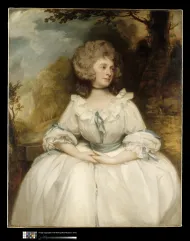
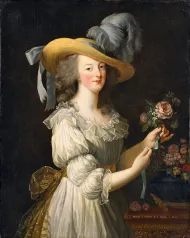
These gardens encouraged the rise of an elegant and largely idealized country life. Customs evolved, as did appearances: lighter clothing, braided straw hats, garden furniture, and accessories suited to outdoor living became fashionable, as illustrated in portraits by Élisabeth Vigée Le Brun and George Romney. The garden became a refined space of sociability, where intimacy, display, and freedom intertwined.
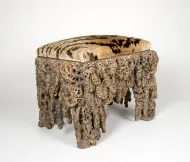
True laboratories of creativity, the follies and their decorative schemes gave rise to unprecedented forms of furniture and objects. Inspired by Antiquity, exoticism, or the rustic world, these hybrid pieces reflect remarkable inventiveness. Among the works presented are a bamboo table made for the Pagode de Chanteloup, a grotto-concretion stool preserved at The Bowes Museum, and reed chairs created for the Shell Cottage at Château de Rambouillet. Together, they demonstrate how the aesthetics of landscape extended into everyday life, blurring the boundaries between nature, architecture, and the decorative arts.
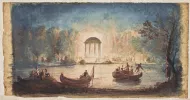
The final room of the exhibition is devoted to the garden as a festive stage, the setting for sumptuous celebrations. Illuminations, performances, and nocturnal entertainments transformed landscapes into ephemeral decors, designed to inspire wonder and illusion.
Painters such as Claude-Louis Châtelet and Louis-Nicolas de Lespinasse captured these suspended moments, when the garden became the theatre of a hedonistic, joyful, and profoundly modern art of living, such as the fake volcanic eruptions by Wörlitz.
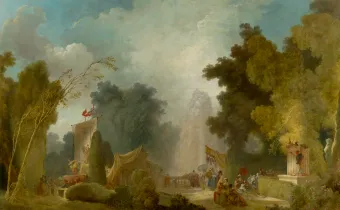
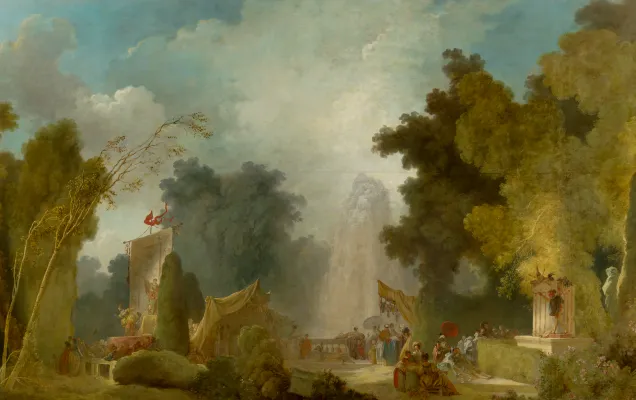
An exceptional loan of La Fête à Saint-Cloud (1755–1780) by Jean-Honoré Fragonard, together with two other paintings from the same series reunited for the first time, evoke these moments of pleasure bathed in an unreal, dreamlike atmosphere. These masterful compositions embody the joie de vivre that characterized the closing decades of the Ancien Régime.
walking around an english garden: the domain of trianon
The Domain of Trianon offers a remarkable testimonial to the art of the English garden in the eighteenth century: admirably preserved, it retains the essential features of the landscaped garden, still embodying today its rustic charm and poetic spirit.
From 1774, the year she ascended the throne, Queen Marie-Antoinette envisioned an ambitious project for the Petit Trianon : the creation of an English garden.
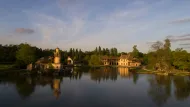
Her architect, Richard Mique, and the gardener Antoine Richard undertook extensive works to compose a new landscape of lakes, hills, grottos, and winding rivers. In 1776, the first factory built took the form of a Chinese-inspired merry-go-round where the queen’s inner circle enjoyed the ring game. It was soon followed by the Temple of Love, the Belvedere, and the Queen’s Hamlet, now emblematic symbols of the landscaped garden.
Within this theatrical setting, the queen gathered a carefully chosen society. She transformed it into a place of pleasure and amusement, of strolls and festivities, allowing her to distance herself from the rigid court etiquette of Versailles. Each member of the royal family followed her example by creating their own folly : Mesdames at Bellevue and at the Hermitage of Versailles, the comte d’Artois at Bagatelle, and the comte de Provence at Balbi.
The exhibition concludes by inviting the visitor to extend his journey into the gardens of Trianon, wandering through the winding paths of the landscaped garden. It will also evokes English-style gardens that may still be admired today, such as Ermenonville, the Désert de Retz, and the park of Bagatelle.