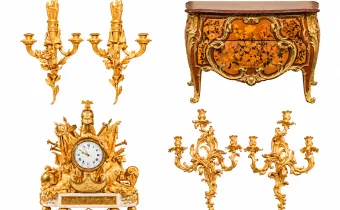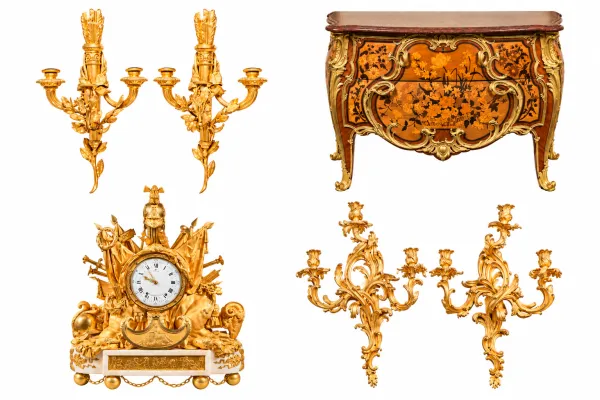

LOUIS XVI’S CLOCK WITH MILITArY TrOPHY: A MASTErPIECE OF rOYAL CLOCKMAKING COMMISSIONED FOr THE CHÂTEAU DE COMPIÈGNE
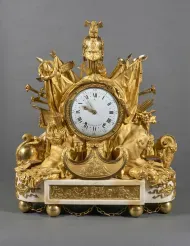
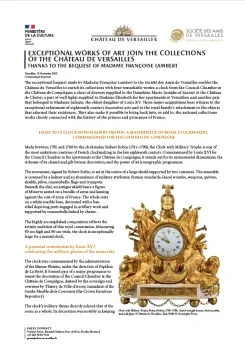
Made between 1785 and 1788 by the clockmaker Robert Robin (1741–1799), the Clock with Military Trophy is one of the most ambitious creations of French clockmaking in the late eighteenth century. Commissioned by Louis XVI for the Council Chamber in his apartments at the Château de Compiègne, it stands out for its monumental dimensions, the richness of its chased and gilt-bronze decoration, and the power of its iconographic programme.
The movement, signed by Robert Robin, is set at the centre of a large shield supported by two cuirasses. The ensemble is crowned by a helmet and an abundance of military attributes: Roman standards, laurel wreaths, weapons, quivers, shields, pikes, cannonballs, flags and trumpets. Beneath the dial, an antique shield bears a figure of Minerva seated on a bundle of arms and leaning against the coat of arms of France. The whole rests on a white-marble base, decorated with a bas-relief depicting putti engaged in artillery work and supported by cannonballs linked by chains.
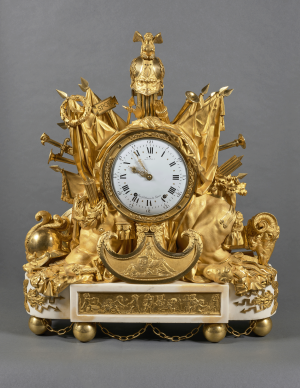
The highly accomplished composition reflects the artistic ambition of this royal commission. Measuring 90 cm high and 80 cm wide, the clock is exceptionally large for a mantel clock.
A personal commission by Louis XVI celebrating the military glories of the monarchy
The clock was commissioned by the administration of the Menus-Plaisirs, under the direction of Papillon de La Ferté. It formed part of a major programme to renew the decoration of the Council Chamber at the Château de Compiègne, desired by the sovereign and overseen by Thierry de Ville-d’Avray, Intendant of the Garde-Meuble de la Couronne (the Crown Furniture Repository).
The clock’s military theme directly echoed that of the room as a whole. Its decoration was notably in keeping with the large silk panel depicting the Crossing of the Rhine, painted in the seventeenth century by François Bonnemer under the direction of Charles Le Brun, as well as with the wall hangings evoking the victories of Louis XV and those of the American War of Independence.
In the wake of the victory of the American revolutionaries, supported by France, military and classical references took on a new prominence in royal interiors. The clock thus celebrates the power of the monarchy and the military successes of Louis XVI, particularly the land and naval victories won against the English.
The commission comprised two monumental clocks intended for the adjoining rooms of the King’s bedchamber and Council Chamber. The second, known as the Rest of Diana, was intended for the royal bedchamber. Their delivery on 20 January 1788 is documented in Robert Robin’s account, which sets their total cost at 50,000 livres, including 20,000 for the Clock with Military Trophy.
The ornamental designer Jean-Démosthène Dugourc may have contributed to the design of the model. As for the bronzes, their execution may be associated with the work of Pierre-Philippe Thomire, although this attribution cannot be regarded as certain.
A turbulent history, from the Revolution to private collections
Because of the lengthy building works at the Château de Compiègne and the political upheavals of the late 1780s, the two clocks were ultimately never installed in the royal apartments.
Probably kept in the storerooms of the Garde-Meuble de la Couronne, the Clock with Military Trophy escaped the Revolutionary sales on account of its exceptional quality. It was subsequently transferred to the Tuileries and then displayed at the Muséum national du Louvre from 1793 onwards. On that occasion, Robert Robin was instructed to remove the symbols of royalty, notably the fleurs-de-lis from the dial and Minerva’s shield.
In 1796, the clock was assigned to the Ministry of War. Following the fall of the First Empire, it joined the collection of the Duke of Croÿ-Havré, before being kept at the Château de Roeulx in Belgium.
It subsequently entered the collection of an American collector.
Its arrival at the Château de Versailles marks the culmination of a long acquisition project. This exceptional work makes it possible to rediscover a major creation by Robert Robin and to deepen our understanding of Louis XVI’s artistic commissions.
The Clock with Military Trophy is now on display on the mantelpiece in the Council Chamber at the Château.
THE CHEST OF DrAWERS OF THE DAUPHINE MArIa Josepha OF SAXONY:
AN OUTSTANDING EXAMPLE OF EIGHTEENTH-CENTUrY FrENCH CABINETMAKING
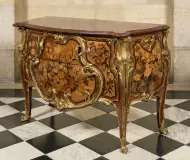
Made around 1756, this chest of drawers is traditionally attributed to Jean-Pierre Latz for its carcass and Jean-François Oeben for its marquetry. It features exceptional floral marquetry on a veneer of satinwood and amaranth, combined with gilt-bronze mounts and a griotte marble top.
With its bombe, serpentine form, the piece stands out for the richness of its decoration. The front is adorned with a basket overflowing with flowers, while the sides feature floral compositions. The marquetry motifs, executed with great finesse, stand out against the satinwood ground and are highlighted by amaranth frames. The gilt bronzes, which adorn the corners and feet, follow the sinuous lines of the piece.
The association of Jean-Pierre Latz and Jean-François Oeben is particularly noteworthy. The former, a cabinetmaker favoured by the King, is especially known for his generously proportioned furniture and characteristic gilt-bronze mounts. The latter, one of the leading Parisian cabinetmakers of Louis XV’s reign, is here associated with the execution of the marquetry, whose bouquets and floral motifs bear similarities to those found on other pieces by him.
A chest of drawers connected with the Dauphine’s history at Choisy
The chest of drawers appears in an inventory of the Château de Choisy dated 1764, where it is listed in the bedchamber of the Dauphine Mara Josepha of Saxony, wife of the Dauphin Louis-Ferdinand, son of Louis XV, and mother of three kings of France: Louis XVI, Louis XVIII and Charles X.
It belongs to a group of pieces of furniture made using comparable materials and decorative principles, intended to furnish the Château de Choisy. Its history nevertheless remains marked by certain documentary uncertainties, particularly regarding its movements between the various royal residences from the late 1780s onwards.
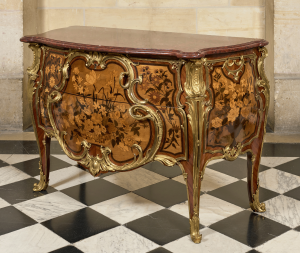
After entering the Rothschild family collection, the chest of drawers was seized by the German authorities in 1941 before being returned to Édouard de Rothschild in 1947. It subsequently passed into the collection of his daughter Jacqueline de Rothschild, and then through several private collections.
With this acquisition, the Château de Versailles welcomes a major work of French cabinetmaking from the reign of Louis XV, whose quality of execution and history shed light on the royal family’s taste for exceptional furniture. The chest of drawers will be displayed in the Dauphine’s private cabinet.
Une paire de bras de lumière de Madame Élisabeth, l'apogée du style louis XVI
Made in Paris during the reign of Louis XVI, this important pair of chased and gilt-bronze wall lights was supplied for the apartments of Madame Élisabeth, the King’s sister, at the Château de Versailles. It is a particularly valuable testimony to the furnishing of princely apartments at the end of the Ancien Régime.
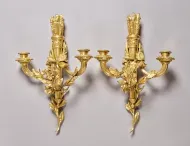
The ensemble is the work of Claude-Jean Pitoin (1757–before 1806), a metal gilder and silverer to the Garde-Meuble de la Couronne and a supplier to the King. The two wall lights, each 62 cm high, stand out for their particularly elegant composition and the outstanding quality of their chasing and gilding.
The central stem takes the form of a quiver, decorated with friezes of acanthus leaves, pearls and plant motifs. It supports a bouquet of finely chased arrows, while two sinuous, fluted lateral arms hold the candle nozzles. A branch of laurel laden with berries winds around the quiver to form a third light-bearing arm. The ensemble is joined by an elegant bronze ribbon bow.
Furniture documented in Madame Élisabeth’s apartments
The archives of the Garde-Meuble de la Couronne make it possible to link these works to the apartment of Madame Élisabeth, located in the Midi Wing of the Château de Versailles, which no longer survives. The pair was delivered before 1785, most probably in 1784, together with a second identical pair intended for the same room.
The general inventory of the palace’s furnishings drawn up in 1785 indeed lists, in the princess’s billiard room and library, two pairs of three-arm wall lights. The description corresponds precisely to the characteristics of the works acquired: two fluted arms and a third formed of branches, leaves and laurel berries, the whole attached to a quiver by a ribbon.
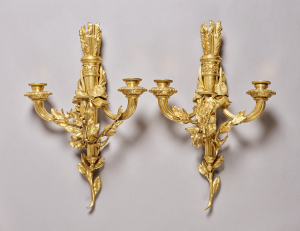
Madame Élisabeth occupied this apartment from 1780 to 1789. The presence of these wall lights in her private rooms makes it possible to reconstruct the decoration of her apartments more precisely and to gain a better understanding of the refinement of their furnishings.
After entering the Rothschild collection in Frankfurt in the nineteenth century, the pair remained in the family by descent until its acquisition by the Palace of Versailles. It is now an exceptional testimony to the decoration of the apartments of Louis XVI’s sister.
A PAIR OF WALL LIGHTS BELONGING TO MADAME INFANTE:
A MODEL BY JACQUES CAFFIErI MADE FOr THE ELDEST DAUGHTEr OF LOUIS XV
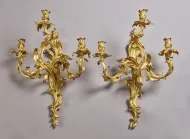
This important pair of three-arm wall lights, attributed to Jacques Caffieri (1678–1755), is a rare example of the art of gilt bronze under the reign of Louis XV. Made around 1750–1755, these chased and gilt-bronze wall lights stand out for their particularly expressive Rococo composition and exceptional quality of execution.
Their backplates, animated by asymmetrical foliate scrolls, display a highly free-flowing composition. At the base, flowers accompany three leafy arms that curl in a continuous movement. The acanthus leaves, candle sockets adorned with foliage and twisted drip pans form an ensemble of great ornamental richness.
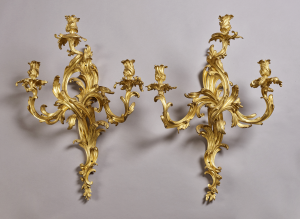
The fluidity of the lines, the vigour of the volumes and the delicacy of the chasing bear witness to the skill of Jacques Caffieri, sculptor, founder and chaser to the King, whose workshop was among the most renowned of its time. Examination of the work also revealed remarkably well-preserved sand casting and mercury gilding.
A work connected with Madame Infante’s collections in Parma
Louise-Élisabeth of France (1727–1759), the eldest daughter of Louis XV and Marie Leszczyńska, became known as Madame Infante after her marriage to Don Philippe, who became Duke of Parma, Piacenza and Guastalla following the War of the Austrian Succession.
During her stays in France between 1752 and 1753, the princess had a substantial group of furniture and works of art assembled to furnish her Italian residences, notably the Palace of Colorno. Jacques Caffieri was one of the principal bronze workers commissioned for these orders.
The pair acquired by Versailles corresponds precisely to a model of wall light supplied for Madame Infante at the Palace of Colorno. Its inventory marks attest to its subsequent presence in the collections of the royal residences of Modena.
This pair is of particular interest to Versailles, which already holds an identical pair, acquired in 1993 at the Hubert de Givenchy sale. Also attributed to Jacques Caffieri and supplied for the Grand Salon of Madame Infante at Colorno, it now provides a valuable point of comparison. Another pair of the same model is held at the Quirinal Palace in Rome.
Bringing these two identical pairs together enables the Palace of Versailles to continue its programme of refurnishing the princely apartments. The new acquisition will notably make it possible to restore the decoration of the Grand Cabinet of Madame Victoire, Madame Infante’s sister, which today has no wall lights, although the inventories attest to the presence of two pairs of three-arm Rococo wall lights in this room.
Having appeared on the Italian art market in 2021, this pair is now reunited with its counterpart held at Versailles. It bears witness both to the influence of French art at European courts and to the movement of works of art between the residences of the royal family.
This pair of wall lights echoes two other similar pairs acquired at public auction in 2026.
About Françoise et Guy Lambert
Born in Paris on 14 October 1937, Françoise de Pinceüoir de Bousquet grew up in a family with a particular attachment to literature, the arts and culture. Her husband, Guy Lambert, born in Paris on 20 February 1928, was trained as an architect and was a bibliophile. He had a particular passion for Egypt and the Middle East, as well as for classical music. Together, they travelled the world, discovering great civilisations and their treasures, notably in Aleppo, Palmyra and Bamiyan, some of whose remains have since disappeared. As aesthetes and collectors, they made their apartment a refined setting, reflecting their shared taste for the arts and objects steeped in history. Their eclectic collection included furniture from the Louis XV, Louis XVI and Directoire periods, a substantial library, and numerous miniatures and engravings devoted to the French Revolution.
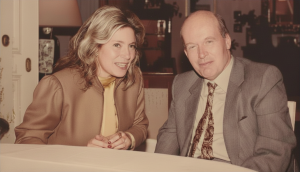
Guy Lambert died in April 2008. Madame Françoise Lambert, who died on 6 March 2023, had appointed the Société des Amis de Versailles as her universal legatee, with the mission of contributing to the refurnishing of the palace.
She had expressed her wish to bring the royal apartments back to life by restoring the atmosphere of inhabited spaces through the acquisition of furniture and furnishings: chests of drawers, desks, books, paintings, works of art and porcelain.
By choosing the Société des Amis de Versailles as her legatee, she wished to pay tribute to her husband and to leave a lasting mark of their shared passion for the arts in this major site of French heritage.
about the Société des Amis de Versailles
Founded in 1907 and now counting 5,400 members, the Société des Amis de Versailles has worked for 120 years with passion and enthusiasm to enrich the collections, restore the Palace and promote the reputation of the Palace and Estate of Versailles. Recognised as being of public utility, it is authorised to receive bequests free of inheritance tax. The Société des Amis de Versailles pays tribute to Madame Lambert, whose generous bequest in support of the refurnishing of the Palace of Versailles has made these exceptional acquisitions possible.
the acquisition policy of the château de Versailles
As a national museum, the Palace of Versailles is tasked with contributing to the enrichment of public collections through the acquisition of cultural property on behalf of the French State.
Purchases, donations and bequests enable the museum to acquire works and objects of art that shed light on the existing collection, develop its narrative and fill its gaps.
The fields covered are diverse, and the Palace of Versailles pursues, in particular, an active policy of refurnishing. Whenever possible, the Palace of Versailles seeks to acquire items of furniture and present them to the public in rooms whose condition comes as close as possible to that of the former royal residence.
Press Release
10.32 MB
Visuels