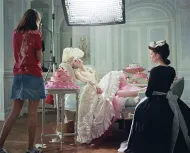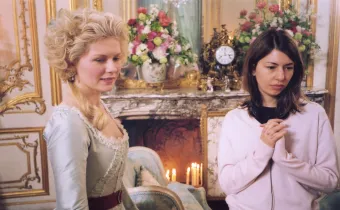
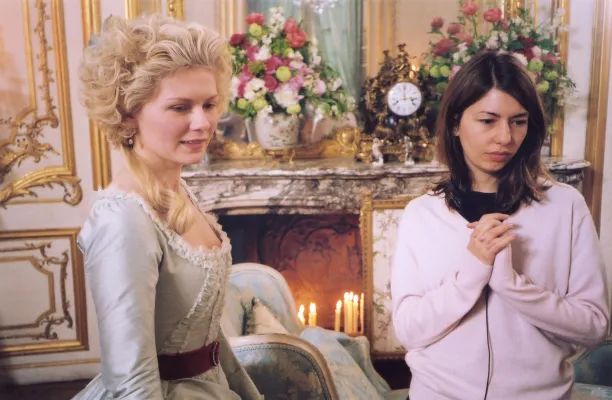

With Marie Antoinette, Sofia Coppola broke away from the historical biopic to offer a sensitive and contemporary interpretation of a figure who, in the collective imagination, remains the last Queen of France — an image largely shaped at Versailles. Through a delicate and colourful aesthetic, and by shifting the focus from the history of a queen to the intimate story of a young woman's life, Coppola profoundly transformed perceptions of Marie Antoinette, as well as the Château itself.
Released in 2006 and shot largely at the Château de Versailles, the film frees itself boldly from historical biography to explore, in an intimate mode, this fascinating figure long obscured by legend. Vilified during the French Revolution, sanctified under the Restoration and aestheticized from the Second Empire onwards, Marie Antoinette becomes, through Coppola's lens, a profoundly human character: a young woman confronted with isolation, boredom and the pressures of court life. By projecting her recurring themes — adolescence and self-construction — onto the figure of the Queen, the filmmaker reveals a sovereign who is not just historical but relatable, both emotionally and as a human being.
Now considered a cult film, Marie Antoinette also contributed to renewing perceptions of Versailles itself: the Château ceases to appear solely as a grandiose setting of power and instead emerges as an intimate space, shaped by feminine sensibilities.
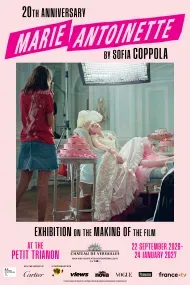
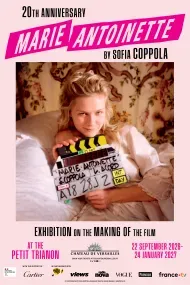
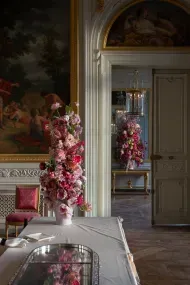
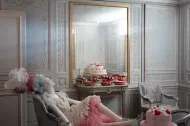
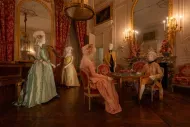
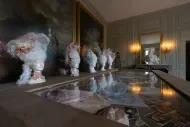
This year, the Château extends this dialogue with an exhibition at the Petit Trianon, conceived in collaboration with Sofia Coppola and dedicated to the film's genesis, aesthetic approaches and shooting conditions. The exhibition retraces the entire creative process behind the work and highlight the elements that enabled Coppola to propose her singular interpretation of the character and, more broadly, of eighteenth-century France. Working documents, the director's early mood boards, costumes and accessories, as well as set elements and reconstructed spaces, reveal the visual references and aesthetic choices that gave rise to a sophisticated universe of pastel tones, in which history is less reconstructed than reinterpreted through a contemporary gaze.
The exhibition also explores the film's cultural impact and that of its aesthetic, particularly in the fields of fashion and the art of living. It will show how Marie Antoinette influenced domains seemingly distant from Cinema — from fashion to gastronomy.
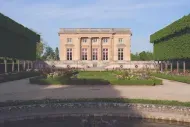
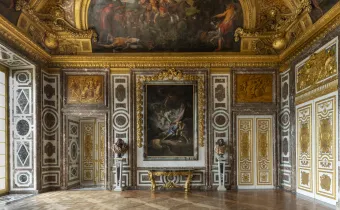
It is fitting that this exhibition should take place at the Petit Trianon; designed for madame de Pompadour, later occupied by madame Du Barry before becoming Marie Antoinette's domain, the site embodies another history of Versailles — intimate and feminine — by representing a space of taste and retreat. Marie Antoinette became deeply attached to it and made it her exclusive domain, removed from etiquette, scrutiny and the constraints of court life.
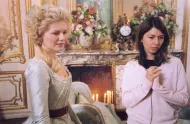
"During the production of Marie Antoinette, Versailles was much more than a location – it became part of the film’s language and atmosphere, a character in the film. Returning twenty years later to explore the creative process behind the film and the incredible team of artisans in this setting feels unexpectedly moving"
Sofia Coppola, director
"Shot at Versailles and inspired by one of its most iconic figures, Marie Antoinette occupies a unique place in the Château's contemporary history. Twenty years after the film, this exhibition explores its lasting impact on the image of Marie Antoinette and Versailles, while highlighting the Château's role as a source of inspiration for cinema and fashion"
Laurent Salomé, Director of the National Museum of the Châteaux de Versailles and Trianon
This exhibition has been made possible thanks to the support of

Cartier is proud to support this exhibition celebrating the 20th anniversary of Sofia Coppola’s Marie Antoinette. The Maison has a long-standing relationship with the world of cinema and its creative communities, built through a shared devotion to artistry, detail, a collective spirit bringing together the finest crafts, and the power of storytelling.
The Maison’s history is also linked intrinsically with the Château de Versailles itself. An aesthete and collector, Louis Cartier nourished his designers' creativity with 18th-century references, including studies of the palace’s decorative elements and furniture leading to the creation of delicate pieces known as the Garland style. In 1910, the Maison set the legendary Hope Diamond in a pendant, believed to be part of the French crown jewels.
Press kit
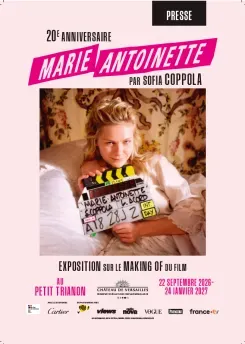
20.61 MB
Visuals