The Splendour of painting on porcelain
Home page
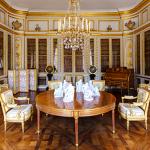
From 16 May to 9 September 2012, the palace of Versailles presents the exhibition The Splendour of painting on porcelain. Charles Nicolas Dodin and the Vincennes-Sèvres Manufactory in the 18th century in the apartments of Madame de Maintenon and in the King’s Guardroom.
This exhibition is consecrated to one of the most gifted painters of the Royal Manufactory of porcelain in the 18th century, Charles Nicolas Dodin, whose works during his lifetime and in the following century were sought after by the greatest collectors of porcelain. The exhibition seeks to highlight both the artistic evolution and the diversity of the sources of inspiration of Charles Nicolas Dodin.
“Gondola” potpourri vase with green bottom
During forty-nine years spent working at the Manufactory, Dodin contributed to the most outstanding commissions produced for the kings and their entourage, in particular the mistresses of Louis XV, and for foreign rulers such as Catherine II of Russia. Through these prestigious works, the exhibition retraces the enlightening artistic evolution of Dodin’s career, as clearly signposted as that of a contemporary easel painter.
It also throws light on the diversity of Dodin’s sources of inspiration by presenting engravings and paintings that inspired him. These works show the very profound correspondences which existed between the arts (paintings, drawings, prints, sculptures, medals, ceramics) in the second half of the 18th century and the extraordinary artistic emulation that they fostered.
Dodin was essentially, as was said in the 18th century, a painter "in miniature", or a painter of “figures”, which meant that his talents were devoted to the most prestigious genre in the hierarchy of the Manufactory. His works were eagerly sought to be included in the most celebrated collections of works of art, notably in the palace of Versailles, where they still featured a century later.
The exhibition is curated by Marie-Laure de Rochebrune, Curator in the palace of Versailles.
Biography of Dodin
From 16 May to 9 September 2012, the palace of Versailles presents the exhibition The Splendour of painting on porcelain. Charles Nicolas Dodin and the Vincennes-Sèvres Manufactory in the 18th century in the apartments of Madame de Maintenon and in the King’s Guardroom.
Charles Nicolas Dodin (1734-1803), who devoted the forty-nine years of his career to the Royal Manufactory of porcelain, was one of the most gifted painters of the 18th century.
Life and career
Born and baptised in Versailles in 1734, Dodin was the second son of Nicolas Dodin, a grocery merchant in Versailles, and Marie de Nauroy, daughter of a tapestry merchant. In 1756 he met his future wife, Jeanne Chabry, daughter of a master sculptor who began working at the Manufactory in 1750. They were married in 1762 and had five children between 1763 and 1778. Dodin died in 1803 at the age of 69, after having devoted forty-nine years of his existence to the Manufactory.
Dodin entered the Porcelain Manufactory of Vincennes in 1754, at the age of 20, and stayed with it when it moved to Sèvres in 1756. Hired as a painter of “figures” or miniatures, he spent his entire career working in this genre which was the most prestigious in the Manufactory. Very soon regarded as one of the workshop’s best artists, he contributed to its most celebrated commissions, including the decoration of vases for Madame de Pompadour and Louis XV, painted panels for the furniture of Madame Du Barry and dinner services for Catherine II of Russia and Louis XVI.
Work
The evolution of Dodin’s sources of inspiration reflects the changes in taste in the second half of the 18th century. From 1754 to 1757, he mostly painted cupids in monochrome or polychrome in the style of François Boucher and his followers. From 1758 to 1761, he was attracted to Flemish and Dutch themes, and was inspired notably by engravings of the paintings of David Teniers the Younger. From 1760 to 1763, he executed Chinese scenes, inspired both by the works of French artists and by oriental sources. From 1760 on, he took as his sources outstanding contemporary painters such as Jean-Baptiste Oudry, Carle van Loo, François Boucher, François-Hubert Drouais and Jean-Honoré Fragonard. Lastly, during the Revolution, he painted a number of Republican allegories.
At the same time, Dodin adapted himself with talent to the changes in styles and motifs used in the Manufactory, from the most decorative rocaille style to accomplished Neoclassicism. He was also a remarkable painter of soft-paste porcelain panels used to decorate pieces of furniture, clocks, barometers or small caskets. He became the first artist at Sèvres to paint porcelain panels intended to be hung on the wall and framed like paintings on canvas.
Dodin's monogram
Destination and posterity of his work
The works of Dodin were snapped up as soon as he had executed them and featured in the period’s greatest collections of works of art possessed by Louis XV and Louis XVI at Versailles, by the royal mistresses Madame de Pompadour and Madame Du Barry, the Comte de Provence and the Comte d’Artois, and in the courts of Catherine II of Russia and foreign rulers who were sent sumptuous diplomatic gifts.
In the following century, the signature of Dodin, the “k” painted on his works to show his authorship, was still much sought after by the greatest collectors such as the Rothschild family, Sir Richard Wallace and Baron Double. That is why many of his works are now found in the major European and American collections of porcelains.
The major collectors
From 16 May to 9 September 2012, the palace of Versailles presents the exhibition The Splendour of painting on porcelain. Charles Nicolas Dodin and the Vincennes-Sèvres Manufactory in the 18th century in the apartments of Madame de Maintenon and in the King’s Guardroom.
The works of Dodin were acquired very soon for the biggest contemporary collections. The exhibition evokes these great collectors by the presentation of their portraits and objects that belonged to them.
The collectors
The collectors of the works of Dodin were also often very keen lovers of paintings and objets d’art of all kinds. They included Louis XV, Madame de Pompadour, Madame Du Barry, Madame Victoire, Louis XVI, the Comte de Provence, the Comte d’Artois, Catherine II of Russia, Christian VII of Denmark, George IV of England, etc.
Pieces with Chinese scenes for Madame de Pompadour
Madame de Pompadour, who played a decisive role in the transfer of the Manufactory to Sèvres, was one of its best patrons. Beginning in the 1750s, she bought pieces featuring cupids and “tesnières” painted by Dodin. Then, from 1760 to 1763, the Manufactory asked Dodin to decorate porcelains with Chinese scenes for Madame de Pompadour and Louis XV.
Fifteen of the twenty-six pieces with Chinese scenes that he executed belonged to the royal mistress, showing her predilection for this type of scene, always painted on incredibly luxurious pieces with particularly audacious designs. The “fountain” pot-pourri now in the J. Paul Getty Museum formed part of a set with a pink background made for the bedchamber of Madame de Pompadour in her Evreux residence, the present Elysée Palace.
This “fountain” or “dolphin” pot-pourri is decorated with three different colour backgrounds, pink, green and lapis lazuli blue, and with different motifs painted in gold. The main side features a small Chinese scene showing two young women and a child beside a fountain in an exotic garden.
Dinner service for Empress Catherine II of Russia
Dodin took part in the decoration of luxurious dinner services made in the Manufactory for prestigious patrons such as Louis XVI and the Empress Catherine II of Russia. In 1776, Catherine II commissioned a sumptuous service with a sky blue background, her monogram and antique cameos. 797 pieces were sent to Russia in June 1779.
LThe choice of the decoration reflected the interest of the Empress in Greco-Roman antiquity and her passion for antique cameos and intaglios. For this service, Louis XVI gave the exceptional authorisation to copy certain cameos from his collections. The monogram of the Empress consists of an “E” for “Ekaterina”, painted with flowers, and the Roman number “II”, painted in gold. The monogram is surrounded by a garland of laurel leaves with ribbons, and surmounted by the imperial crown painted in gold.
The painted decoration of this service occupied at least thirty-seven painters and five gilders for over a year. Dodin executed the decoration of forty-five pieces of different shapes, mostly plates. The twelve pieces of the service of Catherine II, loaned by the Hermitage Museum, are typical examples of Dodin’s work.
The porcelain panels painted for the royal family
Dodin spent a large part of his career painting panels of soft-paste porcelain whose execution required special care and talent, which were often inset on pieces of furniture, clocks, barometers or small caskets, or intended to be hung on the wall and framed like paintings on canvas.
The panels inset on furniture became much sought-after from the 1760s on, replacing the marquetry work on exceptional pieces.
Dodin decorated several pieces of furniture made by the cabinetmaker Martin Carlin, such as the chest of drawers in the Louvre for Madame Du Barry and the occasional table now in Warsaw. Bought by the Comte d’Artois, this occasional table was given as a gift to a Polish countess who in turn gave it to king Stanislaw August of Poland. Its top features a central panel painted by Dodin depicting Telemachus telling his adventures to Calypso surrounded by six grisaille panels.
Dodin was the first artist of the Manufactory to produce these “painting” panels.
In the early 1780s he took part in the largest commission received by the Manufactory in the 18th century: a series of nine porcelain panels painted with scenes after Jean-Baptiste Oudry and intended for the dining room of the new suite built for Louis XVI in Versailles. Dodin executed two panels depicting royal hunts, the largest of which shows The Great Stag Quarry in the forest of Saint-Germain-en-Laye with the Abbaye de Poissy in the background.
Dodin’s styles
From 16 May to 9 September 2012, the palace of Versailles presents the exhibition The Splendour of painting on porcelain. Charles Nicolas Dodin and the Vincennes-Sèvres Manufactory in the 18th century in the apartments of Madame de Maintenon and in the King’s Guardroom.
Throughout his career Dodin diversified his sources of inspiration and painted scenes in different styles, some of them in vogue among the painters of the Manufactory, while others were his own personal style. The exhibition aims to throw light on the different periods of his artistic development.
Pair of pot-pourri 'openwork' vases
The cupids after François Boucher
During the first years of his career, from 1754 to 1757, Dodin concentrated on painting cupids and children, in purple or blue monochrome, based on models by François Boucher (1703-1770). This iconographic choice, predominant in the mid-1750s, testifies to the exceptional impact of the work of the grand painter on the decorative arts in the mid-18th century.
Beginning in 1745, Boucher supplied engravings and then drawings to the Manufactory of Vincennes, set up in 1740 under the king’s protection. Many of the painters of the Manufactory took inspiration from these motifs, featuring children dressed in contemporary costumes and nude cupids. Dodin mastered these motifs so skilfully that he could use them without producing textual copies; he did not hesitate to take a cupid or a child from an engraving to often invent a totally imaginary setting for them.
“Dutch” vases with a sky blue background
The “tesnières”
From 1758 to 1761, Dodin produced a series of “tesnières” when this type of subject was very much in fashion in the Manufactory. These were scenes executed in the late 1750s borrowed from or in the taste of the paintings of the Flemish David Teniers the Younger (1610-1690) depicting peasants at work.
This period coincided with the transfer of the Manufactory to Sèvres from Vincennes in 1756. Madame de Pompadour, who played a decisive role in this move, thus managed to bring the Manufactory close to her favourite residence, Bellevue, as well as to the palace of Versailles. From this date on, the Manufactory turned to increasingly more sumptuous products and invented new colour backgrounds, including pink and pale green.
Square tray with a pink background
and Chinese scene
The Chinese scenes
From 1760 to 1763, Dodin devoted a large part of his time to painting Chinese scenes of a very particular kind. Unlike the two previous styles, Dodin seems to have been the only painter of the Manufactory to have adopted this style. Moreover, the scenes he produced feature a very rich palette of colours not found among the other painters who depicted Chinese scenes.
Dodin was inspired by the French engraver Gabriel Huquier the Elder, by porcelains from China and enamel works from Canton, to decorate his scenes with oriental motifs, figures, flowers or pieces of furniture. The majority of them subsequently entered the collections of Madame de Pompadour and Louis XV.
The genre scenes in the style of the great masters
From 1760 on and until the end of his career, Dodin painted genre scenes borrowed from great European painters of the 17th and 18th centuries, and also mythological and allegorical figures from engravings or directly from the works themselves. The works of Wouvermans, Falens, Oudry, Carle van Loo, Boucher, Drouais, Eisen, Le Prince, Greuze, Fragonard, Pierre, Moreau le Jeune, Jean-Jacques Lagrenée and others were the principal sources of inspiration of the painter for forty years.
Among the contemporary French painters whose work provided models, François Boucher is undoubtedly the painter whose works were most reproduced by Dodin. After the cupids of his early career, it was the lovers’ trysts or pastoral scenes of the great master that inspired him.
The Revolutionary period
The Revolutionary period was a difficult one for the Manufactory and its artists. The commissions grey scarce and the activity of the painters was drastically cut back.
Until 1792, Dodin was still working on the grand dinner service for Louis XVI, on pieces displaying coats of arms and on a certain number of ornamental vases. After 1793 and the death of the king, he produced “Republican” themes on cups or vases, as well as some mythological scenes.
For a more in-depth visit
From 16 May to 9 September 2012, the palace of Versailles presents the exhibition The Splendour of painting on porcelain. Charles Nicolas Dodin and the Vincennes-Sèvres Manufactory in the 18th century in the apartments of Madame de Maintenon and in the King’s Guardroom.
Exhibition catalogue
Splendeur de la peinture sur porcelaine au XVIIIe siècle. Charles Nicolas Dodin et la manufacture de Vincennes-Sèvres
edited by Marie-Laure de Rochebrune
with Artlys, 2012
22 x 26 cm, 240 p., €40
Edited by Marie-Laure de Rochebrune, Curator in the Palace of Versailles, this catalogue recounts in an original way the career and the work of Charles Nicolas Dodin, who has always been a great favourite of art collectors.
Publications of the palace of Versailles in English
Publications of the palace of Versailles in French
Themed visits
For a more in-depth visit to the exhibition, themed visits with a lecturer are programmed. These visits are in French, start at 10:00 am and last 1h30.
|
|
|
To learn more about the themed visits [French only]
Visit game booklet
With the visit game booklet of Le Petit Léonard, the children’s art magazine, visitors aged 7-12 can enjoy the exhibition while doing a fun quiz.
Details to be found, paintings on porcelain that talk, spotting the 7 mistakes: a number of games are included to help them discover the magnificent porcelain objects produced by the Manufactory of Vincennes-Sèvres in the 18th century and decorated by one of its most talented painters: Charles Nicolas Dodin.
This booklet of 8 fun pages in colour is available at the entrance to the exhibition and can soon be downloaded on this page.
The game booklet will also be inserted in Le Petit Léonard and in Histoire Junior, the history magazine for 10 to 15-year-olds, two educational magazines published by Editions Faton.
Sèvres – Cité de la céramique (Sèvres City of Ceramics)
If you wish to admire large collections of porcelain and ceramics and learn more about the context in which Charles Nicolas Dodin worked, discover Sèvres – Cité de la céramique.
Set up in 2010 by the merger of the Manufacture nationale de Sèvres (founded in 1740) with the Musée national de la Céramique (inaugurated in 1824), this establishment forms a major international centre of fine ceramic arts.
Located on the outskirts of Paris, Sèvres – Cité de la céramique combines its activity of porcelain production with a permanent presentation of part of its ceramic and glass collections and a rich programme of temporary exhibitions throughout the year.
Practical information
From 16 May to 9 September 2012, the palace of Versailles presents the exhibition The Splendour of painting on porcelain. Charles Nicolas Dodin and the Vincennes-Sèvres Manufactory in the 18th century in the apartments of Madame de Maintenon and in the King’s Guardroom.
Opening times
The exhibition is open every day except Mondays from 9:00 am to 6:30 pm (last admission at 6:00 pm).
Tickets
The exhibition is accessible with a Passport ticket or a Palace ticket. The audio guide, which contains an introduction to the exhibition, is included in the ticket.
To consult the detailed list of those entitled to free admission, click here.
Access
Enter through the principal entrance of the Palace.