


public textile

© R. Gałczyński
Name of the residence and name of the room:
Wilanów Palace, Dutch Cabinet
Pałac w Wilanowie, Gabinecie Holenderskim
Period of creation:
ca. 1729
Date of the reweaving:
2009-2013
Materials and technique:
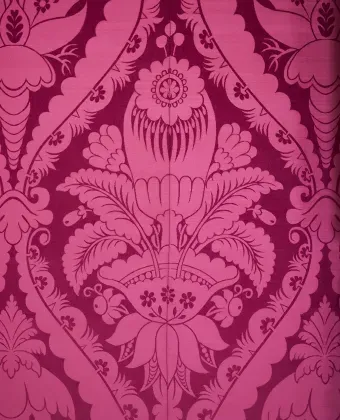
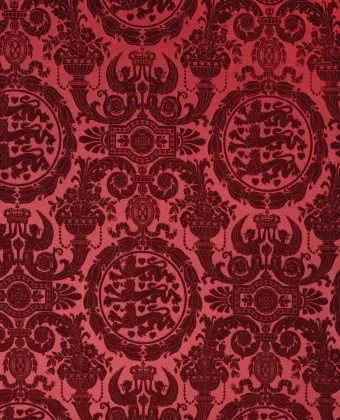
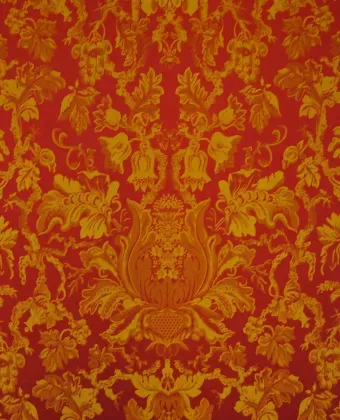
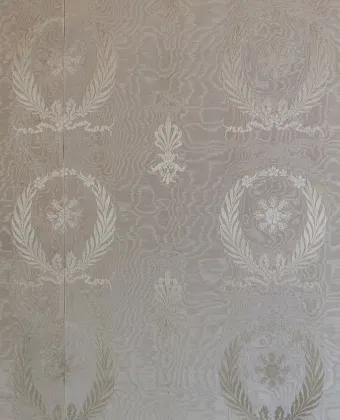
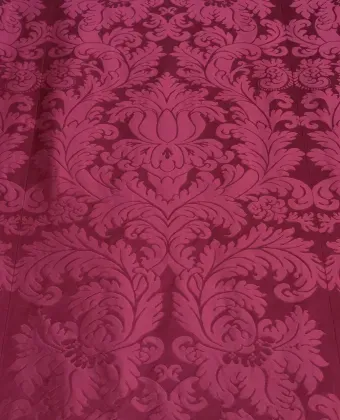
Silk, silver thread, cut and uncut polychrome voided double-corps-shaded-velvet, plain velvet and silver galloons
Pattern unit:
Height: ca. 97cm; Width: 56cm
Manufacturing location:
Italy, Genoa? (for the original textile)
France, Rozier en Donzy, Soierie des Fantasques, Franz Johannès Ippoldt (for the rewoven ciselé velvet)
Poland, Łódź, Lenora Sp. z o.o. (for the rewoven galloons)

© W. Holnicki
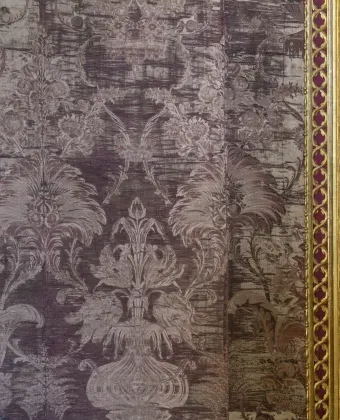
Palace at Wilanów was built as the summer residence of King Jan III Sobieski. After the king's death, the palace became the property of his sons, and in 1720, one of the wealthiest women in Poland at the time, Elizabeth Sieniawska, bought the dilapidated property. In 1730, the palace belonged for three years to King August II. The Dutch Cabinet served as a living room and simultaneously a corridor between the king's and queen's apartments. In the time of Jan III, the interior was decorated similar to the cabinets of Dutch art enthusiasts. The walls were covered with works by Dutch masters. The present furnishings and interior decor date back to 1720-1733, when the palace belonged to Elżbieta Sieniawska. Sieniawska’s bold idea was to have patterned velvets act as frames for centrally positioned panels of plain velvet, which served in turn as background for a rich collection of paintings. This unique decoration scheme, initiated well before her death in 1729, was completed in 1730. Around 1730, the walls were covered with patterned Genoese-style velvet fabrics. The polychrome velvet covering the walls of the Dutch Cabinet is part of a large group of textile-typology which are commonly called garden-velvets because, during the outgoing 17th century, it was fashionable to bring nature into homes as decorative elements. The major characteristics of this cut and uncut voided double-corps-shaded-velvet is that it is in a rather rough definition, with bucolic appearance which means that the design-steps are quite large and the pile extraordinarily high. Patterned velvet fabrics of the Genoese type currently adorning the walls are replicas of 18th century upholstery and were made during the last restoration (2009-2013). After cleaning and preservation, original velvets were placed in the museum’s storage.
Persons associated:
Maria Zofia Denhoff, the daughter of Elżbieta Sieniawska, owner of the Palace at Wilanów (1699-1771)
Velvet manufacturer unknown (for the original textile)
Franz Johannès. Ippoldt, velvet manufacturer (for the rewoven ciselé velvet)
Bibliographic sources:
Czaja, Barbara, Przygońska, Tamara, Obicia ścienne w Apartamentach Królewskich pałacu w Wilanowie, Wilanowski Informator Konserwatorski, Warszawa, 2009, p. 70-89
Ippoldt, Franz, Johannès, Rekonstrukcje XVIII-wiecznego weluru wzorzystego i srebrnej lamy morowanej do apartamentów królewskich pałacu w Wilanowie, Wilanowski Informator Konserwatorski, Warszawa 2013, p. 105-116
Przygońska, Tamara, Konserwacja i rekonstrukcja dekoracji tekstylnej Gabinetu Holenderskiego, Wilanowski Informator Konserwatorski, Warszawa 2013, p. 90-103
private textile

© R. Gałczyński
Name of the residence and name of the room:
Wilanów Palace, King’s Bedroom
Pałac w Wilanowie, komnata królewska
Period of creation:
1729-1730
Date of the reweaving:
2009-2013
Materials and technique:
Silk, silver lamella, silver thread; laminated cut voided velvet; silver moiré and silver galloons
Pattern unit:
Height: from 89 to 98cm; Width: from 52 to 53.5cm
Manufacturing location:
Unknown (for the original textiles)
Italy, Florence, Fondazione Lisio Arte della Seta (for the rewoven laminated cut voided velvet)
France, Rozier en Donzy, Soierie des Fantasques, Franz Johannès Ippoldt (for the rewoven silver moiré)
Poland, Łódź, Lenora Sp. z o.o. (for the rewoven galloons)

© W. Holnicki
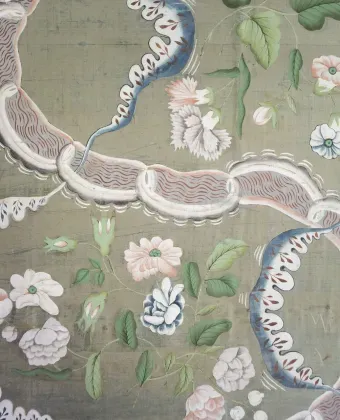
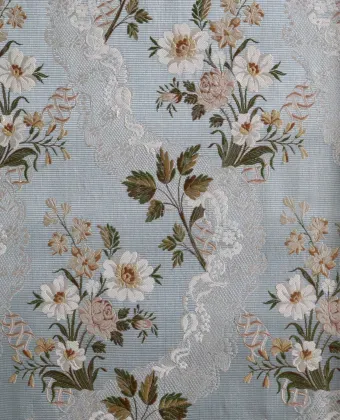
The baroque summer residence in Wilanów was established at the end of the 17th century for King Jan III Sobieski. The King's Bedroom is one of the oldest historical royal apartments. During the reign of Jan III, the walls were covered with white Venetian velvet in colourful flowers. Elżbieta Sieniawska's daughter, Maria Zofia Denhoff, around 1730, introduced major modifications to the decor the King's Bedroom. The surviving correspondence between Maria Zofia Czartoryska and the merchant André Contessa reveals details concerning the purchase of textiles for the King’s Bedroom. The King’s Bedroom contains nine stretchers, measuring circa 346 cm in height and from 35,5 to 441,4 cm in width. These wooden frames are upholstered: first with linen, then with laminated cut voided velvet and silver moiré, and finished with silver trim. The laminated cut voided velvet is patterned with plant-like motives. The fragment of a tree trunk is the central element of the pattern. A gigantic pear-shaped flower appears inside the trunk. Broken tree limbs and fern-like fronds frame the flower. Small twigs grow upwards out of the limbs. The entire composition rest against a cream blue coloured ground interwoven with the silver lamella weft. This original decorative motive resembles somewhat an axial-symmetrical lace composition as well as containing certain elements typical of bizarre patterns in French fabrics from the first quarter of the 18th century. In the course of the following hundred years, the colour of the fabric underwent the next transformation and become a greyed yellowed-green. The original colour of velvet was of the light blue colour called « bleu mourant ». Patterned velvet fabrics currently adorning the King's Bedroom walls are replicas of 18th century upholstery and were made during the last restoration (2009-2013). After cleaning and preservation, original velvet was placed in the museum’s storage.
Persons associated:
Maria Zofia Denhoff, the daughter of Elżbieta Sieniawska, owner of the Palace at Wilanów (1699-1771);
André Contessa, merchant (original textiles);
Oriana Castagnozzi, Lisio weaver (for the rewoven velvet);
Bibliographic sources:
Czaja, Barbara, 18th c. Wall Upholstery inside the King’s Bedroom at Wilanów Palace and its Contemporary Reconstruction, Jacquard Pagine di Cultura Tessile, vol. 70, Florence 2012, p. 35-38
Holyoke, Julie, The reconstruction of an 18th century laminated cut velvet for the King’s bedroom at Wilanów Palace by the Lisio Foundation in Florence, Italy, vol. 70, Florence 2012, p. 38-42
Marabelli, Paola, A project to produce a 280-year old velvet. Meeting today’s challenges with the skills of the past, vol. 70, Florence 2012, p. 42-45
authors
Barbara Czaja
Dr Agnieszka Laudy
Discover the Museum of King Jan III's at Wilanów
Royal Silks in Europe