

In the very near future, the Gallery of the Enlightenment and the Revolution will open in the Chimay Attic and will form part of the selfguided visitor route. It will offer a fresh perspective on an number of figures, some of whom remain little known, and will place in context the major events that transforms France during the second half of the 18th century.
Adopt a Work of Art from the Gallery of the Enlightenment and the Revolution
The new museum route in the chimay attic
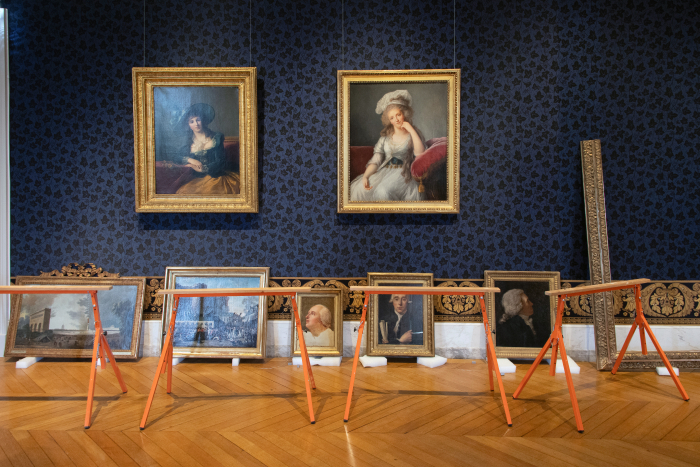
Located above the Queen's Apartments and overlooking the South Parterre, the Chimay Attic housed the apartments of courtisers under the Ancien Régime. Incorporated into the Museum of the History of France during the reign of Louis-Philippe, these spaces have, since the 1960s, displayed works dedicated to the French Revolution and the Consulate. The redesign of the museum route will make it possible to bring together a broader selection of masterpieces from the second half of the 18th century and to relocate the Consulate paintings to the South Attic, which is dedicated to the figure of Napeleon.
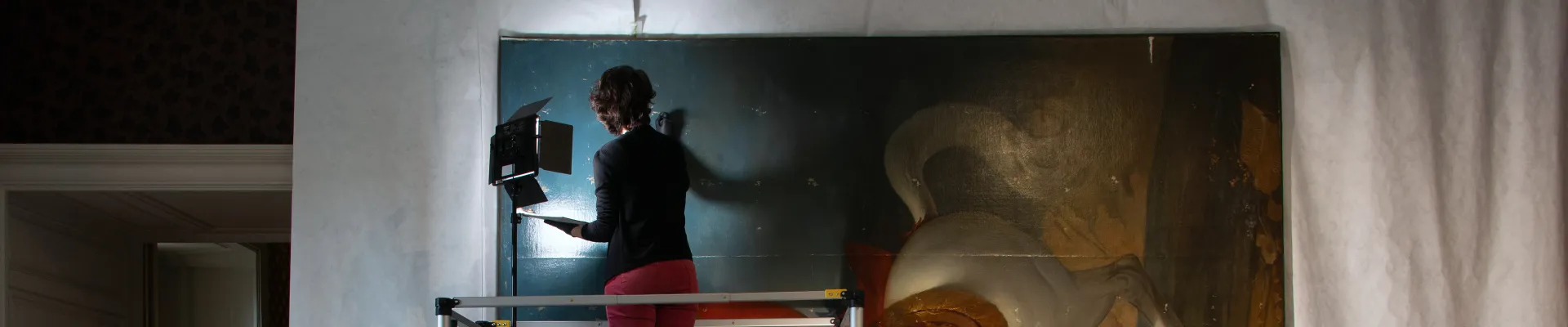
Some of the works of art that will be displayed require conservation treatment, including meticulous cleaning and, where necessary, restoration work.
Choose a work depicting the royal family and their circle, the artists, thinkers and scientists of the Enlightenment, or a figure of the French Revolution, and support the Palace of Versailles in its mission : to preserve and pass on the history of France through the richness of its collections.
Support the restoration of the works of art
Adopting a painting or a bust creates a special connection between the patron and the works of art. as such, each patron receives an adoption certificate, wich can be issued in their name or in the name of a loved one, allowing them to dedicate this philanthropic gesture to someone special.
Through your support, you also help preserve the expertise and craftsmanship of heritage professionals, particularly that of painting conservators, whose specialist skills require meticulous work carried out entirely by hand.
To make your commitment easier, your patronage can be spread over a periode tof two years.
Painting | ||
| You are | An individual | A company |
| Your donation | 8 000 € | |
| Tax relief | 66 % | 60 % |
| Cost after tax relief | 2 720 € | 3 200 € |
| Acknowlegement | A "1 year in Versailles" subscription card | 2 000 € |
Bust | ||
| You are | An individual | A compagny |
| Your donation | 5 000 | |
| Tax relief | 66% | 60% |
| Cost after tax relief | 1 700 € | 2 000 € |
| Acknowledgement | A "1 year in Versailles" subscription card | 1 250 € |
If you would like to become a patron, please contact the Palace of Versailles' Patronnage Department : mecenat@chateauversailles.fr / +33 (0)1 30 83 77 40
Alternatively, you may download and return the adoption form below
Become a patron Download the brochure
discover the Works of art to be restored
The painting
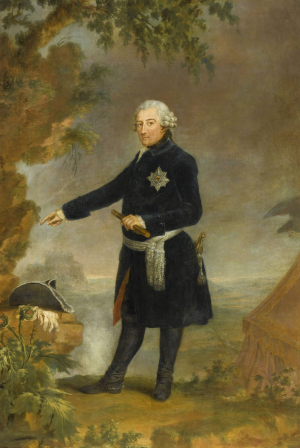
Anne-Dorothea Therbusch, Frédéric II, King of Prussia (1721-1782), 1722, oil on canvas
King of Prussia, Frederick II of Prussia was both a conquering monarch and a brilliant military strategist, as well as one of the leading exponents of enlightened absolutism, seeking to reconcile monarchical authority with philosophical ideals. This portrait is the work of Anna Dorothea Therbusch, a German artist who was among the few women of her time to gain access to the highest circles of the European art world.
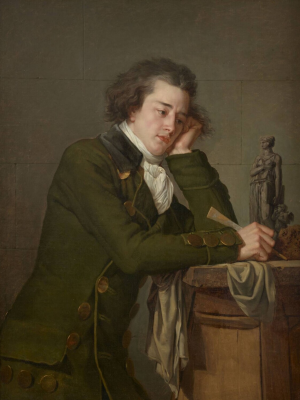
Jean-Baptiste-Frédéric Desmarais, Antoine-Denis Chaudet (1763-1810), 1778, oil on canvas
In Rome, where he completed his training after winning the Grand Prix of the Royal Academy in 1785, Desmarais painted this portrait of his friend, the sculptor Antoine-Denis Chaudet, then aged twenty-five. The young man is depicted leaning on a table in his studio, deep in thought, before a terracotta group representing Friendship Leading Love. Recently acquired, this painting is one of the few works by Desmarais held in the French national collections. The artist spent most of his career in Italy, notably as a result of the upheavals brought about by the French Revolution.
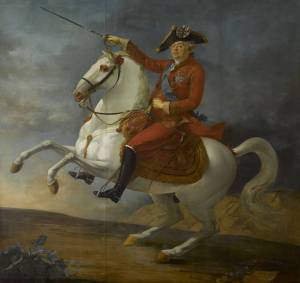
Jean-François Carteaux, Louis XVI, King of France (1754-1793), 1791, oil on canvas
As the last official portrait of Louis XVI, this work of art by Jean François Carteaux depicts the King as a constitutional monarch. The choice of an equestrian portrait follows a long-established tradition of portraying sovereigns in a majestic manner. However, the tricolour cockade and the sword with the words "La loi" [The Law] allude to the new political order.
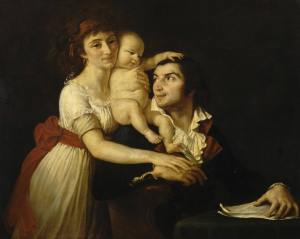
School of Jacques-Louis David, Camille Desmoulins, his Wife Lucile and their Son, 1792, oil on canvas
Camille Desmoulins was one of the most prominent figures of the French Revolution . A committed journalist, noted for his speech at the time of the Storming of the Bastille, he became one of the youngest deputies of the National Convention before being arrested alongside the Dantonists and executed on 5 April 1794, just weeks before his Wife Lucile Desmoulins. This portrait depicts him in a family setting, allongside his wife and their son Horace, in the role of a devoted and caring father.
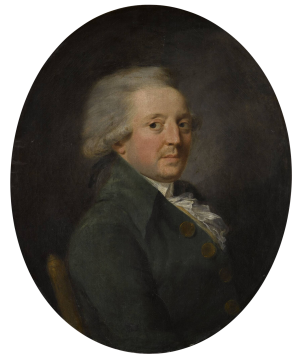
Anonymous, Marquis de Condorcet (1743-1794), 1779-1793, oil on canvas
Mathematician, philosopher and statesman, Nicolas de Condorcet ranks among the leading intellectual figures of the Enlightenment. Appointed to the Académie des Sciences at the age of twenty-six and a close associate of Voltaire and Jean le Rond d'Alembert, he embodied the ideal of engaged scholar. A pioneer in the fields of statistics and voting theory, he consistently advocated the abolition of slavery, equality between the sexes, and educational reform. During the French Revolution, he sat with the Girondins in the National Convention before being indicted in 1793. After a period in hiding, he was arrested and found dead in his cell on 29 March 1794.
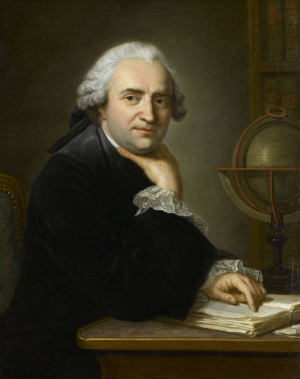
Anonymous, Jean-Baptiste Bourguignon d'Anville (1697-1782), 18th century, oil on canvas
Appointed Geographer to the King at the age of just twenty-two, Jean Baptiste Bourguignon d'Anville was one of the greatest cartographers of the 18th century. Through nearly two hundred maps and numerous memoirs, he transformed the representation of the known world through an unprecedented degree of scientific rigour. A member of the Académie des Inscriptions et Belles-Lettres and later of the Académie des Sciences, he assembled an exceptional cartographic collection over the course of his life. Sold to the King in 1779, it is preserved as the Bibliothèque nationale de France.
Anonymous, Bertrand Barère de Vieuzac (1755-1841), 18th century, oil on canvas
A lawyer who went on to serve as a deputy in both the Constituent Assembly and the National Convention, Bertrand Barère de Vieuzac was one of the most complex and controversial figures of the French Revolution. An influential orator, he initially belongs to the Convention's centrist faction before aligning himself with the Mountain and joining the Committee of Public Safety in 1793, at the height of the Reign of Terror. Condemned under the Thermidorian Convention, he was eventually granted amnesty during the Consulate.
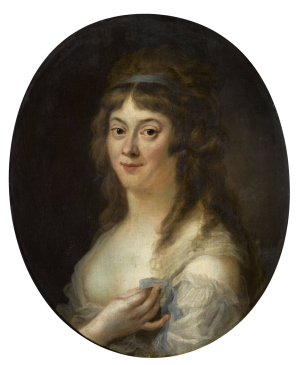
Johann-Ernst Heinsius, Madame Roland (1756-1793), 1792, oil on canvas
Born to Parisian artisan and educated in the spirit of the Enlightenment, Manon Roland emerged as one of the most remarkable female figures of the French Revolution. Her Paris salon became a major political meeting place for the Girondins, and her influence over her husband, who served as Minister of the Interior in 1792, was considerable. She contributed to the drafting of ministerial correspondence and oversaw an office responsible for shaping public opinion. Arrested following the fall of the Girondins on 31 May 1793, she wrote her memoirs while in prison before being guillotined on 8 November of the same year.
Adopted
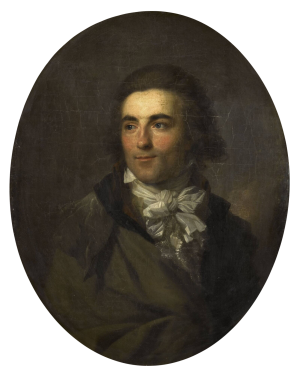
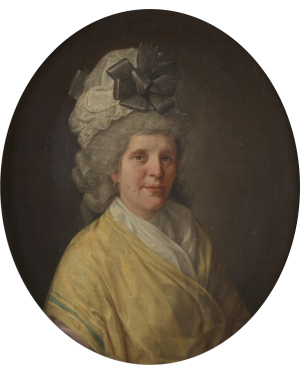
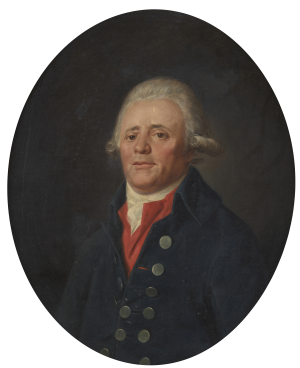
Simon Julien, Portraits of Georges Jacob and his Wife Jeanne Loyer, 1793, Oils on canvas
George Jacob was the most celebrated and prolific chair-maker of 18th century France. Admitted to the guild as a master craftsman in 1765, he supplied furniture to the royal family and the leading aristocratic households before being ruined by debts left unpaid by clients who had emigrated during the Revolution. Simon Julien portrays him in three-quarter view, dressed in a dark coat and white cravat, in the same restrained and dignified manner as his portrait of Jacob's wife, Jeanne Germaine Loyer, painted in the same year. Conceived as companion pieces, the two paintings provide a rare depiction of a couple emblematic of Paris's artisan bourgeoisie on the eve of the Revolution.
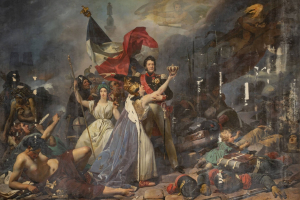
Jean-Baptiste Mauzaisse, France Presents the Crown to Louis-Philippe, 1830, oil on canvas
In 1830, the July Revolution brought Louis-Philippe to power. In this allegorical painting, Mauzaisse depictes France offering the crown to the "Citizen King", while the symbols of the former monarchy and the Empire are deliberatly omitted. The work thus conveys the idea of a new beginning founded on national reconcialiation, an ambition that Louis-Philippe would later realise through the Museum of Versailles, dedicated "To all the glories of France". Originally intented for the city of Bordeaux, the painting was never delivered.
The busts
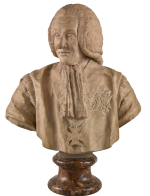
Jean-Antoine Houdon, Armand-Jérôme Bignon, Councillor of State (1711-1772), 1771, terracotta
A lawyer, the King's librarian, a member of the Académie française and the Académie des Inscriptions et Belles Lettres, and Provost of the Merchants of Paris, Armand-Jérôme Bignon embodies the enlightened administrator of the 18th century. Jean-Antoine Houdon portrayed him in the year before his death with remarkable insight: his marked features, slight smile, the cross of the Order of Saint Louis, and the star embroidered on his coat all evoke the dignity of his office.
Adopted
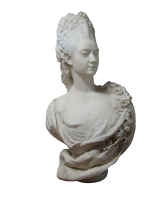
Anonymous, Elisabeth of France, known as Madame Elisabeth, (1764-1794), 1764-1774, marble
The younger sister of Louis XVI, Elisabeth of France was one of the most engaging figures of the royal family. Deeply pious and inwaveringly loyal to her brother, she refused to emigrate, was imprisoned in the Temple in 1792, and was guillotined on 10 May 1794. The sculptor's work is distinguished by its remarkable delicacy : the powedered, curled hairstyle adorned with pearls, together with the drapery embellished with finely carved roses, lends the piece a grace characteristic of the art of the second half of the 18th century. The work also reflects the care devoted to the depiction of royal children.
Adopted
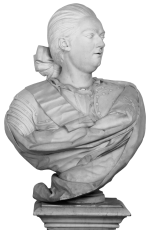
Anonyme, Louis Stanislas Xavier of France, count of Provence (1755-1824), circa 1775, marble
The younger brother of Louis XVI, Louis Stanislas Xavier of France was a cultivated man of letters. A shrewd politician, he survived the turbulent years of the French Revolution and become King of France in 1814, following the fall of the Empire. This bust depicts him in his youth, dressed in a richly embroidered military coat. With his face turned in three-quarter view, he wears an expression of determination.
Adopted
Anonymous, Marie Joséphine Louise of Savoy, countess of Provence (1753-1810), circa 1775, marble
A Princess of the House of Savoy, Marie Joséphine Louise married the Count of Provence, the future Louis XVIII in 1771. She emigrated with him on the night of 21 june 1791, at the same time as the Flight to Varennes. She died in 1810, four years before her husband's accession to the throne. The refinement of the hairstyle and the delicacy of the lace adorning the neckline make this bust one of the finest examples of sculpted portraiture from the Ancien Régime.
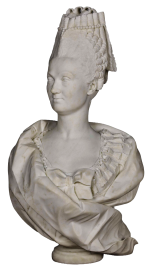
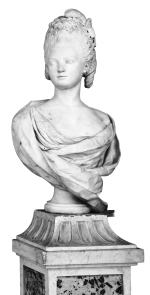
Anonymous, Clothilde of France, Queen of Piemont-Sardinia (1759-1802), circa 1775, marble
The sister of Louis XVI, Louis XVIII and Charles X, Clotilde of France married Charles Emmanuel of Savoy, Prince of Piedmont and future King of Sardinia, in 1775 at the age of fifteen. A woman of deep faith, loved and respected at the court of Turin, she learned in exile of the deaths of her brother Louis XVI and her sister Elisabeth of France. Following her death at the age of forty-two, the process for her canonisation was initiated as early as 1804. Today, she is recognised by the Catholic Church as Venerable.
Adopted
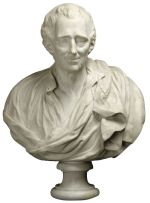
Félix Lecomte, Charles de Secondat, baron de Montesquieu (1689-1755), 1779, marble
Jurist, philosopher and writer, Montesquieu, born Charles de Secondat, Baron de Montesquieu, was one of the founding figures of modern political thought. With L'Esprit des lois [The Spirit of the Law] (1748), he laid the foundations of the theory of the separation of powers, which would directly inspire first the American and then the French revolutionaries. This posthumous bust, executed in 1779 by the sculptor Félix Lecomte, reflects the reverence that the Enlightenment held for its great intellectual figures.
Adopted
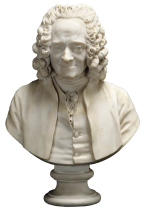
Jean-Antoine Houdon, François-Marie Arouet, known as Voltaire (1694-1778), 1782, marble
A towering figure of the Enlightenment, Voltaire, born François-Marie Arouet, ranks among the most brilliant and combative minds of the 18th century. Philosopher, playwright, historian and polemicist, he fully embodied the ideal of the engaged writer. Houdon created this bust in 1782 four years after Voltaire's death, drawning on studies made during the philosopher's triumphant return to Paris in 1778. The sculptor captured the ageing philosopher with remarkable insight : the faintly ironic smile, the piercing gaze beneath prominent brows, and the curled wig contrasting with the sobriety of his attire.
Jacques Nicolas Roëttiers de la Tour, Louis Hercule Timoléon de Cossé, 8th Duke of Brissac, mareshal General of the King's Camps and Armies, governor of Paris (1734-1792), 1784, marble
Governor of Paris, Grand Panetier of France, and one of the wealthiest men in the kingdom under Louis XVI, the Duke of Brissac embodied the highest ranks of the court nobility on the eve of the Revolution. A bibliophile and discerning patron of the arts, he remained loyal to the King and was murdered at the Palace of Versailles on 9 September 1792 during the September Massacres. Although commissioned for a private patron, this bust adopts the conventions of the formal state portrait.
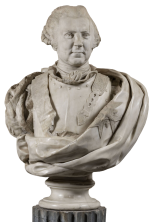
Adopted
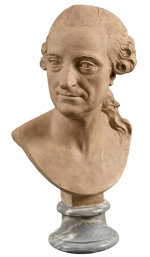
Philippe-Laurent Roland, Nicolas Marie Potain (1723-1790), 1788, terracotta
Architect and Controller-General of the King's Buildings, Nicolas Marie Potain was a discreet yet influential figure in the royal administration under Louis XVI, as well as the father-in-law of the sculptor Philippe-Laurent Roland. With this highly intimate portrait, Roland pays tribute to him. Trained under Augustin Pajou, who decorated the private apartments of Marie-Antoinette and Louis XVI at the Palace of Versailles, Roland produces in this bust one of the finest examples of his art of terracotta portraiture.
Patronage
Get your Patronage Token
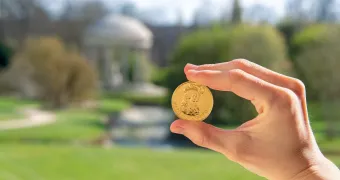
This year in Versailles, equestrian excellence reigns supreme : take part in our latest news and become a patron. By donating 8 euros in addition to your ticket, contribute to the influence and heritage restorations of the Palace of Versailles. For this occasion, you will receive a limited edition token created by the Maison Arthus-Bertrand, illustrating Louis XIV on horseback.
Adoption
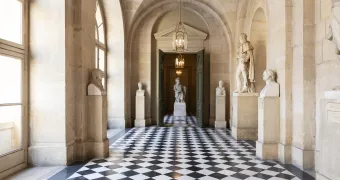
Adopt a sculpture of the First Empire Gallery
Help restore busts and statues from the French Revolution and First Empire to rebuild the historic 1837 collection of the Historic Galleries.