


public textile

Name of the residence and name of the room:
Alhambra
Period of creation:
Nasrid, 14th century
Date of the reweaving:
2004-2006
Materials and technique:
Lampas, silk and “oropel” on a silk core
Cochineal red and ellagic acid
Undyed silk serving as a backing for sequins
(Detection of dyes by thin-layer chromatography)
Silver with an alloy containing 18.6% copper and 2.55% lead; alloy containing 20% copper (Detection by X-ray fluorescence)
Pattern unit:
Height: 212cm; Width: 61.5cm
Manufacturing location:
Spain, Nasrid Sultanate. Granada? Almeria?

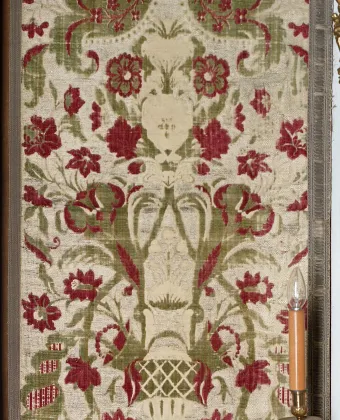
The silk hangings in the palaces of the Alhambra served two distinct purposes. On the one hand, they were used as curtains to divide spaces and ensure privacy; on the other, they were hung like tapestries to insulate the winter rooms from the cold and, together with the carpets, provided protection from the harsh winter weather. The use of these textile highlights the decorative and functional aspects of the home, creating comfort and privacy by defining distinct spaces. They demonstrate the overall ornamental effect of the interior decoration that adorned the rooms and walls of Nasrid palaces and houses.
Some preserved examples reveal that these panels were extended in width by similar panels, between which a decorative frieze was inserted.
The design, on a yellow silk background, features a curved knot of red ribbons. It is interrupted at the ends and in the centre, where silver is the predominant colour, while the silk comes in shades of yellow, blue, white, black, and green.
The pattern consists of eight-pointed stars and intertwined crosses. The star transforms into two interlocking circles of alternating eight-lobed shapes of different sizes.
The arrangement of this motif leaves a cross-shaped space between each circle, adorned with a floral motif arranged in a cross. The centre is a square whose corners are adorned with a floral motif. From its centre, a pivoting cross extends into other tulip-shaped motifs.
The outer borders interrupt the curtain’s pattern, enriching it with silver threads, while the central border, also enhanced with metallic threads, features a different motif. The richness of these decorative bands is revealed in the shifting hues of the silk threads: green, white, black, blue, and yellow, against a shimmering silver background.
Bibliographic sources:
Cabrera Lafuente, Ana, Tejidos y Alfombras del Museo de la Alhambra, Granada, 1998
Marinetto Sánchez, Purificación y López Redondo, Amparo, A la Luz de la Seda, español y francés, Madrid, 2012
private textile

Name of the residence and name of the room:
Alhambra
Period of creation:
Nasrid, Muhammad V, 14th century
Materials and technique:
“Taqueté” weave with 4 wefts, ellagic red dye, cochineal dye, and acid
Pattern unit:
Height: 22.5cm; Width: 48cm
Manufacturing location:
Spain, Nasrid Sultanate. Granada? Almeria?

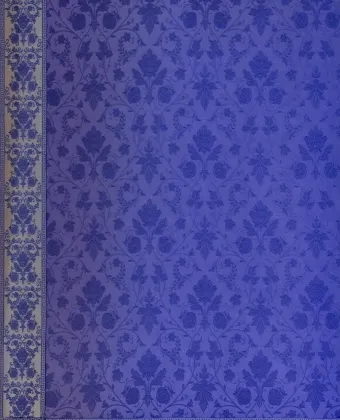
This is a fragment of a curtain panel, with part of the border and background design preserved.
It is made of silk dyed with cochineal red along its entire length, followed by golden yellow, ellagic blue, and white.
The design continues along the entire length, and the border is distinguished by the use of blue, which replaces the yellow. It also features two borders on either side, thus delineating the composition.
The decorative pattern is plant-based, arranged in rounded, pointed shapes formed by garlands of leaves. The space is organized within these plant wreaths, centred on a small tree with a vertical trunk ending in a small cup with leaves arranged in palmette patterns.
The preserved border features the same design, but with a change in colours: the red background remains, while the plant pattern is blue, thus creating a very different aesthetic. The evolution of the design on this curtain fragment corresponds to the ornamental period that developed around 1369, the time of the construction and decoration of the north pavilion of the Comares Palace.
This period reveals a naturalistic ornamental style that would later be greatly expanded and developed in the decoration of the Riyadh Palace. During this time, a decorative scheme emerged that was primarily based on naturalistic plant patterns, with geometric forms serving solely to organize the composition’s themes.
Person associated:
Muhammad V, Nasrid emir of Granada (1339-1391)
Bibliographic sources:
Cabrera Lafuente, Ana, Tejidos y Alfombras del Museo de la Alhambra, Granada, 1998
Marinetto Sánchez, Purificación y López Redondo, Amparo, A la Luz de la Seda, español y francés, Madrid, 2012
author
Purificación Marinetto Sánchez
Discover the Alhambra and Generalife
Royal Silks in Europe