


public textile

© Madrid, Patrimonio Nacional
Name of the residence and name of the room:
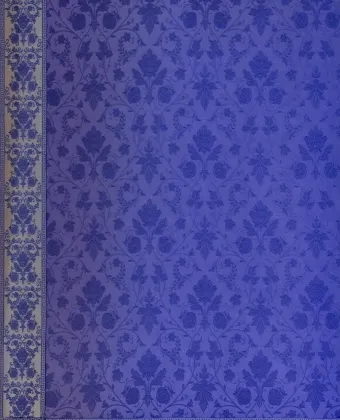
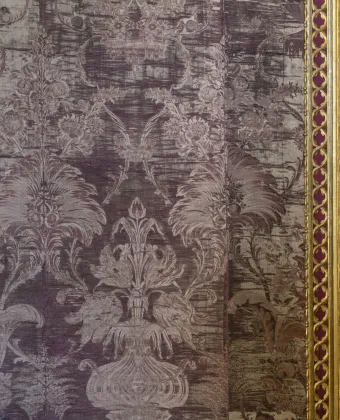
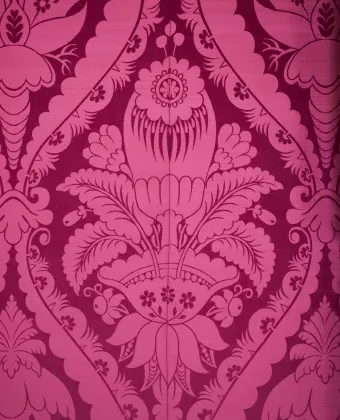
Palacio Real de Madrid, Gasparini Room
Palacio Real de Madrid, Salón Gasparini
Period of creation:
1763-1791
Date of the reweaving:
1991-1992
Materials and technique:
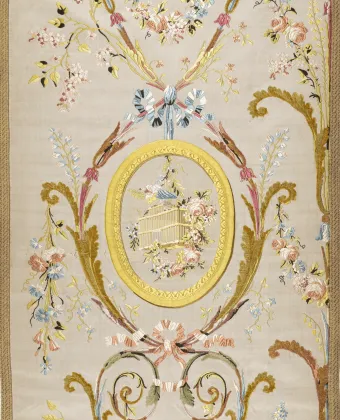
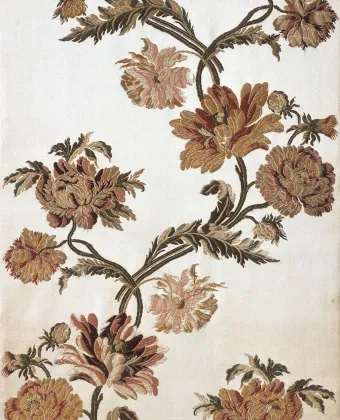
No. 8 silk satin embroidered with coloured silks and gilt silver thread
Manufacturing location:
Spain, Madrid, Embroidery Workshop of the Royal Palace of Madrid (for the original textile)
France, Lyon, Tassinari & Chatel (for the rewoven fabric)
Spain, Seville, Brenes, Workshop of Fernández and Enríquez (restauration directed by Patrimonio Nacional).

© Madrid, Patrimonio Nacional
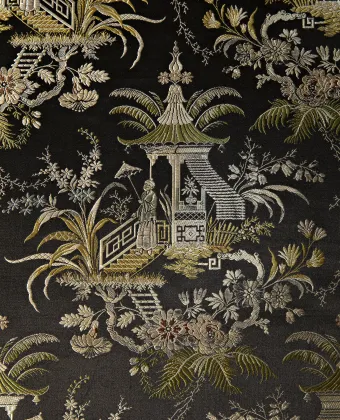
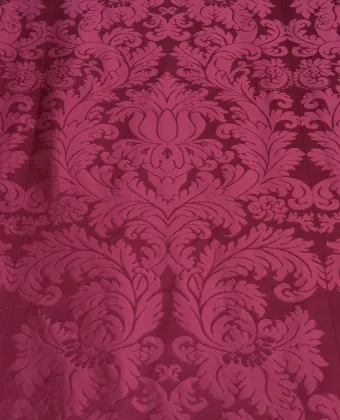
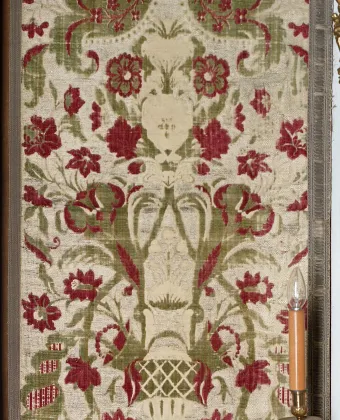
Carlos III, who became King of Spain in 1759, commissioned the Venetian painter Mattia Gasparini to design the decoration for the dressing room of the New Royal Palace in Madrid. Three workshops were set up to produce the hangings and furniture for this room, the most important of the sovereign's private chambers: the Cabinetmaking Royal Workshop, the Bronze Royal Workshop and the Embroidery Workshop. The latter was initially run by Gasparini's wife, María Luisa Bergonzini, and later by their son Antonio.
The complexity of the embroidery on the hangings, which included wall hangings, curtains and seat upholstery, delayed their completion so much that the textiles were not installed in the room until 1815, during the reign of Ferdinand VII. The curtains were removed from the hall in the second half of the 19th century; the upholstery, which had not yet been fitted, was installed during the reign of Alfonso XII on the newly restored original seats, the work of Gasparini and José Canops, which replaced the Spanish Empire-style furniture that had decorated the room until then.
The decorative motifs chosen by Gasparini for this space, which are also displayed on the marble flooring and the spectacular plaster vaulted ceiling, reflect the taste for chinoiserie that dominated the interiors of Spanish royal palaces during the reign of Charles III. Scrolls, foliage, flowers and fruits intertwine to create a unique Rococo ensemble in which, as is customary in Gasparini's designs, rocaille does not appear.
The condition of the hanging in the 20th century made restoration necessary. The original embroidery was removed from the satin base and placed on a new support similar in technique and colour. This work was carried out in the Seville workshop of Fernández y Enríquez, under the direction of María Lourdes de Luis Sierra from Patrimonio Nacional.
Persons associated:
Carlos III, King of Spain (1716-1788)
Mattia Gasparini, designer
Maria Luisa Bergonzini, director of the Embrodery Royal Workshop
Antonio Gasparini, director of the Embroidery Royal Workshop
Bibliographic sources:
Barreno Sevillano, M.ª Luisa, “Salón Gasparini o Pieza de Parada. Palacio de Oriente”, Reales Sitios, 12, 43 (Patrimonio Nacional, 1975): 61-72
Cabeza Gil-Casares, Carmen, “Bordados del Salón Gasparini”, Reales Sitios, 114 (Patrimonio Nacional, 1992): 10-28
Mateos Martín, Mario, "Lo que Gasparini no imaginó para la Cámara de Carlos III en el Palacio Real de Madrid", librosdelacorte.es, 25 (2022): 120-151
private textile

© Patrimonio Nacional, RAP17C, Antonio Úbeda
Name of the residence and name of the room:
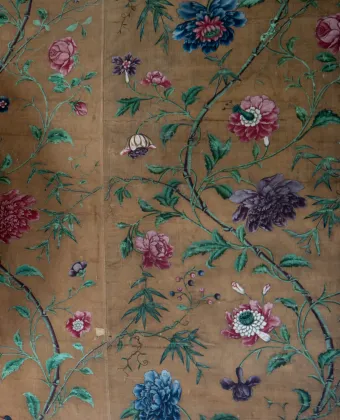
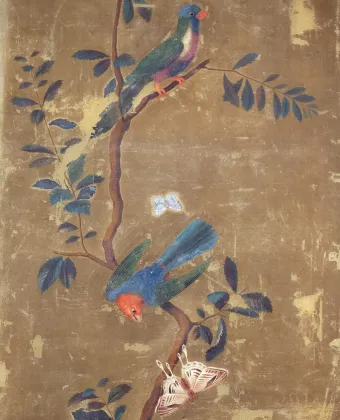
Casa del Labrador, Royal Site of Aranjuez, María Luisa Hall or Company Hall
Casa del Labrador, Real Sitio de Aranjuez, salón de recepción de María Luisa
Period of creation:
1802-1803
Materials and technique:
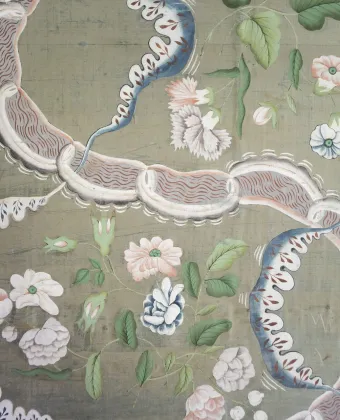
Silk, brocaded and painted lampas, embroidered
Pattern unit:
Wall hanging: Height: 63cm; Width: 60cm
Manufacturing location:
France, Lyon, Camille Pernon Workshop

© Patrimonio Nacional, Héctor Pérez
The Casa del Labrador in the Royal Site of Aranjuez (Madrid), like those in El Pardo and El Escorial, is a small palace whose construction as a place of leisure was promoted by Charles IV when he was prince. The building was completed in 1803, when he was already king, and the interior decoration work had to be finished abruptly in 1808, on the eve of the War of Independence against France (1808–1814).
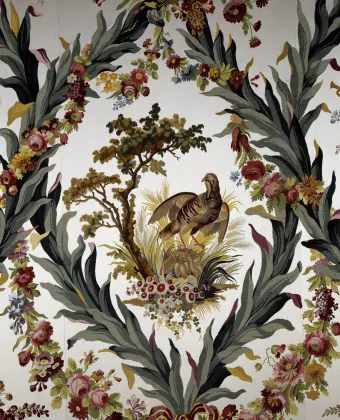
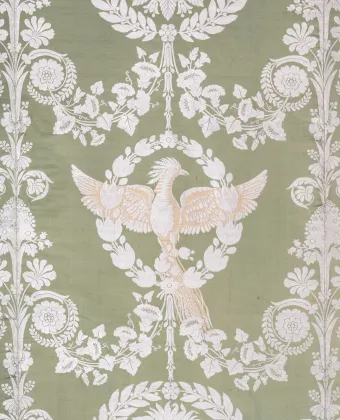
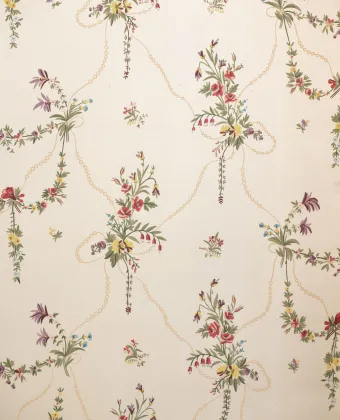
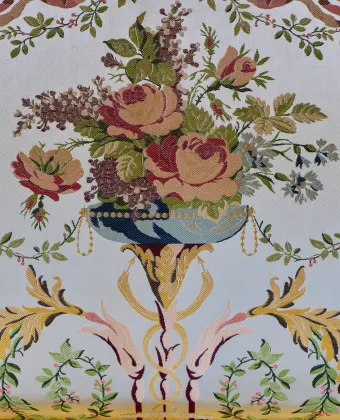
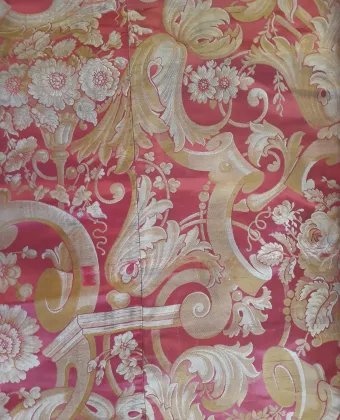
The hanging in the María Luisa Room, also known as the ‘Company Room’ because it was the space where high-ranking dignitaries were received, was woven on a white background imitating marble, decorated with bronze and gold-coloured weapons trophies and octagons embroidered with landscapes based on prints. Also noteworthy are the curtains on the doors and windows, made of white silk decorated with double palmettes and a gold-embroidered pink border, identical to those on the walls with corners or ‘ecusones’ at the angles, and the four window and door valances, all of which are also embroidered.
The commission, from Camille Pernon's factory in Lyon, arrived in different phases between May 1802 and October 1803. Its complexity made it necessary to differentiate each part of the hanging according to a pre-established plan – which had to be sent from Spain – for each wall of the room, so that it could be assembled correctly. Pernon's silk weaving factory in Lyon was the most prestigious in 18th-century Europe, and the quality and quantity of orders placed with it by the Spanish Royal Household were unparalleled. The proposal to produce these textiles came to the French weaver through Juan Antonio Miquel, a manufacturer and merchant of silk fabrics from Valencia, but originally from Lyon, who had close contacts with the Pernon factory. The furniture in this room, which also features upholstery, consists of stools and a fireplace screen, also by Pernon.
Persons associated:
Carlos IV, King of Spain (1748-1819)
Jean-Démosthène Dugourc, designer (1749-1825)
Camille Pernon, weaver (1753-1808)
Bibliographic sources:
Arizzoli-Clémentel, Pierre et Gastinel-Coural, Chantal, Soieries de Lyon. Commandes royales au XVIIIe siècle. (1730-1800), p. 131, nº 84
Benito García, Pilar, Las colgaduras de seda del Salón de María Luisa en la Casa del Labrador, Madrid, 1997, Archivo Español de Arte, n.º cclxxx, p. 449-453
Jordán de Urríes y de la Colina, Javier, La Real Casa del Labrador de Aranjuez, Madrid, 2009, p. 151-158
author
Pilar Benito García
Discover the Patrimonio Nacional
Royal Silks in Europe