


public textile

Name of the residence and name of the room:
Palace of Venaria, The Queen’s State Room
Reggia di Venaria, Camera di parata della regina
Period of creation:
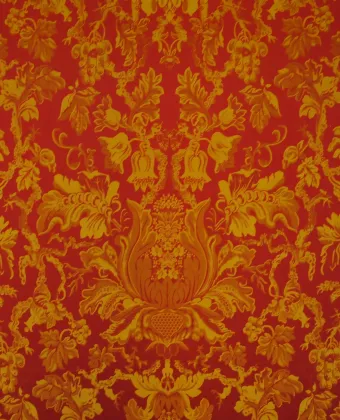
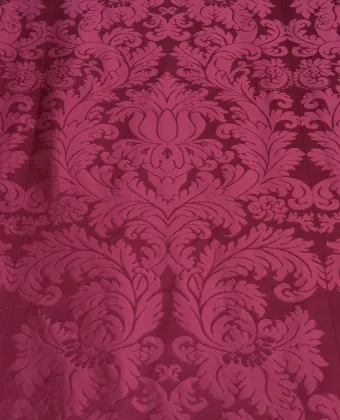
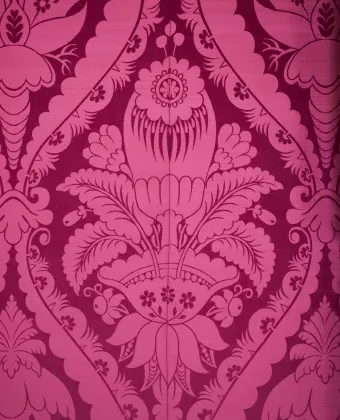
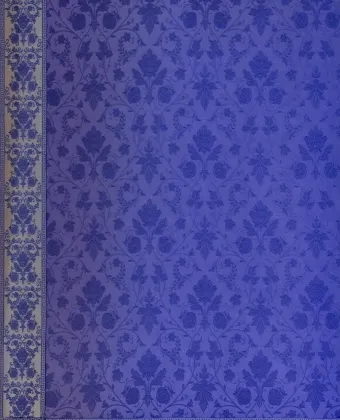
1711 - Crimson damask with green flowers
Date of the reweaving:
2011
Materials and technique:
Red silk tabby iridescent green
Manufacturing location:
Manufactory of Turin (for the original fabric)
Créations Métaphores - Holding Textile Hermès, Paris (for the new textile)

In the early 18th century, the construction of the western Garovian pavilion and the fitting out of the new apartments within it for Vittorio Amedeo II of Savoy and Anna of Orléans led to the creation of new furnishings, as described in the Inventory of « Furniture and Effects of the Royal Palace of Venaria » of 1711, the only such document to have survived. There is a clear distinction between the private rooms, which are fully furnished, and the state rooms, which are more sparingly furnished and feature portraits of the kings of France and England and of the Emperors on the walls; yet it is evident that the red colour of the “crimson damask with green flowers” upholstery was the dominant feature in the rooms intended for receptions. In contrast to the state rooms, the inventory of 1711 for the private rooms of the Royal Apartment lists hangings and fabrics in “green damask with bands of red damask”.
In 1737, during the refurbishment of the royal apartment to mark the third marriage of Carlo Emanuele III to Elisabeth of Lorraine, records show new supplies of tapestries, upholstery and curtains in crimson “Persiena” (i.e. silk lampas) with “large gold-coloured flowers”, supplied by the Gioanetti merchants. As late as the mid-18th century, an expenditure of 1753 was recorded for the king’s apartment; the king, who had been a widower since 1741, had the court supplied with “crimson satin with gold accents” by Carlo Francesco Vanetto, a merchant and manufacturer of silk, gold and silver fabrics. As a sign of continuity, in 1776 the Gioanetti brothers were still supplying the crimson damask for the state room in King Victor Amadeus III’s apartment in the east wing.
When the court left Venaria and the palace was converted for military use, all the tapestries, along with the furnishings, were lost without a trace. During the restoration of the Reggia (2000-2007), several fragments of fabric (a cotton and linen damask) dating from the 19th century were discovered; however, these were not considered suitable for reproduction.
Supported, therefore, by archival documents, but in the absence of fragments of original fabrics and iconographic evidence of the interiors, the exhibition design, guided by a scientific Committee, aimed to recreate the appearance of the apartments in accordance with their original intended use (1711) and to favour an “evocative reconstruction” of silk curtains and upholstery limited solely to the colours (red iridescent green) without decorative motifs.
Furthermore, the complete absence of fixed wall fixtures to define the fabric panels - such as panelling, frames and door jambs - and the fact that any decorative elements present were incomplete, led to the adoption of a display method typically used for movable wall hangings. The fabrics are hung from rods fixed beneath the cornice; this reversible system, as if the decorations were temporary, is reminiscent of the practice of changing the wall hangings according to the seasons and occasions, given that the Reggia is a country residence subject to frequent changes in décor.
The payment records show that the Court sourced its silk fabrics for the Reggia from Turin merchants who oversaw the work of more than 200 master craftsmen operating in the city. Silk production has, moreover, a long tradition in Piedmont dating back to the 16th century, with a significant contribution made by the “Manifattura dell’Albergo di Virtù”, a charitable institution founded in Turin by Carlo Emanuele I in 1587, which established silk weaving and achieved high standards of quality. This was followed in 1686 by the establishment of the “Università dei Mastri fabbricatori di stoffe di seta, argento e oro” and, in 1710, by the “Fabbrica Reale delle stoffe di seta”, which exported its goods to the markets of Lyon and Paris. In 1761 the Velvet and Silk Fabrics Royal Manufactory was established in Venaria Reale by the Avignon merchant Costa, at the behest of Carlo Emanuele III, continuing the manufacturing tradition linked to the production and processing of silk that had been characteristic of the village of Venaria since its foundation, based on the original project of Duke Carlo Emanuele II, who in 1670 had commissioned Giovanni Francesco Galleani of Bologna to establish a silk mill using an innovative hydraulic system. Throughout the 18th century, the Piedmont of the House of Savoy remained the leading producer of the finest silk yarn on the market: organza; it was only under the Napoleonic government that the sector fell into decline, to the benefit of the manufacturers in Lyon, who held the exclusive right to produce furnishings for the imperial residences. The only known silk satin tapestry, produced in 1763 by the Royal Manufactory of Venaria (1761-1766), has recently been identified at the Palazzina di caccia di Stupinigi, located in two rooms: Reception room and Bedroom in the Eastern Apartment.
Persons associated:
- Vittorio Amedeo II of Savoy (1666-1732)
- Carlo Emanuele III of Savoy (1701-1773)
- Giovanni Battista, Michel Angelo and Sigismondo Gioanetti, merchants
- Carlo Francesco Vanetto, textile manufacturer and merchant
Bibliographic sources:
- P. Chierici, Da Torino tutt’intorno: le ‘fabbriche da seta’ dell ’antico regime in G. Bracco (a cura di), Torino sul filo della seta, Città di Torino, Torino 1992, pp. 177 – 202
- S. Ghisotti, C. Spantigati, Mestieri preziosi alla corte dei Savoia in La Reggia di Venaria e i Savoia. Arte, magnificenza e storia di una corte europea, catalogo della mostra (Reggia di Venaria Reale, 12 ottobre 2007- 30 marzo 2008) a cura di E. Castelnuovo, Allemandi, Torino 2007, pp. 306-312
- Venaria e la seta. Il complesso Galleani, proposta di restauro e valorizzazione - Venaria and the silk. The Galleani's complex, proposal draft of restoration and valorization. Rel. Maria Adriana Giusti, Marco Ferrari. Politecnico di Torino, Tesi di laurea, Corso di laurea magistrale in Architettura Per Il Restauro e Valorizzazione Del Patrimonio, 2020 https://webthesis.biblio.polito.it/15146/
private textile

Name of the residence and name of the room:
Stupinigi Hunting Lodge, Eastern Apartment, Bedroom (1767-1800)
Palazzina di caccia di Stupinigi, Appartamento di Levante, Camera da letto (1767-1800)
Period of creation:
1763
Materials and technique:
Liage repris satin, brocade
Pattern unit:
Height: 212 cm; Width: 62,5 cm
Manufacturing location:
Venaria Reale (Turin), Royal Manufactory

The upholstery covers the bedroom with 21 panels and a door, covering a total area of approximately 52 m². The same fabric also covers the adjoining room, intended to serve as a Reception room, with 28 panels, a door and 6 door panels, covering a total area of approximately 70 m². There are at least six chairs upholstered in the same fabric, on which one can also see the wide border of approximately 4 cm consisting of three white lines and three red lines. The fabric dates back to the original fitting-out of the apartment, completed in 1767 for the Duke of Chiablese, Benedetto Maurizio, the youngest son of Charles Emmanuel III of Savoy. The preparatory work on the apartment was overseen by the architect Ludovico Bo, and the hangings were produced by the Royal Manufactory of Venaria, founded by the Avignon merchant Costa in 1761, which comprised a spinning mill, a dye works and over 30 looms for velvets and worked silk fabrics. The structure of this impressive tapestry, whose decorative motif measures over 2 metres and whose width exceeds that of ordinary looms, required the use of a draw loom, with at least two pullers and a weaver. The height of the fabric is also extraordinary, at over 62 cm, which is more than one “raso” (a Piedmontese unit of measurement: 1 raso = 60 cm).
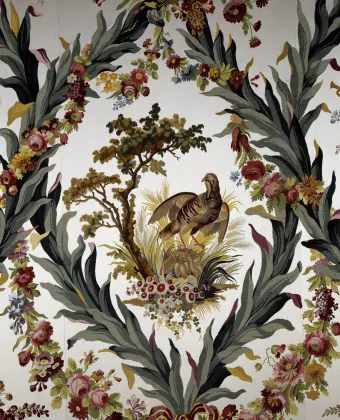
The pattern, which runs vertically, features a meandering design alternating between a vase of bellflowers, bouquets of roses and tulips, with small birds perched on either side of the vases; these stand out in relief thanks to the black brocade border that casts shadows around them.
The satin weave (5-end, 3-shed) forms the glossy white background of the pattern. The design is created by the background weft, inserted in a different colour and secured by the background warp (repetitive weave, 2 threads out of 6). The design is by Mr Breton, a designer from Lyon who joined the company in 1761. The manufactory sent to the Royal Furniture Store in 1763 the “persiennes” - the fabric name in the documents - for the Stupinigi hunting lodge. It was produced in large lengths (919 rasi = approx. 550 metres).
Persons associated:
- Duke of Chiablese (1741-1808), Benedetto Maurizio
- Charles Emmanuel III of Savoy (1701-1773)
- Mr Costa (1761-1766), merchant and owner of the Royal Manufactory
- Mr Breton, designer from Lyon
Bibliographic sources:
- L. D’Agostino, “Echi d’Oriente nelle tappezzerie della Villa. I documenti d’archivio e le rare sopravvivenze”, in Villa della Regina. Il riflesso dell’Oriente nel Piemonte del Settecento, L. Caterina, C. Mossetti (a cura di), Torino 2005, pp. 238-239.
- A.M. Bava, E. Carbotta, Gli apparati tessili, in La Palazzina di Caccia di Stupinigi, E. Gabrielli (a cura di), Firenze 2014, pp. 267-276.
- M. P. Ruffino, “Camille et Pauline Borghèse à Turin”, Bulletin du Centre de recherche du château de Versailles [Online], 24 | 2025, URL:http://journals.openedition.org/crcv/39871; DOI : https://doi.org/10.4000/137z8
authors
Donatella Zanardo
Clara Goria
Stefania de Blasi
Discover the Consortium of Royal Residences of Savoy
Royal Silks in Europe