


public textile

© Fabrice Gallina
Name of the residence and name of the room:
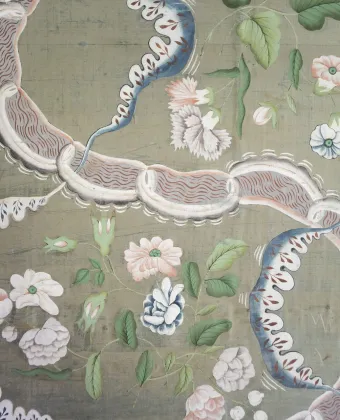
Historic Museum and Park of Miramare Castle, Chinese Room
Castello di Miramare, Salottino cinese
Period of creation:
Not known, probably third quarter of the 19th century
Materials and technique:
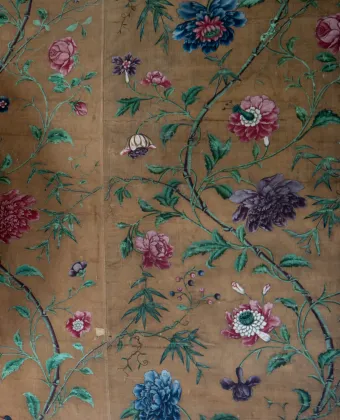
Silk, 8-sided satin, decorated with a design created by weaving in green, white, light blue, red, yellow and pink silk threads
Pattern unit:
Height: 40cm; Width: 30cm
Manufacturing location:
Unknown

© Matteo Weber
Passionate about non-European cultures and intercontinental travel, Archduke Maximilian acquired numerous vases, cabinets and sculptures of Oriental origin or style. The oriental rooms of Historic Museum and Park of Miramare Castle, located inside the tower, were designed to house this collection on the floor and on shelves along the walls. It is likely that the so-called Chinese Room, adjacent to the dining rooms, was occasionally used as a smoking room.
The curtains and tapestries in this room are among the oldest preserved in the museum's collection. The curtains are made from a fabric with a Chinese-style pavilion pattern, i.e. an 8-sided satin, woven in black silk and decorated with a design created by weaving in multicoloured silk threads in various colours such as green, white, light blue, red, yellow and pink. The curtains are lined on the inside with yellow canvas. Their edges are made of interwoven yellow and purple thin cords.
According to Maximilian's wishes, mirrors were to be placed along the walls; the decision to replace them with oriental-style tapestries was made after his death. Curtains and upholstery with a Chinese-style pavilion motif on a black satin background contribute to the oriental atmosphere of the room and characterise it as a treasure chest. The motif depicts a pavilion with a figure descending a staircase.
Person associated:
Ferdinand Maximilian of Habsburg, Archduke of Austria and later Emperor of Mexico (1832-1867)
Bibliographic source:
Contessa, Andreina (a cura di), Miramare. Il castello e il suo giardino. Guida artistico-botanica del museo storico, Cinisello Balsamo, Silvana Editoriale 2023
private textile

© Matteo Weber
Name of the residence and name of the room:
Historic Museum and Park of Miramare Castle, Carlotta’s Room
Castello di Miramare, Camera da letto di Carlotta
Period of creation:
1859-1863
Materials and technique:
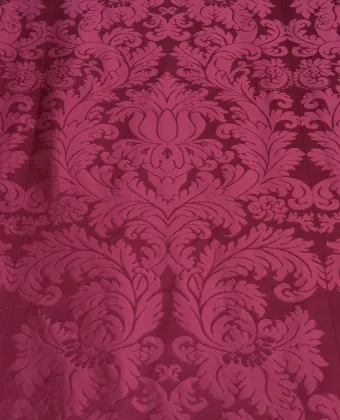
Silk, damask
Pattern unit:
Height: 180cm; Width: 120cm
Manufacturing location:
Italy, Milan

© Irene Thè
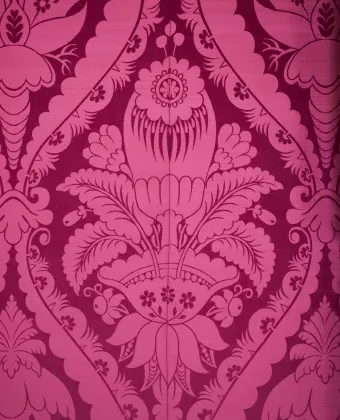
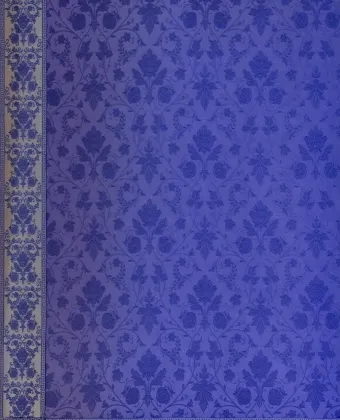
Archduchess Charlotte's bedroom contains some of the few fragments of fabric that are probably original. According to Archduke Maximilian's instructions, the curtains, upholstery and trimmings were to be made of blue silk, to reflect the colour of the sea.
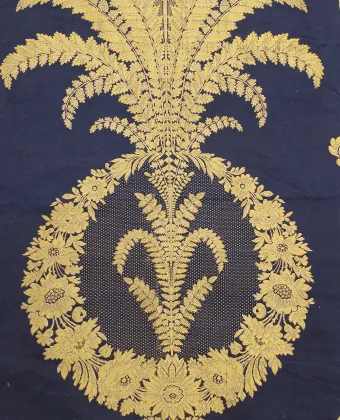
The curtains motif alternates between two personal emblems of the Archduke: the pineapple, symbolising fertility and the charm of the American continent, and the anchor with a crown, representing his role as commander of the Austrian navy. The same emblems are found in the wooden decorative bands that run along the entire height of the walls. The fabric is a raw blue silk made using the damask technique. The decorative motif consists of heart-shaped meshes formed by thin branches of laurel, oak and acanthus leaves arranged vertically. The scrolls envelop the pineapple in the centre. The design is blue on a blue background, with a contrasting glossy and matt finish.
A private space par excellence, this bedroom was nevertheless the scene of a crucial event: here Maximilian received the delegation from the Mexican monarchist faction, who offered him the throne of Mexico. The Archduke hosted this delicate meeting in this room because the reception rooms on the first floor of the castle had not yet been completed.
Person associated:
Charlotte of Belgium, Archduchess of Austria, and later Emperess of Mexico (1840-1927)
Bibliographic source:
Contessa, Andreina (a cura di), Miramare. Il castello e il suo giardino. Guida artistico-botanica del museo storico, Cinisello Balsamo, Silvana Editoriale 2023
AUTHOR
Alice Cavinato
Royal Silks in Europe