


public textile

© Paleis Het Loo
Name of the residence and name of the room:
Paleis Het Loo, State Bedchamber of Queen Mary II
Paleis Het Loo, Staatsie slaapkamer van koningin Mary II
Period of creation:
1697-1698
Date of the reweaving:
1997-1998
Materials and technique:
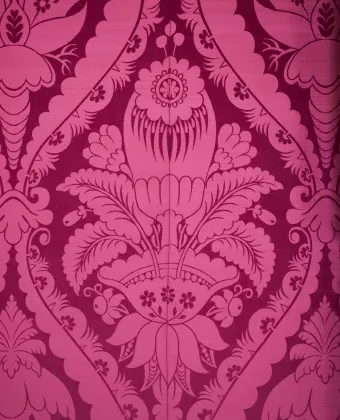
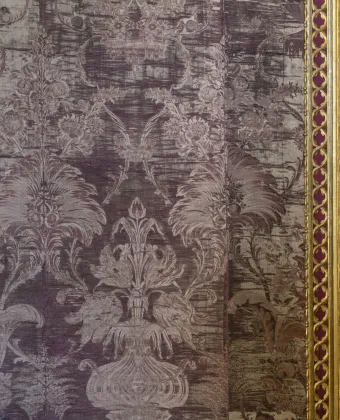
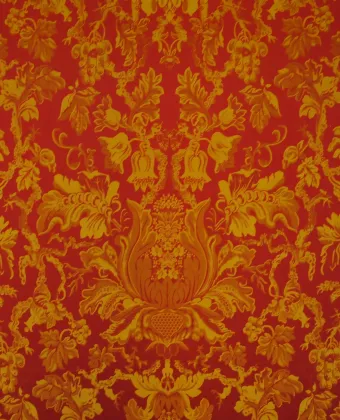
Woven silk crimson damask, weighted with an extract of gall apples, painted with cochenille
Pattern unit:
Height: 92cm; Width: 55cm
Manufacturing location:
Italy, probably woven in Genoa, (for the original textile)
Applied in England in unknown workshop (for the original textile)
France, Tours, Jean Rose (for the rewoven textile)

© Paleis Het Loo
The crimson silk damask was used on the entire state bed. The silk is glued to the carved and profiled parts of the bed and is designed as draperies and curtains. During the last restoration, parts that were found to be in poor condition or had disappeared were replaced with newly woven silk damask, which was also used for the hangings and upholstery.
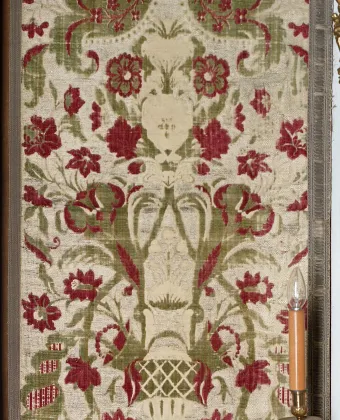
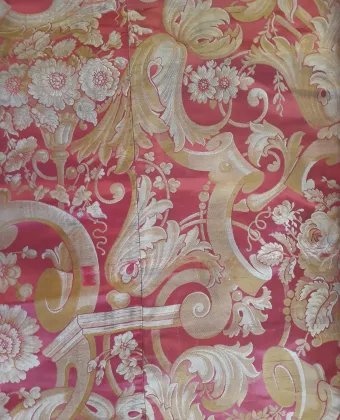
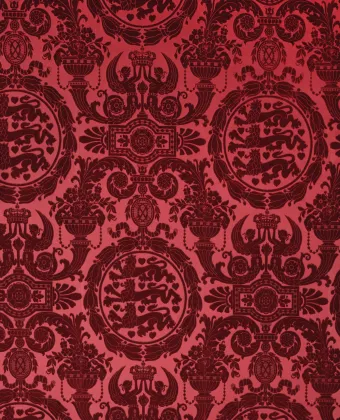
The silk has a woven, symmetric and repeating pattern of fantastically stylized tulips on a coronet of three-lobed leaves and on a fond of three-lobed leaves with pronounced leaves, the entire decoration being surrounded by acanthus leaves. The original silk is very similar to that in the damask that was used in 1699 in the Presence Chamber of Willem’s own Hampton Court Palace close to London.
The state bed could be purchased by Paleis Het Loo in 1995. After the elevation of the Prince and Princess of Orange, William III, stadtholder of the Dutch Republic, and his wife Mary Stuart, to King and Queen of England and Ireland, their favourite palace in the Republic underwent a large-scale expansion and embellishment. A state bed of red damask with bands of green silk was installed in Mary's new apartment as queen around 1693-1695. This bed was not preserved.
In 1977-1984 the apartments of William III and Mary II at Paleis Het Loo have been largely reconstructed and furnished with items that correspond to the records in the estate inventory from their time. In 1995, Paleis Het Loo managed to acquire a crimson state that had come from Hampton Court near Leominster in Herefordshire, United Kingdom. Its resident, Thomas Coningsby, had commissioned the bed between 1697 and1698 in order to furnish the King’s Chamber.
The suspicion that Mary's new state bed as a queen was made in England, like Coningsby's bed, seems to be confirmed by Sir Constantine Huygens the Younger, first secretary to King William III, who stayed at Paleis Het Loo in 1693. The interiors of the new royal apartment of Mary proved to be still unfinished. In his journal he wrote: “We went to the new quarter of the queen. There were 5 to 6 damask beds that had arrived from England”.
Persons associated:
Thomas Coningsby, 1st Baron Coningsby of Clanbrassil (1656-1729), first acquirer (for the original textile)
Jean Rose, manufacturer (for the rewoven textile)
Bibliographic source:
Rem, Paul, “Restoration of the State Bed acquired by Paleis Het Loo and intended for the Bedchamber of King Stadholder William III”, Textile History, 31 (2000) 2, p.150-162
author
Dr Paul Rem
Royal Silks in Europe