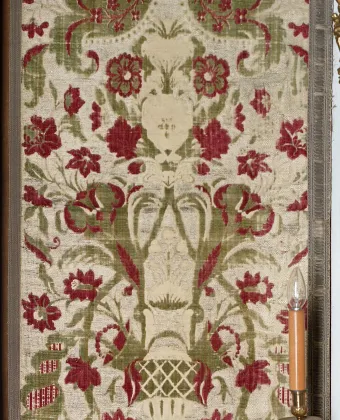



public textile

© Fondazione Real Sito di Carditello
Name of the residence and name of the room:
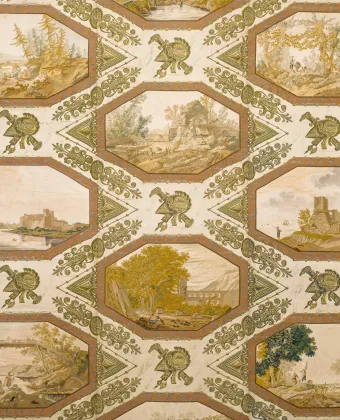
Royal Site of Carditello, Royal Apartment, Gallery
Reggia di Carditello, appartamento reale, galleria
Period of creation:
1791
Materials and technique:
Tapestry in silk, wool, metallic gold thread
Manufacturing location:
Italy, Naples, Royal Tapestry Factory

© Fondazione Real Sito di Carditello
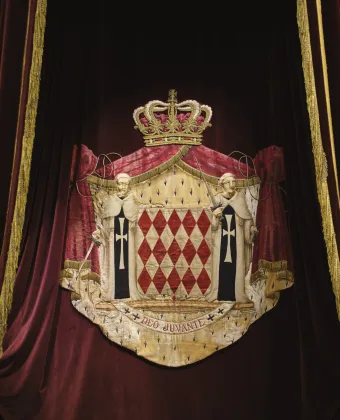
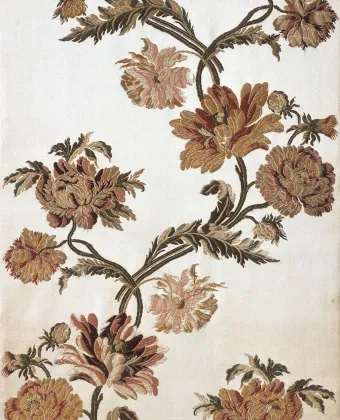
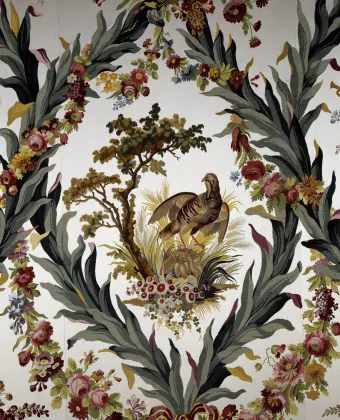
The tapestry series entitled 'Stories of Henry IV' includes a cycle of six pieces celebrating the deeds of the French king, common ancestor of all the Bourbons of Europe, together with seven monochrome overdoors with mythological scenes. They decorated the Gallery, the great ballroom of the Royal Apartment in the Real Casino of Carditello, and today are partly preserved at the Capodimonte Museum in Naples, and partly exhibited at the Royal Palace of Naples. The work exhibited at the Royal Palace of Naples is in the process of being returned to its original location. The work was reproduced on canvas using sophisticated techniques as part of the "Quadreria Digitale: dal Fisico al Digitale, dal Digitale al Fisico" project. This initiative also created striking dynamic digital projections that now move visitors by reconstructing, in real-time before their very eyes, the missing parts of the frescoes that have not yet been physically restored.
The set was woven around 1791 and was already present in Carditello by 1792, as confirmed by the first inventory preserved in the Archives of the Royal Palace of Caserta. Thanks to the “Quadreria Digitale” project, they can now once again be admired in their original setting.
These are tapestries, woven with the traditional technique: interlacing warp (vertical) and weft (horizontal), worked on the reverse side of the loom, both on high-warp and low-warp looms. The warp was wool, linen, or silk, while the weft was mainly wool, with variants in silk and, more rarely, metallic gold thread. The variety of yarns gave the compositions their rich material and visual qualities.
The production was entrusted to the Royal Neapolitan Tapestry Factory, founded by Charles of Bourbon in 1737 and continued under Ferdinand IV, in keeping with the tradition of adorning royal residences with tapestry cycles. The cycle was produced under the direction of Pietro Duranti, last master of the factory, based on a painted model by Fedele Fischetti. Duranti, formerly a tapestry maker for Cardinal Albani and creator of a salon in the villa on Via Salaria in Rome, was called upon by Luigi Vanvitelli to direct the Neapolitan Tapestry Factory. The Carditello Gallery represents his final work. This Bourbon commission gives the series exceptional artistic and historical value, marking the conclusion of Duranti’s production and one of the most significant episodes of textile decoration in Naples in the late 18th century.
Persons associated:
Ferdinand IV of Bourbon, King of Naples (1751-1825);
Fedele Fischetti, designer of the model (1732-1792);
Pietro Duranti, silk manufacturer and director of the Royal Neapolitan Tapestry Factory (1710-ca. 1791)
Bibliographic sources:
Possenti, E., “L’Arazzeria napoletana”, Bollettino d’arte del MPI, 1936
Spinosa, N., “L’Arazzeria napoletana”, Napoli 1791, v. 11 pp. 96-106
Pradel, C. M., “La tecnica e il linguaggio degli arazzi”, in Arazzi dei Farnese e dei Borbone. Le collezioni dei secoli XVI-XVIII, Milan 1998, p. 15
private textile

© Fondazione Real Sito di Carditello
Name of the residence and name of the room:
Royal Site of Carditello, Royal Apartment, Boudoir
Reggia di Carditello, appartamento reale, boudoir
Period of creation:
1960s-70s
Materials and technique:
Classic damask, presumably with silk warp and cotton weft
Pattern unit:
Height: 40cm; Width: 50cm
Manufacturing location:
Italy, Caserta, San Leucio Silk Factories

© Fondazione Real Sito di Carditello
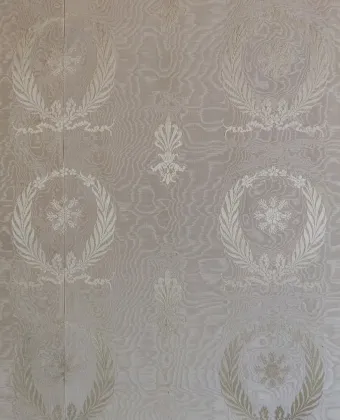
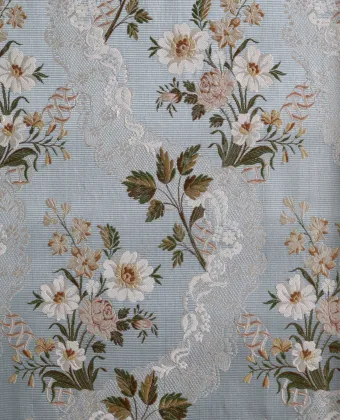
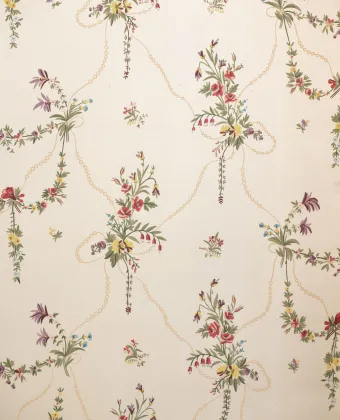
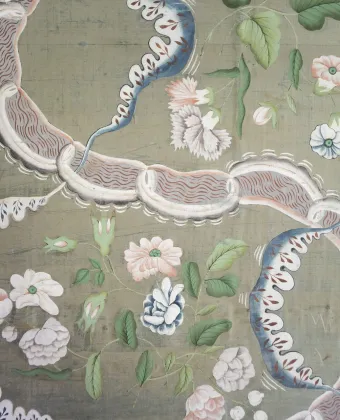
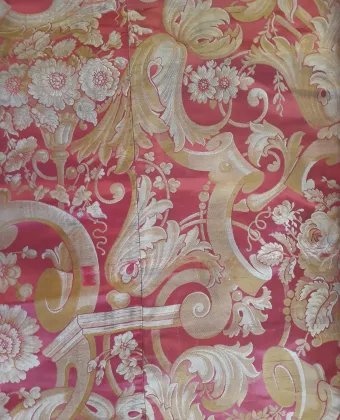
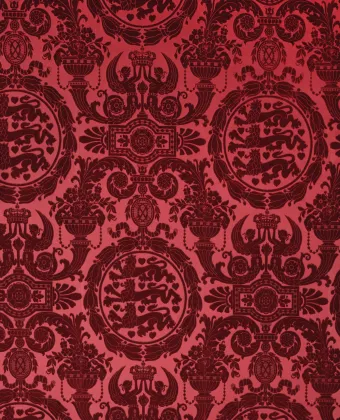
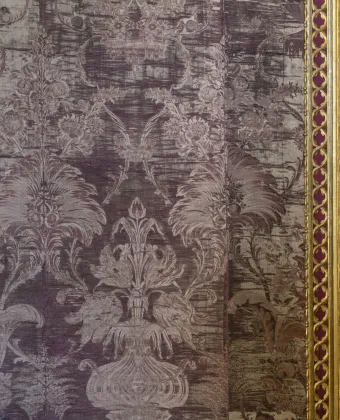
The Royal Palace of Carditello features a coherent decorative scheme centered on pastoral and hunting motifs found in its tapestries, hangings, and wall coverings. The original condition of the palace is only documented by historical inventories, beginning with its inauguration in 1792. These inventories provide information about the colour palettes used in each room. Currently, there are no known graphic or photographic documents that would allow for a philological and historically accurate reconstruction. Documents describe the refined textiles—embroidered with polychrome silk threads, woven as tapestries, or painted—that decorated the interiors of the Royal Apartment, consistent with the neoclassical style of the late 18th century. The curtains and wall hangings of some private rooms, like the Boudoir, were reconstructed in later periods with unique characteristics.
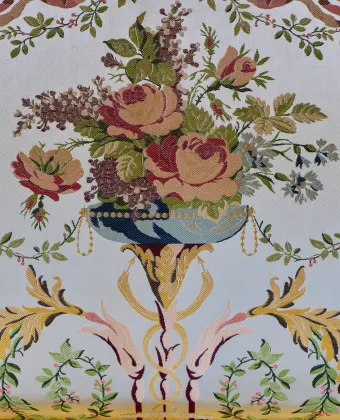
In this specific subsequent reconstruction, the dominant colour of the silk background was a delicate grey-blue, also known as powder blue. The ornamental design was a floral and vegetal motif, arranged vertically with clear symmetry and a rhythmic flow that created a damask or brocade effect through the interplay of glossy and matte weaving. The details include stylized flowers alternating with acanthus leaves, volutes, and garlands. Recurring urns or baskets hold floral arrangements enriched by chains or strings of beads that form festoons. This continuously repeating pattern reflects the decorative elegance of the mid-20th-century San Leucio manufacturing, which was inspired by 18th-century designs. The textile was produced in the 1960s-70s, a period when San Leucio's jacquard production revived traditional floral and vase motifs.
The Boudoir, originally envisioned as a private English-style room next to the bedroom, was designed by architect Francesco Collecini, a student and collaborator of Luigi Vanvitelli. Waiting for the luxurious documented furnishings and textiles to be restored, the original 18th-century model-project of the entire monumental complex is currently housed in this very small but important room.
Person associated:
- San Leucio Silk network manufacturers
Bibliographic source:
Aa.Vv. “Carditello Ritrovato” - Siti Reali e territorio. Storia restauro valorizzazione nn. 2-3, special issue, July 2014, Artemide Editoriale – Rome
author
Michele Amordeluso
Discover the Carditello Palace
Royal Silks in Europe