


public textile

© Ints Lūsis, 2019
Name of the residence and name of the room:
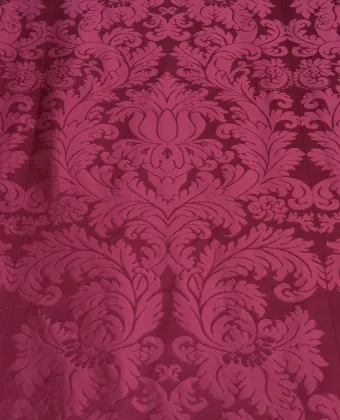
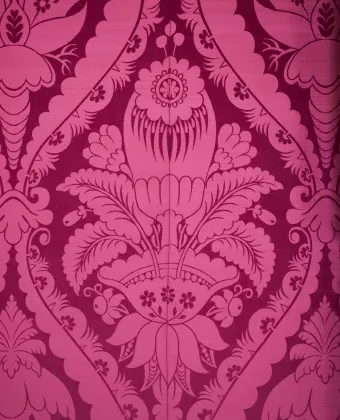
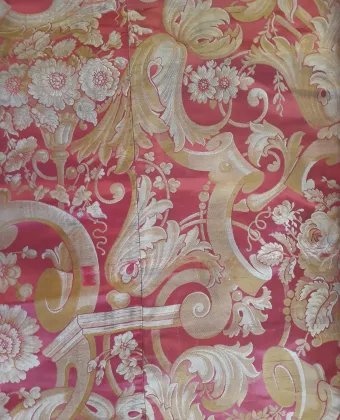
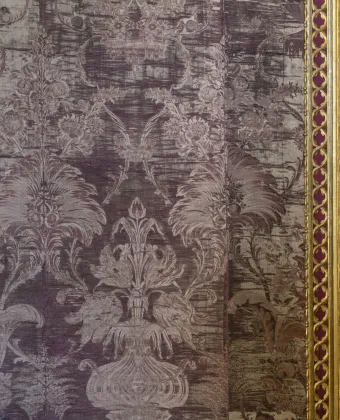
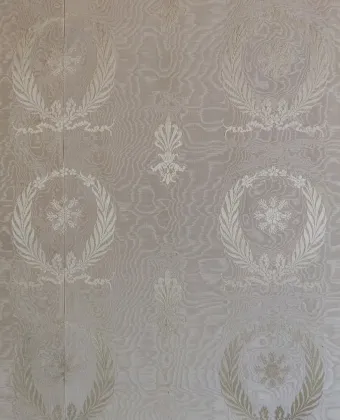
Rundāle Palace, Duke’ Reception Room
Rundāles pils muzejs, Hercoga Audienču kabinets
Period of creation:
ca. 1765
Date of the reweaving:
Installed in 1999, manufactured in 1982–1985
Materials and technique:
Silk damask, density: 160 threads per cm
Pattern unit:
Height: 54.7cm; Width: 56cm
Manufacturing location:
Prototype from the Tressenzimmer, Neues Palais, in Potsdam; Berlin silk manufacture.
Produced at the Specialised Design Workshops for Scientific Restoration of Ancient Fabrics of the All-Union Scientific Restoration Factory Soyuzrestavratsiya in Moscow.

© Ints Lūsis, 2025
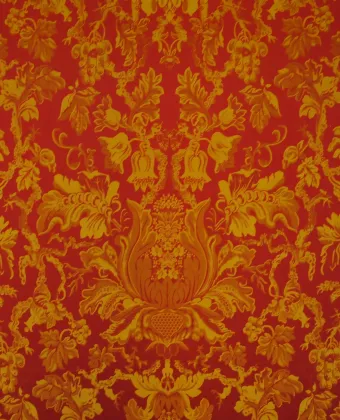
The Reception Room is located in the middle of the southern enfilade of the central wing of Rundāle Palace, next to the Duke's bedroom. The chamber is furnished in accordance with the reign of Duke Peter of Courland and Semigallia (last third of the 18th century).
The 1800 palace inventory mentions that the room had red damask wall hanging. It is known that after the devastation of Napoleon's wars in 1812, the wall hanging was torn down and the walls were plastered. The next inventory, made in the middle of the 19th century, states that the walls were covered with green wallpaper, while a 1932 report on the condition of the palace notes that the walls in this room were unplastered and painted with distemper.
In the 1980s, when extensive restoration of the palace began, it was decided to restore the room to its late 18th-century appearance, including reconstructing the damask wall hanging. During World War II, Latvia was occupied by the Soviet Union, isolating the country from Western Europe, so the only place where silk wall hanging of the required quality could be produced was in specialised scientific restoration workshops for ancient fabrics in Moscow. In 1981, red damask was ordered there. At that time, the palace management established contacts with the Palace Administration of the German Democratic Republic, so it was possible to use the wall hanging pattern used in the decoration of the Braided Room of the New Palace in Potsdam as a model, which the administration sent to Rundāle in photographs. The choice of the Prussian pattern was based on entries in Count Ernst Ahasverus von Lendorff's diary from 1780, which mention that the wall hanging in Rundāle Palace was made in Berlin. The choice of the colour was confirmed by the pinkish colouring found in the room's back wall area. Flannel underlay or “molleton” was placed under the silk wall hanging.
Bibliographic sources:
Latvian State Historical Archive
Lehndorf, E. A. von. Tagebücher aus meiner Kammerherrenzeit. Gotha, 1921
Lancmanis, I. Rundāles pils, vol. III Restaurācija. Rundāle, 2021
private textile

© Ints Lūsis, 2021
Name of the residence and name of the room:
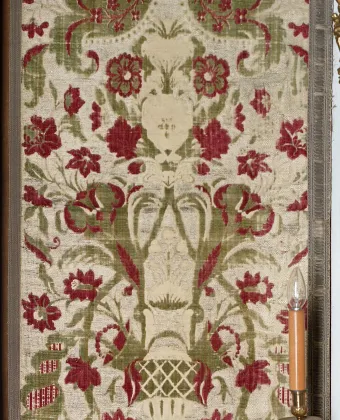
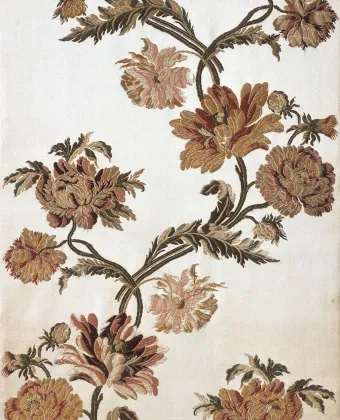
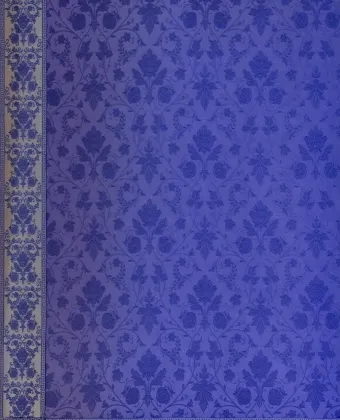
Rundāle Palace, Duchess’ boudoir
Rundāles pils muzejs, Hercogienes buduārs
Period of creation:
1760s
Date of the reweaving:
Installed in 1997, manufactured in 1981-1986
Materials and technique:
Brocatelle, density: 160 threads per cm
Pattern unit:
Height: 50.6cm; Width: 26.8cm
Manufacturing location:
Prototype from the State Historical Museum in Moscow (ГИМ А 448/67911).
Produced at the Specialised Design Workshops for Scientific Restoration of Ancient Fabrics of the All-Union Scientific Restoration Factory Soyuzrestavratsiya in Moscow

© Ints Lūsis, 2025
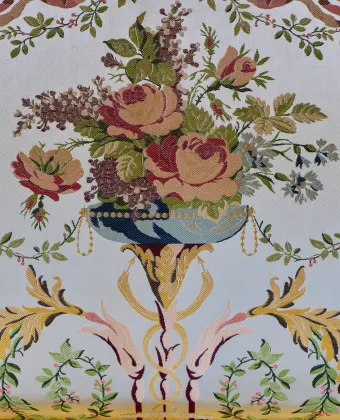
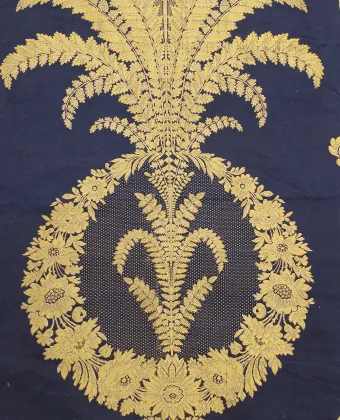
The room is located in the middle of the west wing of Rundāle Palace, in the west enfilade, which houses the apartments of the Duchess of Courland and Semigallia. The interior design is based on analogies from 18th-century European palace boudoirs depicted in paintings and engravings. Similar to the Reception Room, the fabric wall hanging in this room was removed after 1812. After the establishment of the Latvian state, landowners’ manors were expropriated pursuant to the agrarian reform. The expropriated buildings had to be given a socially useful function, so in 1922 a school was established in the west wing of the palace. At first, a laundry room was set up in the boudoir, and later a teachers' room. The walls of the room were plastered and painted, and remained so until the restoration of the palace began in the 1960s and 1970s.
As part of the restoration project, it was decided to reconstruct the interior of the Duchess' boudoir. The main information about the decoration of the boudoir walls is provided by the 1800 inventory of Rundāle Palace, which mentions that brocade silk, also known as ‘embroidered silk’, was used in two rooms on the second floor. During the restoration of the palace, which began in the 1970s, most of the 18th-century historical analogies were sought in the palaces of St. Petersburg and the museums of Moscow. This was justified by the close historical ties between the palace's builder, Duke Ernst Johann Biron of Courland and Semigallia, and Russian Empress Anna Ioannovna. A prototype from the State Historical Museum in Moscow was chosen for the wall hanging in the Duchess' boudoir. The blue brocade silk fabric was ordered from specialised scientific restoration workshops in Moscow in 1981. Flannel underlay or “molleton” was placed under the silk wall hanging.
Bibliographic sources:
Latvian State Historical Archive
Lancmanis, I. Rundāles pils, vol. III Restaurācija. Rundāle, 2021.
author
Dzintra Spradzenko
Royal Silks in Europe