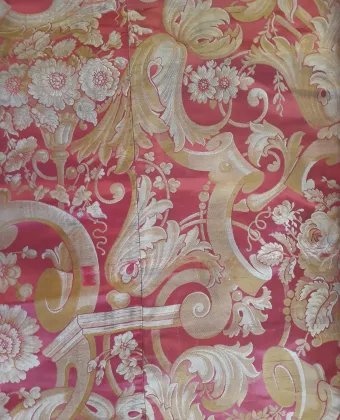



public textile

© Iben Kaufmann, Agency for Culture and Palaces
Name of the residence and name of the room:
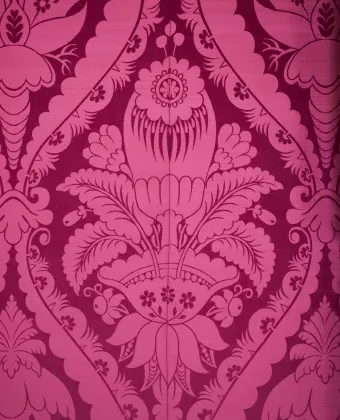
Christiansborg Palace, The Velvet Room
Christiansborg Slot, fløjlsstuen
Period of creation:
ca. 1928
Date of the reweaving:
2014
Materials and technique:
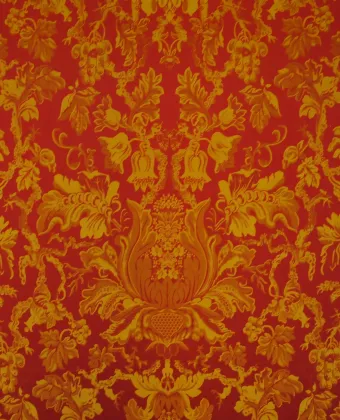
Silk velvet
Pattern unit:
Height: 147cm; Width: 63cm
Manufacturing location:
India, Bangalore, Delphi Overseas

© Iben Kaufmann, Agency for Culture and Palaces
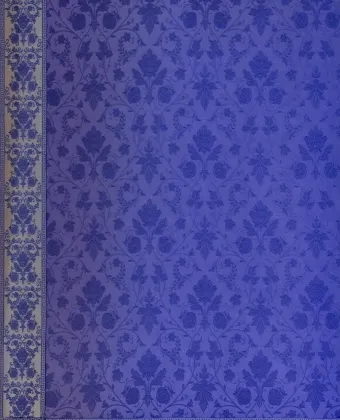
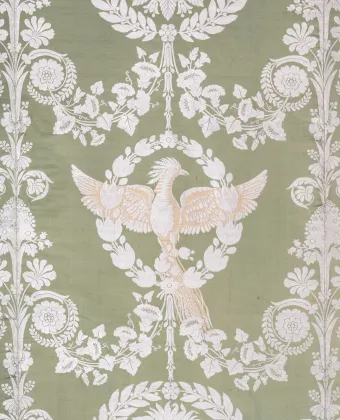
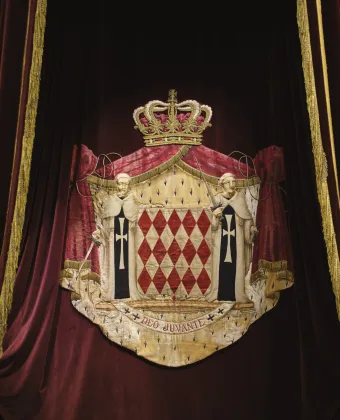
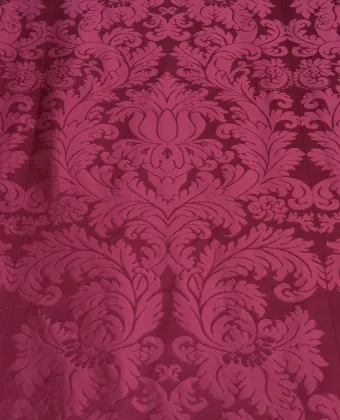
The Velvet Hall is one of the most distinguished royal reception rooms at Christiansborg Palace. Its name derives from the 300 meters of velvet wall hanging, which was designed by the palace’s architect Thorvald Jørgensen and handwoven in Lyon around a century ago. The hall was completed in 1924 as part of the reconstruction of Christiansborg Palace following the devastating fire of 1884.
Inspired by the splendour of Louis XIV’s bedchamber at Versailles, Jørgensen created a ceremonial space adjoining the Great Hall. Conceived between 1924 and 1933 as a throne hall to King Christian X, it now serves as the setting where the Royal Family receive their guests during banquets in the Great Hall.
The velvet has a crimson colour and a grandiose design with the royal crown and national coat of arms - three lions and nine hearts. The monogram of Christian X is incorporated within the design. Originally the velvet is of silk with the design created by alternating areas of cut and uncut velvet against a contrasting satin ground.
In the new millennium, the velvet was in a severe degraded state, and the wall hangings needed replacement. It turned out to be quite challenging to find a manufacturer able to deliver 300 meters of a patterned silk velvet in a quality matching the original, and that was within the projects’ budget. After thorough research, the task was given to an Indian weaving workshop, that was able to copy the pattern and quality in a satisfactory manner on a machine loom. The room was restored, and the new velvet mounted on the walls in the spring of 2015.
Persons associated:
Christian X, King of Denmark (1870-1947)
Thorvald Jørgensen (1867-1946)
Vasantha Nagesh, Proprietor of the Delphi Overseas
Bibliographic source:
Christiansborg Slot, II, Folketingets Præsidium, 1975
private textile

© Iben Kaufmann, KOSA
Name of the residence and name of the room:
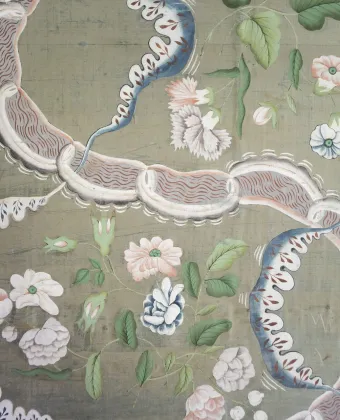
Rosenborg Castle, Christian IV’s Writing Room
Rosenborg Slot, Christian IV's arbejdsværelse
Period of creation:
1714, according to a receipt dated 31st March 1714 from Anna Christina, a widow of the Master Upholsterer Schalck
Materials and technique:
Silk rep (warp: 100 tr/cm) with linen warp (14 tr/cm), moiré treated, block print and possibly supplemented with painted details
Pattern unit:
Height: 55.5cm; Width: 46cm
Manufacturing location:
Due to its narrow width, it is believed to originate from Europe, possibly Italy or France. King Frederik IV undertook two extended journeys to Italy and France, during the period 1692–93 and 1708–09 respectively, and it is likely that he brought it home from one of these trips

© Iben Kaufmann, KOSA
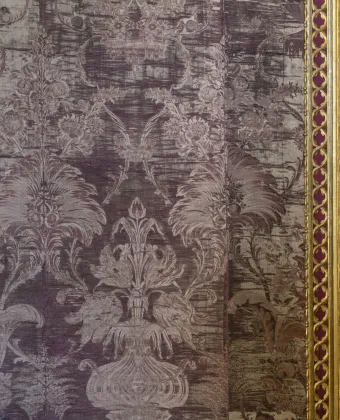
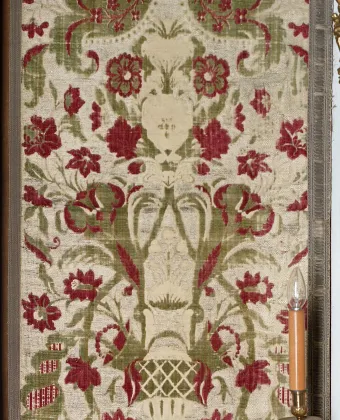
This silk wall hanging, dated 1714, is mounted in Christian IV’s Writing Room at Rosenborg Castle. It was commissioned by Frederik IV and installed as part of a modernization of the castle’s interior. The fabric is a silk moiré by an unknown manufacturer with a printed and painted “bizarre” design. Bizarre silk designs represented the height of fashion around the year 1700. They are inspired by oriental motifs and characterized by asymmetrical, diagonally oriented patterns, geometric forms, and stylized flowers and leaves.
The green ribbed fabric is woven with a dominant silk warp and a linen weft, and the design is printed and painted in gold, silver, white, and purple. The fabric measures 46 cm in width, and the lengths were originally hand-stitched together. A total of 55,5 meters of silk fabric was used for the walls, and an additional 7 meters of the same fabric was used to upholster four high-backed chairs, edged with tongue-shaped gold fringes. Unfortunately, the chairs have not been preserved.
The wall hanging is now in a degraded condition, with fibre loss and fading. It has undergone several restorations over the years, and individual strips and pieces have been rearranged to disguise fading, insect damage, and general deterioration. Over time, various adhesives and different support fabrics have been applied, and only a few areas remain untouched. Small sections still preserve the original green colour, as well as the original colours of the printed and painted pattern.
Person associated:
Frederik IV, King of Denmark (1671-1730)
Bibliographic sources:
Ackermann, Hans Christoph, Seidengewebe des 18. Jahrhunderts 1 - Bizarre Seiden, Riggisberg, 2000
Boesen, Gudmund, Kgl. Slotsinteriører omkring 1700. Særtryk til Knud Fabricius, Copenhagen, 1945
Slomann, Vilhelm, Bizarre Designs in Silks, Copenhagen, 1953
Thornton, Peter, Baroque and rococo silks, London, 1965
author
Kent Alstrup
Discover the Agency for Culture and Palaces
Discover the Royal Danish Collection
Royal Silks in Europe