


public textile

© Château de Versailles, Dist. RMN, C. Fouin
Name of the residence and name of the room:
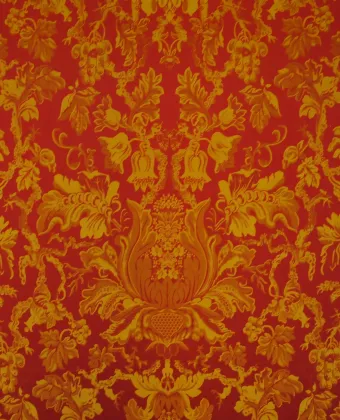
Palace of Versailles, King Louis XIV’s Bedchamber
Château de Versailles, chambre du Roi Louis XIV
Period of creation:
1731-1733
Date of the reweaving:
1957-1979
Materials and technique:
Silk, gold thread, gold frisé, silver frisé, gold lamé frisé;
Lampas with two supplementary wefts, brocaded, 8-shaft satin ground
Pattern unit:
Height: 358cm; Width: 115cm
Manufacturing location:
France, Lyon, Bron (for the original textile);
France, Lyon, Prelle and Tassinari & Chatel (for the rewoven fabric)

© Château de Versailles, Dist. RMN, C. Fouin
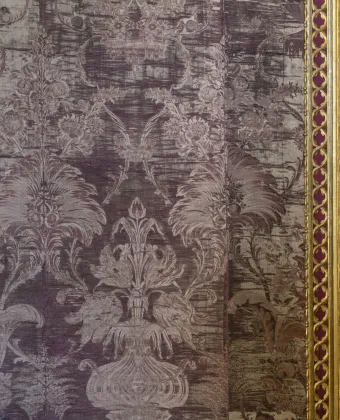
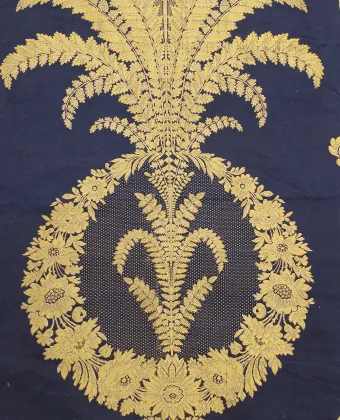
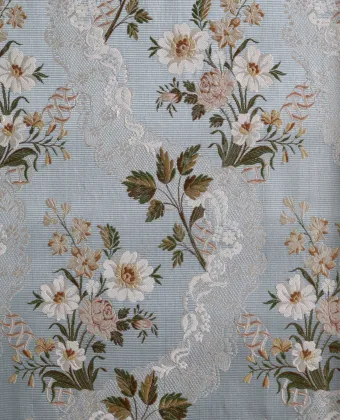
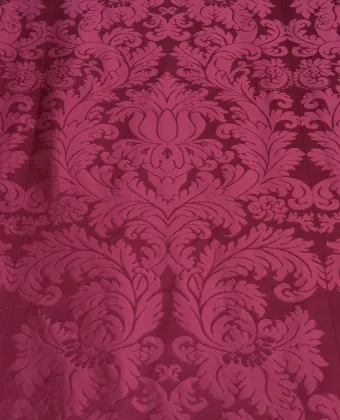
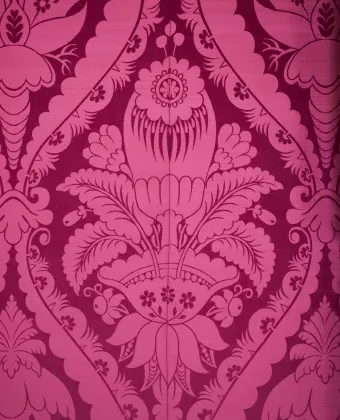
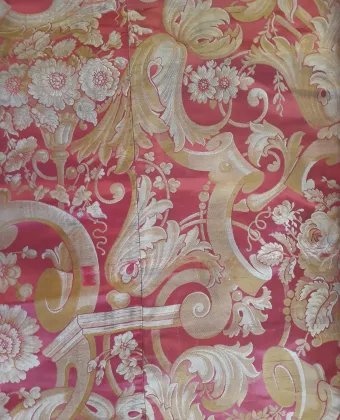
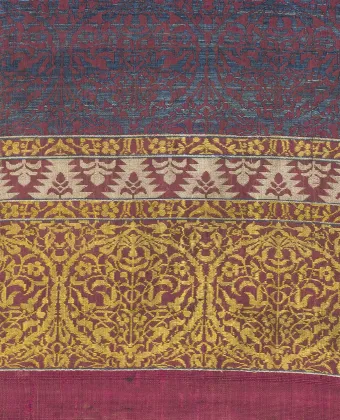
The King’s Bedchamber is one of the most important spaces within the Etiquette — the complex set of rules governing the life of the French royal family under the Ancien Régime. Unfortunately, the design of the crimson and gold brocades that decorated the room during Louis XIV’s reign, created from 1701 onwards, is not known. For this reason, when the room was restored starting in the 1950s, the curators chose as their weaving model a magnificent brocade commissioned in the 1730s from the Bron workshop, fragments of which are preserved by the Mobilier national. Set between gold-woven columns, large vegetal motifs composed of stylized acanthus leaves unfold against a crimson satin background. The design of the patterns is enhanced by the interplay of spun and frisé gold threads interwoven with silver threads. Highly prized in the 17th century, these large vegetal patterns invading the decoration were a reference to Italian textiles, particularly the velvets of Genoa and Lucca, which then dominated European production. However, the Kings of France sought to rival Italian production by encouraging fabric manufacture in France, notably in Tours and Lyon. Louis XIV and Louis XV, who placed sumptuous orders for the Crown’s palaces, promoted the emergence of a French production that would flourish from the 18th century onward.
Persons associated:
Louis XIV, King of France (1638-1715)
Pierre Ringuet, designer
Bron, silk manufacturer
Bibliographic sources:
Gastinel-Coural, Chantal, Soieries de Lyon, commandes royales au XVIIIe s., (1730-1800), catalogue d’exposition, Lyon, musée historique des tissus, décembre 1988 – mars 1989, imprimerie Sézanne, Lyon, p. 112
Gastinel-Coural, Chantal, « Quelques remarques sur le décor textile du Versailles de Louis XIV », in Furnishing textiles, Studies on Seventeenth- and Eighteenth-Century Interior Decoration, Abegg-Stiftung, 2009, p. 9-20
private textile

© Château de Versailles, Dist. RMN, C. Fouin
Name of the residence and name of the room:
Palace of Versailles, Queen’s Private Apartments, Billiard Room
Château de Versailles, petits appartements de la Reine, cabinet du Billard
Period of creation:
1984-1993
Materials and technique:
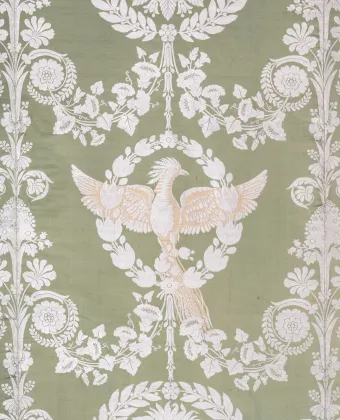
Silk, brocaded lampas, 8-shaft satin ground, medallion applied with silk embroidery
Pattern unit:
Height: 112cm; Width: 54cm
Manufacturing location:
France, Lyon, Jean Charton (for the original textile);
France, Lyon, Tassinari & Chatel (for the rewoven fabric)

© Château de Versailles, Dist. RMN, C. Fouin
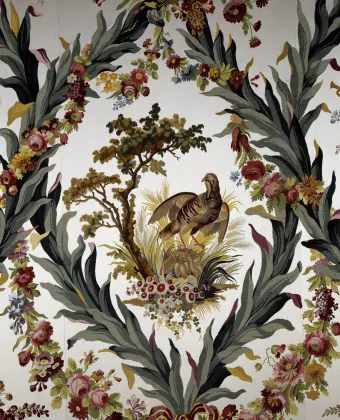
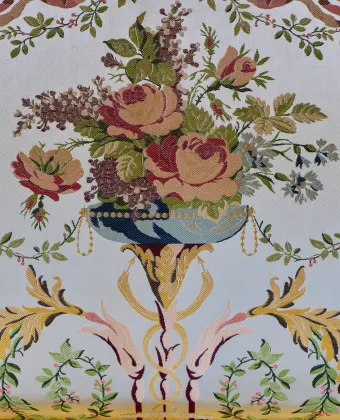
This silk fabric is among the richest and most intricate ever produced for the furnishings of the Château de Versailles. The panel shown here is one of the rare surviving original textiles, dating from before the French Revolution. This exceptional piece served as a model for the reweaving of the fabric, a project sponsored by Lady Michelham of Hellingly. Queen Marie Antoinette had a deep passion for interior decoration. In her private rooms at Versailles, she had the furnishings renewed nearly every three years to remain at the forefront of fashion and to enjoy ever more luxurious surroundings. For the Queen’s grand Inner Cabinet, the upholsterer Capin delivered in 1779 this sumptuous furnishing ensemble in white satin brocade, adorned with medallions enhanced with embroidery stitches. The arabesque design features delicate acanthus scrolls and floral branches, enriched with garlands of roses and lilacs. This silk was designed by Jacques Gondoin, architect and designer for the Crown’s Garde-Meuble, who created this pattern of “scrollwork ornaments in arabesque,” in the finest Louis XVI style. The beauty of this silk lies not only in the great variety of tones (32 woven colours), but also in the contrast of materials between the chenille-brocaded threads and the refined embroidery stitches. However, in 1783, Marie-Antoinette decided to redecorate her grand cabinet, and this magnificent fabric was later reused, beginning in 1787, in a second-floor room known as the “billiard cabinet.”
Persons associated:
Marie Antoinette, Queen of France (1755-1793)
Jacques Gondoin, designer (1737-1818)
Jean Charton, silk manufacturer
Bibliographic sources:
Gastinel-Coural, Chantal, Soieries de Lyon, commandes royales au XVIIIe siècle (1730-1800), catalogue d’exposition, Lyon, musée historique des tissus, décembre 1988 – mars 1989, imprimerie Sézanne, Lyon, p. 116-117
Hans, Pierre-Xavier, Marie-Antoinette, le goût d’une Reine, catalogue d’exposition, Bordeaux, musée des Arts décoratifs, 2005, imprimerie Re.Bus, Italie, p. 124-125
author
Noémie Wansart
Discover the Palace of Versailles
Royal Silks in Europe