


public textile

© SPSG, W. Pfauder
Name of the residence and name of the room:
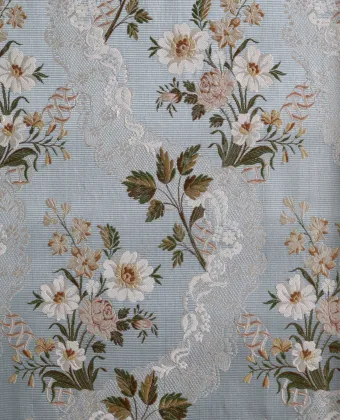
New Palace, large bedroom of the Lower Royal Suite
Neues Palais, großes Schlafzimmer des Unteren Fürstenquartiers
Period of creation:
ca. 1765
Date of the reweaving:
Probably 1897/1898 and 1965/1966
Materials and technique:
Silk, brocaded 8-shaft satin ground
Pattern unit:
Height: 70cm; Width: 53cm
Manufacturing location:
Kingdom of Prussia, Berlin, Girard and Michelet or Baudouin brothers and sons/Frères Baudouin Fils (for the original textile)
France, Lyon, Tassinari & Chatel (for the rewoven fabric)

© SPSG, C. Zitzmann
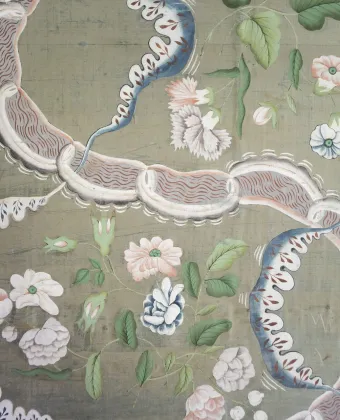
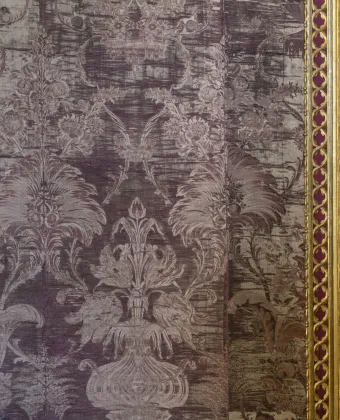
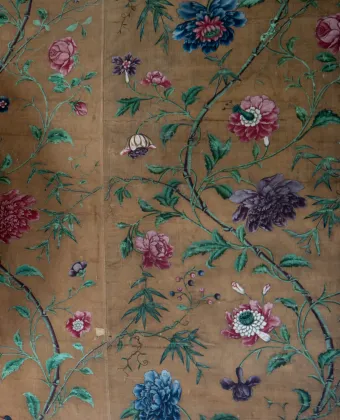
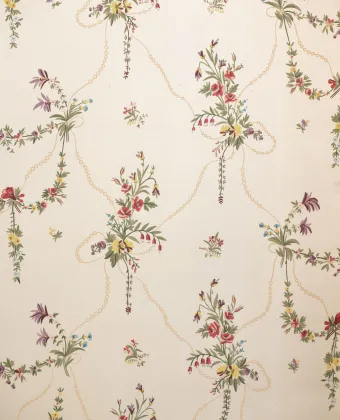
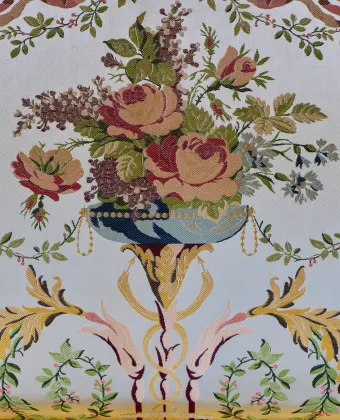
The fabric was created in Berlin around 1765, though it was largely inspired by French models. Its floral tendril motif recalls the wave-like patterns fashionable in France at the time. Unlike the French designs, however, it is not combined with lace bands, bouquets of flowers, or figurative elements. The sweeping floral tendril set against a smooth satin ground creates a striking illusionistic effect. This sets the pattern apart from conventional dress fabrics and makes it particularly well suited for furnishing purposes.
The two flowers depicted, chrysanthemums and peonies, originate from China and were still little known in European gardens at the time. They were familiar mainly through Chinese porcelain painting. These unusual blossoms distinguish the fabric from contemporary floral patterns and lend it a character worthy of princely interiors.
Frederick the Great commissioned the fabric for two bedrooms in the representative suites of the New Palace in Sanssouci Park. There, the floral pattern dominates the entire impression of the rooms. Chrysanthemum and peony tendrils also appear in the decoration of the ceilings, floors, and furniture. It is therefore likely that the designer of the interior decoration also created the silk pattern—something highly unusual in Europe at the time.
Person associated:
Frederick the Great, King of Prussia (1712-1786)
Bibliographic source:
- Evers, Susanne et al., Seiden in den preußischen Schlössern. Ausstattungstextilien und Posamente unter Friedrich II. (1740-1786), hrsg. von der Stiftung Preußische Schlösser und Gärten Berlin-Brandenburg, Berlin, 2014 (Bestandskataloge der Kunstsammlungen), p. 351-367
private textile

© SPSG, R. Handrick
Name of the residence and name of the room:
New Palace, Chamber in front of the library of the kings’ apartment
Neues Palais, Lesekabinett Friedrichs des Großen in der Königswohnung
Period of creation:
ca. 1765
Materials and technique:
Silk, silver lamella and silver fries, brocaded 8-shaft satin ground
Pattern unit:
Height: 53cm; Width: 27cm
Manufacturing location:
Kingdom of Prussia, Berlin, probably Isaak Bernhard

© SPSG, W. Pfauder
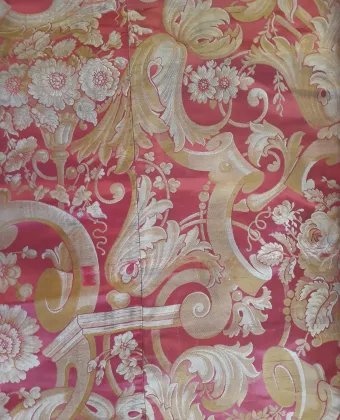
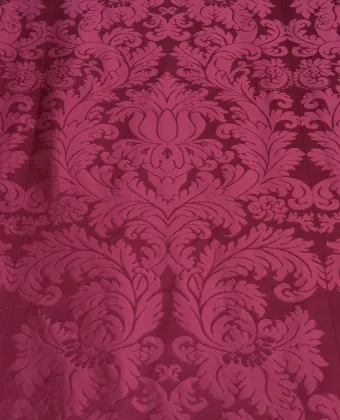
The red silk satin, brocaded with silver, is one of only two 18th century wall coverings still preserved in the New Palace at Sanssouci Park. It adorns the small chamber leading to the library in the apartment of King Frederick the Great. Pattern, material, and colour appear carefully attuned to the intimate proportions of the space.
The design belongs to a group of patterns characteristic of the 1760s: two parallel wave bands, each accompanied by a floral tendril flowing in the opposite direction. Compared with French fabrics of the period, the repeat is taller and the vertical axis more pronounced. The tendrils consist exclusively of carnations, while the brocade is limited to silver threads. The design is thus condensed and restrained in every respect. The once brilliant sheen of the silver against the smooth red ground must have created a particularly striking effect, now softened by the darkening of the metal. This intensification through reduction seems especially appropriate in such a small space, at the threshold of the king’s private library.
Person associated:
Frederick the Great, King of Prussia (1712-1786)
Bibliographic source:
Evers, Susanne et al., Seiden in den preußischen Schlössern. Ausstattungstextilien und Posamente unter Friedrich II. (1740-1786), hrsg. von der Stiftung Preußische Schlösser und Gärten Berlin-Brandenburg, Berlin 2014 (Bestandskataloge der Kunstsammlungen), p. 299-309
authors
Susanne Evers
Sabrina Müller
Discover the Prussian Palaces and Gardens of Berlin-Brandenburg
Royal Silks in Europe