


public textile

© Schloß Schönbrunn Kultur- und Betriebsges.m.b.H., SG Medienhaus
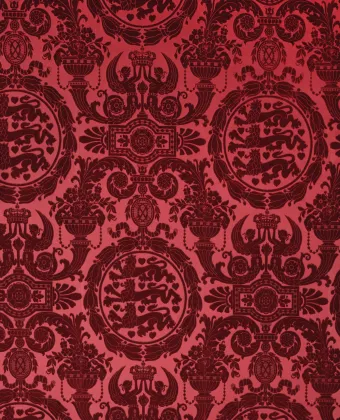
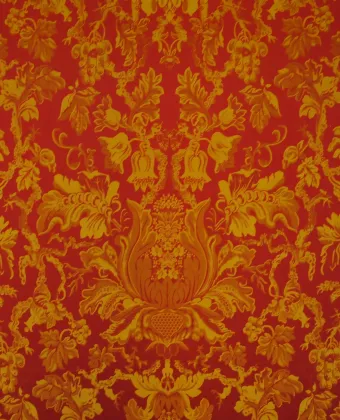
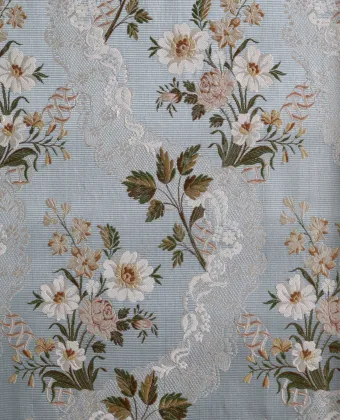
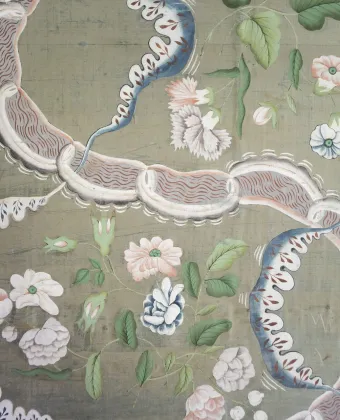
Name of the residence and name of the room:
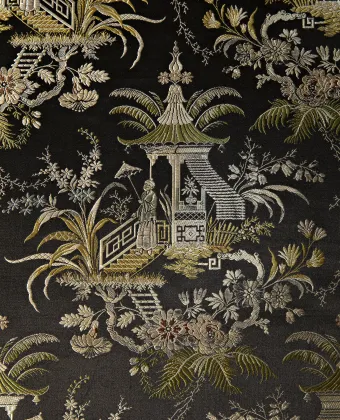
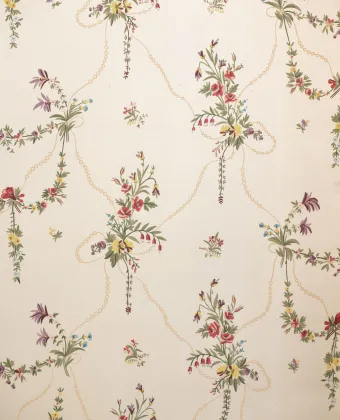
Schönbrunn Palace, Salon of Empress Elisabeth (reception room)
Schloss Schönbrunn, Salon der Kaiserin Elisabeth
Period of creation:
1872
Date of the reweaving:
2022
Materials and technique:
Silk, broché, 16 different colours
Pattern unit:
Height: ca. 140cm; Width: 53.4cm
Manufacturing location:
Austria, Vienna, Philip Haas & Söhne (for the original fabric of 1873)
France, Tassinari & Chatel (for the rewoven fabric)

© Schloß Schönbrunn Kultur- und Betriebsges.m.b.H., SG Medienhaus
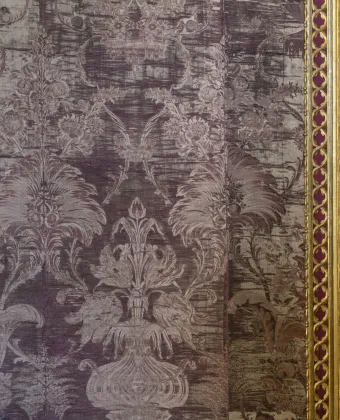
The salon of Empress Elisabeth was once the most precious and official room of her appartement in Schönbrunn Palace, the summer residence of the Habsburg court. It has been dedicated to the Empress´ official receptions. The importance of the salon becomes evident due to a still existing furnishing scheme that shows a large quantity of chairs. On the occasion of the marriage of Franz Joseph I. and Elisabeth in 1854 the interiors of the couple´s appartements in Vienna Hofburg and Schönbrunn Palace have been modified. Very exclusive and expensive silk fabrics were used as wall coverings, curtains, draperies and furniture upholstery. In the second half of 19th century, the Viennese manufactory Philip Haas & Söhne was well known for high quality silk fabrics and supplied the Habsburg court. In 1873, the precious fabrics have been produced whereby not enough written sources are preserved to trace back the details of the circumstances of the order. It is recorded however that the value of the fabric was highly estimated since during the Empress´ absence, furniture, curtains and even the wall coverings were covered with protective textiles to maintain their condition and prevent from dust and light. Apart from that, fortunately fragments of the original fabric are preserved by Bundesmobilienverwaltung (Vienna), since the textiles have been exchanged during the 19th and 20th centuries. Based on that the reconstruction of pattern and fabric was possible.
Person associated:
Elisabeth, Empress of Austria (1837-1898)
Bibliographic sources:
Ottillinger, Eva B., Hanzl, Lieselotte, Kaiserliche Interieurs. Die Wohnkultur des Wiener Hofes im 19. Jahrhundert und die Wiener Kunstgewerbereform, Wien Köln Weimar, 1997, p. 204-209
Iby, Elfriede, Mader-Kratky, Anna, Schönbrunn. The Imperial Summer Residence, Vienna, 2025, p. 403-406
private textile

© Schloß Schönbrunn Kultur- und Betriebsges.m.b.H., Alexander Eugen Koller
Name of the residence and name of the room:
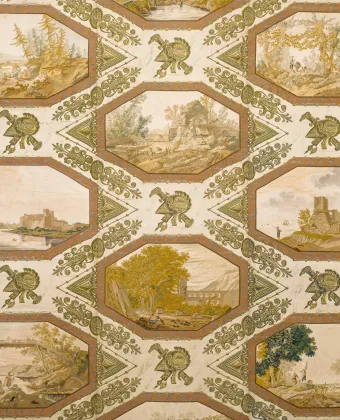
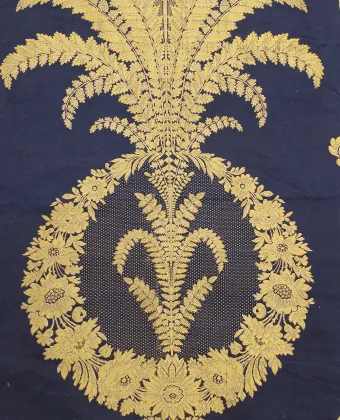
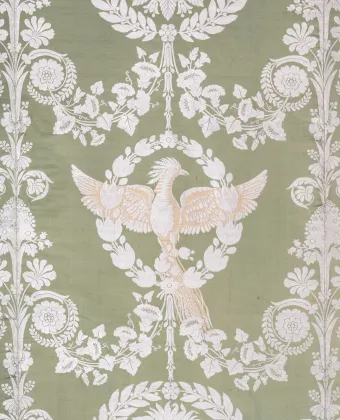
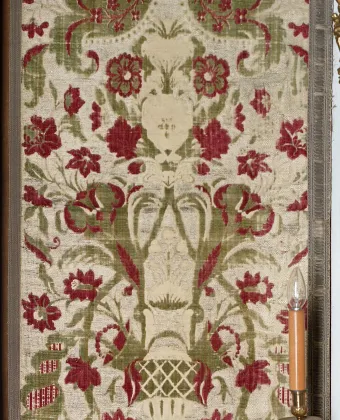
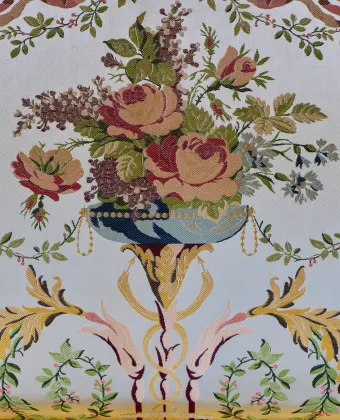
Schönbrunn Palace, Stairs Cabinet of Empress Elisabeth (writing room)
Schloss Schönbrunn, Das Arbeitszimmer an der Treppe der Kaiserin Elisabeth (Arbeitszimmer)
Period of creation:
1854
Date of the reweaving:
2022
Materials and technique:
Lampas, silk
Pattern unit:
Height: ca. 118cm; Width: 53.4cm
Manufacturing location:
Unknown manufactury (Rubelli?) (for the historic fabric)
France, Tassinari & Chatel (for the rewoven fabric)

© Schloß Schönbrunn Kultur- und Betriebsges.m.b.H., Lieselotte Hanzl-Wachter
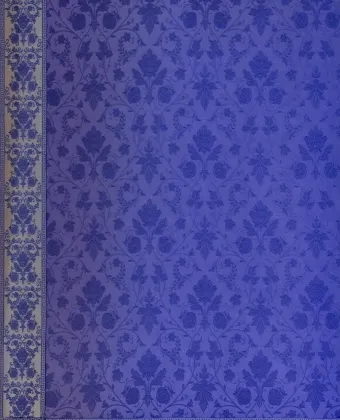
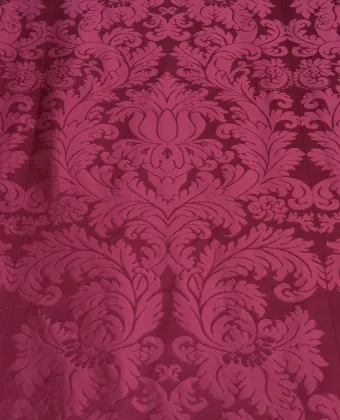
The Stairs Cabinet of Empress Elisabeth appears as an intimate room within her private appartement situated in the bel étage of Schönbrunn Palace. It has been decorated and furnished in 1864 after the marriage of the Imperial couple in 1856. Inventories provide details of the furnishing of this room dedicated to the Empress´ personal daily life. Elisabeth used it as writing room for personal correspondence and writing of poems as well as for reading. Some of the books of her library are still presented there. The Stairs Cabinet and the adjoining private dressing room presented furniture of rosewood, the fabrics differed in their patterns but not in their red colouring. The historic fabrics are still mounted on the walls and now covered (in addition to a particular fabric) with the rewoven silk to ensure an ideal preservation. As a model for the process of reconstruction fragments of curtains have been used. Those are preserved in the Bundesmobilienverwaltung (Vienna) and served also for the reconstruction of the posaments. Unfortunately, the origins of the fabric have not been found to date. The same fabric in blue can be observed in one of the rooms of the appartement of Empress Elisabeth in the Palazzo Reale in Venice (reweaving by Rubelli, Venice). Until 1920, a spiral staircase led from the cabinet downstairs to the private appartement of Empress Elisabeth. It connected to the garden area of Schönbrunn Palace and has been furnished in 1864.
Person associated:
Elisabeth, Empress of Austria (1837-1898)
Bibliographic sources:
Ottillinger, Eva B, Hanzl, Lieselotte, Kaiserliche Interieurs. Die Wohnkultur des Wiener Hofes im 19. Jahrhundert und die Wiener Kunstgewerbereform, Wien Köln Weimar, 1997, p. 204-209
Iby, Elfriede, Mader-Kratky, Anna, Schönbrunn. The Imperial Summer Residence, Vienna 2025, p. 406-407
author
Birgit Schmidt-Messner
Discover the Schönbrunn Palace
Royal Silks in Europe