


public textile

Name of the residence and name of the room:
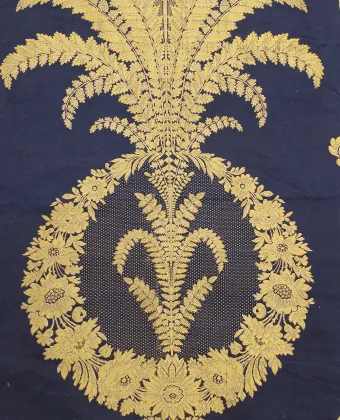
Palace of Fontainebleau, Empress Joséphine’s Bedchamber
Château de Fontainebleau, chambre de l’Impératrice Joséphine
Period of creation:
1788-1791, completed in 1805
Date of the reweaving:
1968-1986
Materials and technique:
Silk, chenille thread, brocaded, 8-shaft satin ground
Pattern unit:
Height: 283cm; Width: 73cm
Manufacturing location:
France, Lyon, Gilles Gaudin and Joseph Savournin (for the original textile)
France, Lyon, Prelle and Tassinari & Chatel (for the rewoven fabric)

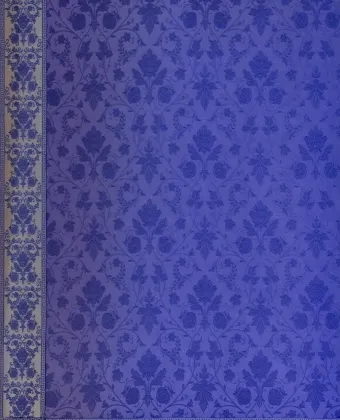
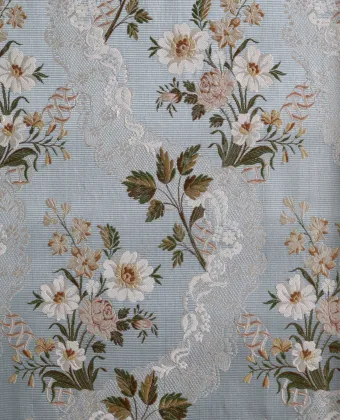
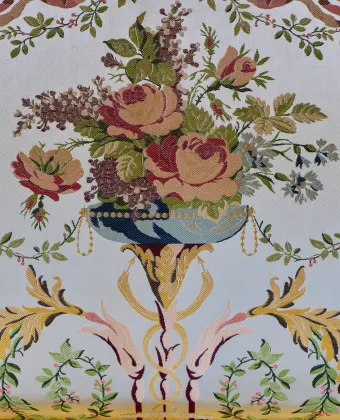
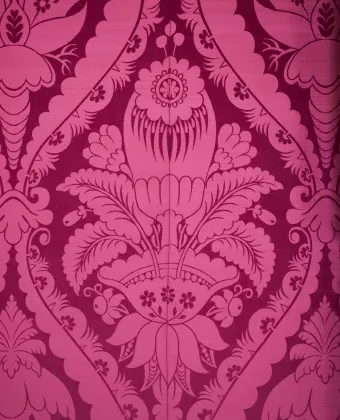
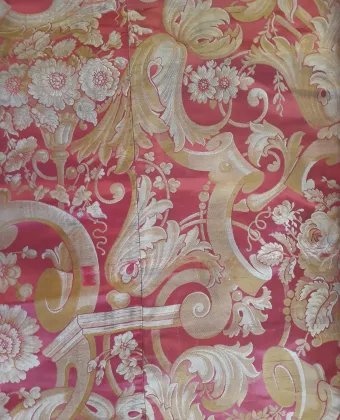
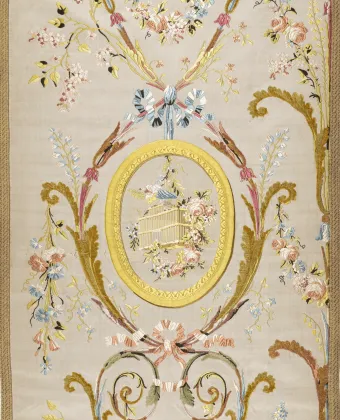
Exceptional in the number of colours and the use of chenille thread, the fabric placed in 1805 in the bedroom of Empress Joséphine, including on the bed made in 1786 for Marie-Antoinette, could be considered as one of the tours de force of Lyon silk manufacturers at the end of the 18th century. The weaving is particularly complex due to the four different designs placed in the cartouches formed of palm leaves; these inserted brocaded patterns are a partridge, a music trophy with tambourine and cage, another one with mandolin and a landscape with ruins and a basket of fruits. It seems to have been started in 1787, for an unfortunately unknown sponsor. The very large scale of the design and the richness of the fabric indicate a princely commission or that of a foreign sovereign.
The Garde-Meuble of the Crown decided to buy the footage woven by Gilles Gaudin when he bankrupted in 1789. The fabric was then intended for the service of the King or Queen. The factory of Savournin was responsible for continuing the weaving with the help of other weavers in Lyon. The textile included sections reserved for embroidery, entrusted to the widow Baudouin. The set was delivered in 1791 and remained in storage until 1805. The fabric was then chosen for the Empress’s bedroom at Fontainebleau to make the wall hangings, complete with matching borders, the curtain valances, the bed cover, the upholstery of the armchairs and a series of stools, a fire-screen and a folding screen. The embroidery was completed by Augustin Picot. The whole was adorned with sumptuous trimmings in silk and gold thread.
This exceptional fabric remained in the Empress's bedroom throughout the 19th century. It was restored under Napoleon III before being rewoven in the 20th century. This reconstruction took nearly 20 years of weaving. The original elements are preserved at Fontainebleau and at the Mobilier national (Paris).
Persons associated:
Joséphine de Beauharnais, Empress (1763-1814)
Gilles Gaudin et Joseph Savournin, silk manufacturers
The Widow Baudouin, embroiderer
Augustin Picot, embroiderer (1756-1822)
Bibliographic sources:
Gastinel-Coural, Chantal, Soieries de Lyon. Commandes royales au XVIIIe siècle (1730-1800), catalogue d’exposition, Lyon, musée historique des tissus, décembre 1988 – mars 1989, Lyon, imprimerie Sézanne, 1988, p. 126
Samoyault-Verlet, Colombe, « Restitution de la soierie de la chambre de l’impératrice », Revue du Louvre et des musées de France, n°3, 1986, p. 174-178
private textile

Name of the residence and name of the room:
Palace of Fontainebleau, Empress Joséphine’s Turkish boudoir
Château de Fontainebleau, Boudoir turc de Joséphine
Period of creation:
1806
Materials and technique:
Cotton, silk and gold thread
Gros de Tours fabric, patterned and edged with gold thread, appliqué embroidery on silk satin with gold thread, paillettes and paillons, gold fringe
Pattern unit:
Height: 4.5cm; Width: 7cm
Manufacturing location:
France, Paris or Lyon, Vacher, fournisseur, « Au Page, ci-devant rue Saint-Honoré […] magasin de toutes sortes d’étoffes de soie, et broderies des plus nouvelles, pour habits, robes et ameublements »

The boudoir, furnished in the Turkish style for the Queen Marie-Antoinette in 1776-1777, showcased exoticism and taste in extravagant upholstery. During the French Revolution, the château's furnishings were seized and sold. The boudoir's furniture and textile decor then disappeared.
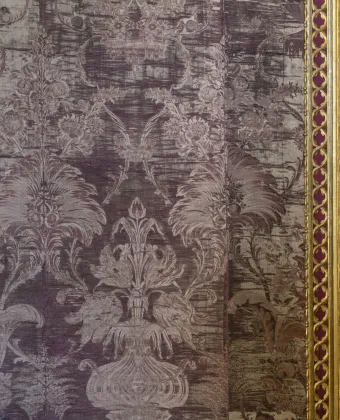
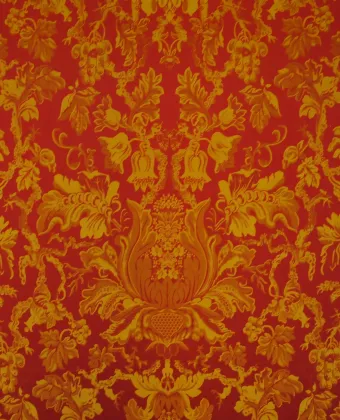
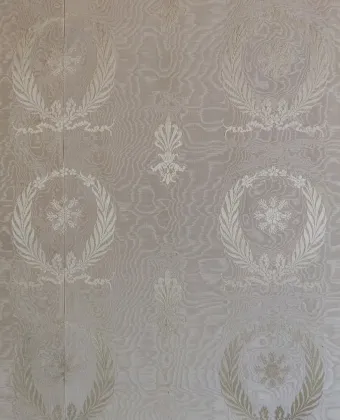
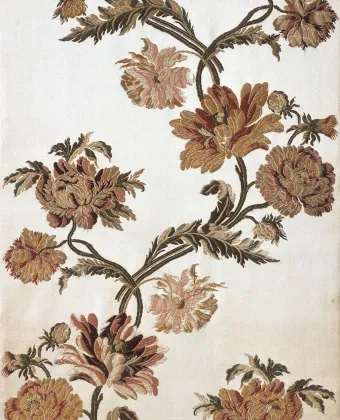
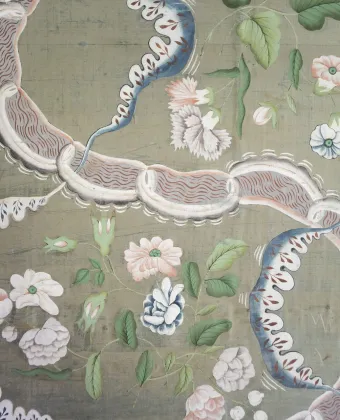
In 1806, Empress Joséphine decided to install her small winter bedroom in the old boudoir, whose panelling and fireplace have been preserved. The mirrors that entirely adorn the alcove, the one placed over the fireplace, and the one that obscured the window thanks to a clever mechanism were replaced. Joséphine then ordered sumptuous furniture, including a stunning mahogany bed, which was placed in the alcove. This, along with the seats, the daybed, the pedestal table, and the fire-screen, were supplied by François-Honoré-Georges Jacob-Desmalter. They are made of mahogany and have received significant gilded bronze decoration. But the magic of the place lies above all in the textiles. Indeed, these evoke a fantasy Orient through their abundance and richness. Thus, to furnish the alcove, the upholsterer Susse composed a layering of three fabrics: a muslin embroidered with gold thread, taffeta curtains with gold braid, and finally draperies cut from a fabric with a vermiculated pattern. These are arranged in festoons and falls on either side of the alcove and the window opening onto the garden.
This fabric with a worm-like pattern does not appear to have been a special order. It was acquired from the manufacturer and merchant Vacher, before being adorned with red satin bands embroidered by Picot and gold fringes. Alongside the large orders placed with the silk manufacturers of Lyon, it bears witness to the customs used in the making of furnishings for imperial residences. This arrangement extends the world of The Arabian Nights desired by Marie-Antoinette.
Persons associated:
Joséphine de Beauharnais, Empress (1763-1814)
Vacher, marchant and silk manufacturer
Pierre-Jean-François Susse, upholsterer
Augustin Picot, embroiderer (1756-1822)
Gobert, trimmer
Bibliographic sources:
Coural, Jean, Gastinel-Coural, Chantal, Müntz de Raïssac, Muriel, Paris, Mobilier national, Soieries Empire, Paris, réunion des Musées nationaux, 1980, p. 134-135
Cochet, Vincent, The Turkish Boudoir of Marie-Antoinette and Joséphine at Fontainebleau, Saint-Rémy-en-l’Eau, éditions Monelle Hayot, 2023, p. 128-160
author
Vincent Cochet
Discover the Palace of Fontainebleau
Royal Silks in Europe