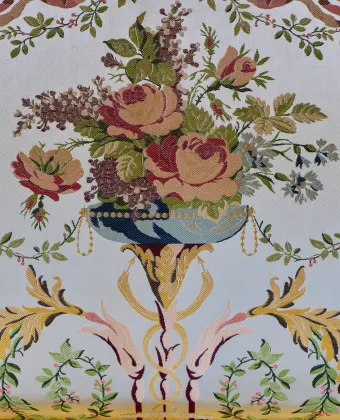



Public textile

© Historic Royal Palaces, James Britton
Name of the residence and name of the room:
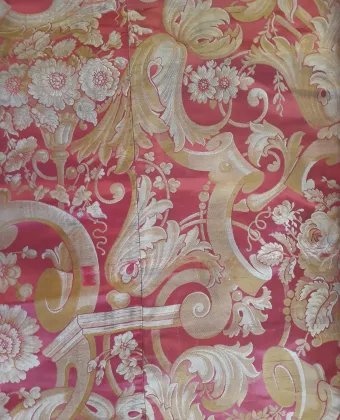
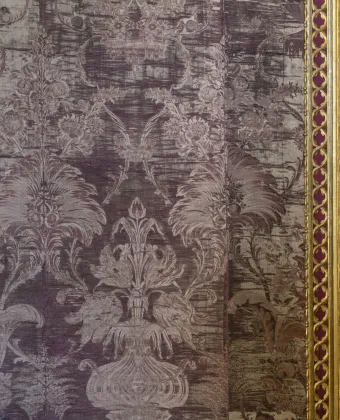
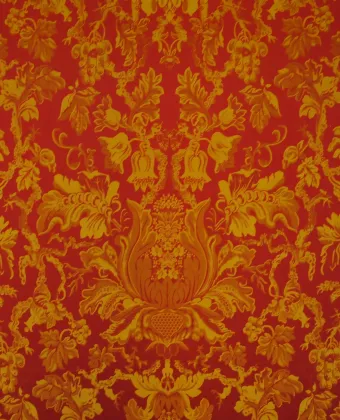
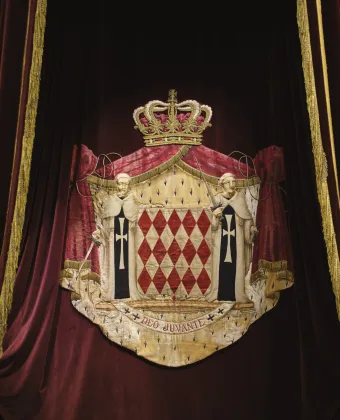
Kensington Palace (London), King’s Presence Chamber - Queen Anne’s Canopy of State from the Embassy at the State of Holland, The Hague (Netherlands)
Period of creation:
1709
Date of the reweaving:
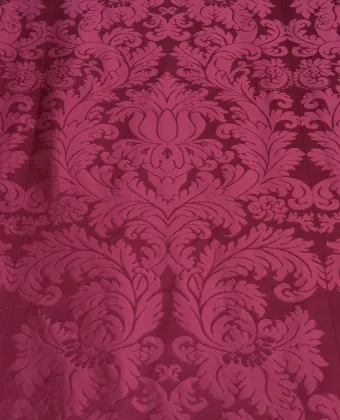
Some eighteenth century later replacement damask on canopy; damask rewoven for Hampton Court Palace, 1992
Materials and technique:
Silk damask, handloom woven
Pattern unit:
Height: 96cm; Width: 53cm
Manufacturing location:
Italy, Genoa (for the original textile);
Suffolk, UK, by Humphries Weaving Company (for the rewoven fabric)

© Historic Royal Palaces
In the years around 1700 the state rooms of the palaces of joint sovereigns William III and Queen Mary II, together with her successor - and sister - Queen Anne, were extensively hung with crimson damask from Italy. Crimson colour was so predominant in the palaces at this time that a leading courtier referred to ‘the red furniture’ in the rooms where she served the Queen. Where damask was not used for the first time the best old tapestries were hung permanently, some of them made for Henry VIII. The effects of sunlight, 200 years of tourism and hanging pictures on top of the silk has been to destroy all these original wall hangings, but substantial amounts of the same original silk survive on several canopies of state in the Royal Collection and on this canopy, made for Queen Anne’s ambassador to the Hague in the Netherlands, in 1709. This was recently acquired from the ambassador, Lord Townshend’s country house for display at Kensington. He kept the canopy as a perquisite – a reward for service - which he turned into a four-poster bed. This particular baroque pattern of damask, with its acanthus leaves and large tulip-shaped flower, was the most popular royal pattern which almost always survives in crimson. In 1700 it cost 24 shillings per yard (about 90cm), a high price for the time. The pattern later became known as Hampton Court because of its association with the palace rebuilt by William and Mary, and decorated by architect William Talman, but it was used elsewhere and was also woven in France. The new English silk industry was promoted by Queen Anne from 1702, and many Huguenot Protestant refugees came from France to work in London’s Spitalfields district, although the best Italian silks continued to be hung in English palaces for years.
Persons associated:
- King William III (1650-1702) and Queen Mary II (1662-1694)
- Queen Anne (1665-1714)
- Samuel Orme, mercer
- Hamden Reeve, upholsterer
- William Elliott, laceman
- William West, embroiderer
- Hamden Reeve, upholsterer
- Thomas Roberts, joiner
Bibliographic sources:
- Thornton, Peter, Baroque and Rococo Silks, (Faber & Faber, London: 1965), pp. 59,190
- Westman, Annabel, “Splendours of State: The Textile Furnishings”, pp. 39-45 in The King’s Apartments Hampton Court Palace, Apollo Magazine, Vol. CXL, 390, August 1994
private textile

© Royal Collection Enterprises Limited 2026 | Royal Collection Trust. Photograph: Historic Royal Palaces
Name of the residence and name of the room:
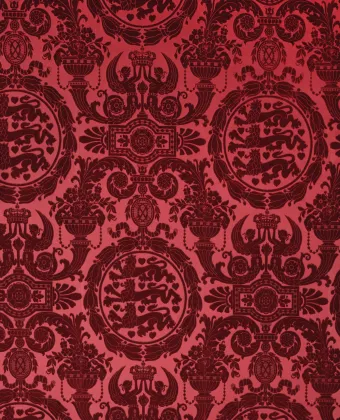
Hampton Court and Kensington Palaces: George, Prince of Wales’s field or travelling bed (for the original textile)
King’s Presence Chamber, Drawing Room and Gallery (for the rewoven fabric)
Period of creation:
1718?
Date of the reweaving:
1993, 2012, 2014
Materials and technique:
Silk damask, handloom woven (for the original textile)
Hand and machine loom (for the rewoven fabric)
Pattern unit:
Height 65cm; Width: 53 cm
Manufacturing location:
Probably Italy, Genoa, maker unknown (for the original textile)
Suffolk, UK, by Humphries Weaving Company (for the rewoven fabric)

© Historic Royal Palaces, Simon Jarratt
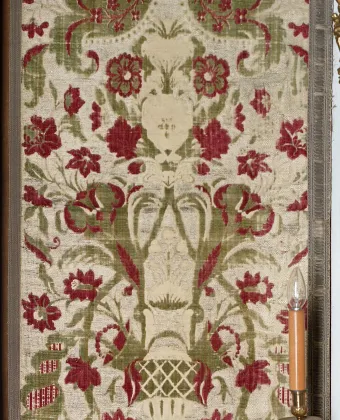
This exceptional surviving royal travelling bed in the Royal Collection at Hampton Court Palace is hung with another crimson damask design, much of it still original material. It is likely to be a bed made for the son of George I, the future George II, who arrived in England at the Hanoverian succession of 1714. Both men were active commanders in the battlefield, and they also travelled back to Germany regularly, making such a collapsable bed a useful addition to the royal wardrobe. That bed or its matching window curtains may have moved between St James’s, Kensington and Hampton Court Palaces throughout the 1720s. Its damask is more sophisticated than the Hampton Court pattern, drawn across two widths of material and features large poppy heads. It later appeared at Hampton Court on a large set of green damask stools made for George II’s gallery in 1737 and is not pattern that is unique to the English court. It also survives in French textile archives and has been rewoven for the Dauphine’s apartments at Versailles in the 1980s. The pattern could be from this later date, although designs for English-made damasks with similar bold motifs exist as early as the 1710. Crimson damasks continued to be favoured by English monarchs for their state apartments well into the eighteenth century, while lighter textiles and wallpapers became increasingly common in private and royal family lodgings.
Persons associated:
- George, Prince of Wales (future King George II r. 1727-1760);
- Unknown Italian weaver and English craftsmen from the Royal Wardrobe ca. 1718
Bibliographics sources:
- Davies, Val, State Beds and Throne Canopies – Care and Conservation, (Archetype Publications, London: 2003), pp. 7, 28-29
author
Sebastian Edwards
Discover the Historic Royal Palaces
Royal Silks in Europe