


public textile

© Botond Soós
Name of the residence and name of the room:
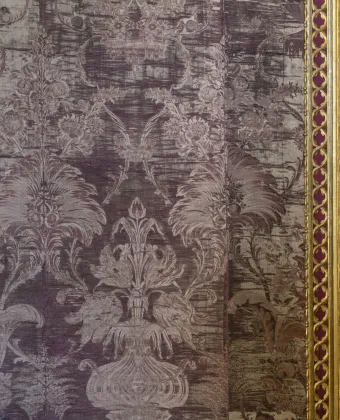
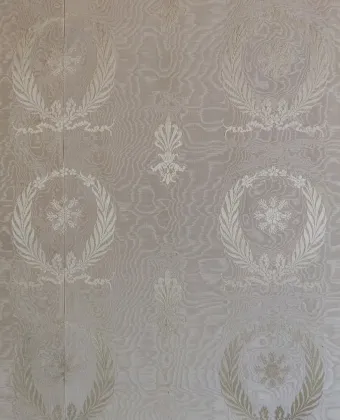
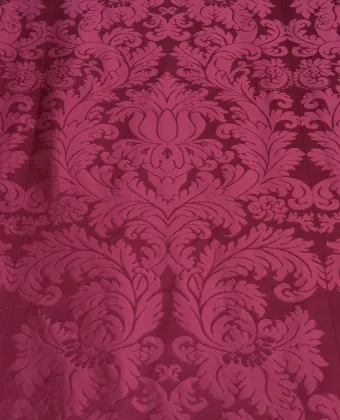
Royal Palace of Gödöllő, The reception room of Franz Joseph I
Gödöllői Királyi Kastély, I. Ferenc József szalonja
Period of creation:
The second half of the 19th century
Date of the reweaving:
1994-1996
Materials and technique:
Viscose, damask-weaving
Pattern unit:
Height: 82cm; Width: 70cm
Manufacturing location:
Unknown (the original textile)
Hungary, Aste Hungaria Ltd., Kőszeg (reweaved textile)

© Botond Soós
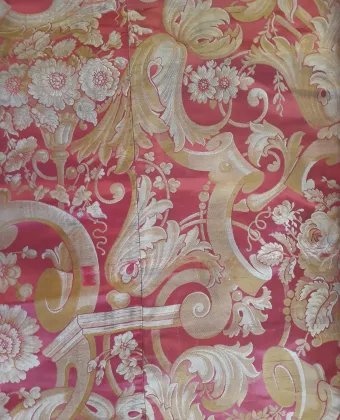
The Grassalkovich family had the Royal Palace of Gödöllő built in the middle of the 18th century and in 1867 the Hungarian National Assembly gifted it to the Royal Couple (King Franz Joseph and Queen Elisabeth) as a summer residence. The fact that its exterior is reminiscent of Schönbrunn Palace (Vienna) thus reminds the Hungarians that their favourite queen, Maria Theresa, played a role in the selection of the residence. The royal suites were then renovated in the third rococo style of the 18th century, in harmony with the character of the old building.
During the next phase of the restoration (1994) it was decided to strive to reconstruct the suites from the Franz Joseph era. The walls of the royal apartments were framed with 18th century wainscots, which were from the same period that the window and door panels, and the stucco decoration on the ceiling was of the same style. The period panel parquet, a few ceramic heaters and the fireplace also survived. These interior elements were restored; however, the upholstery and drapery were missing. Fortunately, a few black-and-white photographs remained of the rooms with the descriptions of the colour of the textiles.
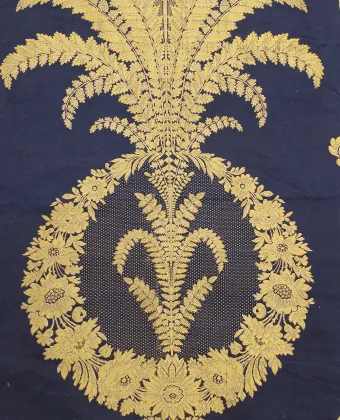
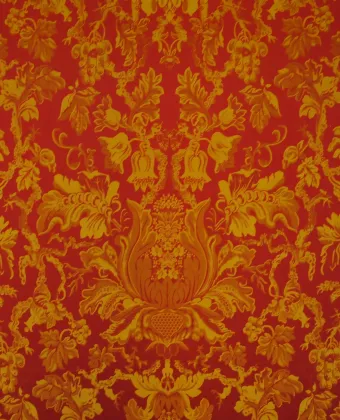
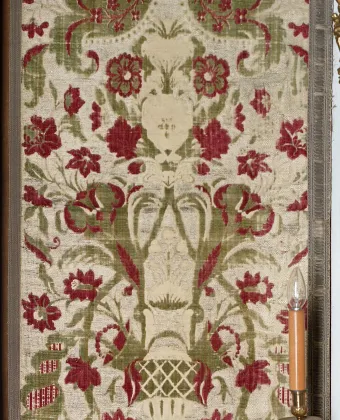
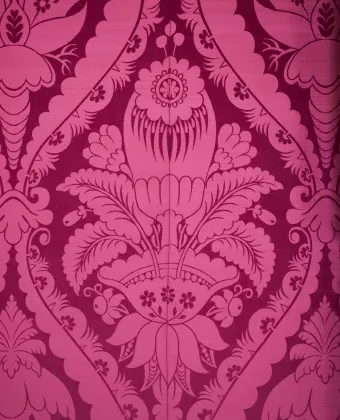
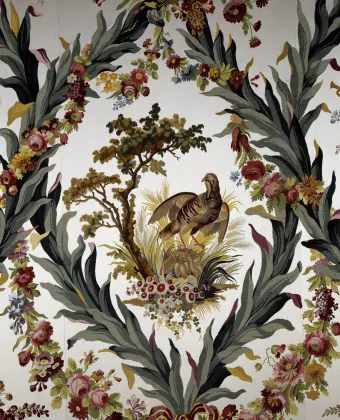
The Museum of Applied Arts conserved a piece of the throne tapestry from Buda Castle from the era of Franz Joseph I. The pattern of large acanthus leaves, with a princely report size, became the basis of Flóra Remsey's design work. The new design, created by innovative use of the original findings, follows the old one in size and character, but its central motif is new, making the Gödöllő tapestry unique. The wall tapestry and drapery have a captivatingly fiery and deep crimson colour, and the series of tapestries create a warm and intimate atmosphere. A silver-grey colour series was also made with the same pattern, which decorates the private spaces of Franz Joseph’s suite – the bedroom and the dressing room.
Persons associated:
Franz Joseph I, Emperor of Austria, King of Hungary (1830-1916)
Flóra Remsey, tapestry artist
Katalin F. Dózsa, art historian
Éva Bakonyiné Schubert, historic building architect
Éva Marianna Kovács, historian and museologist
Bibliographic sources:
Remsey, Flóra, Kastély kárpitok. Függöny, tapéta és bútorszövet rekonstrukciók, Budapest, 2001
Kecskés, József, Kerényi, Eszter B., Őri Nagy, Cecília (ed.), A világ felett. A Remsey család négy generációja, Kiállítási katalógus, Gödöllő, 2016
private textile

© Botond Soós
Name of the residence and name of the room:
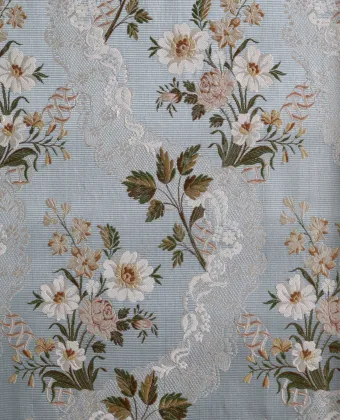
Royal Palace of Gödöllő, Dressing Room of Queen Elisabeth
Gödöllői Királyi Kastély, Erzsébet királyné öltözőszobája
Period of creation:
1873
Date of the reweaving:
1994-1996
Materials and technique:
Viscose, damask-weaving
Pattern unit:
Height: 44cm; Width: 35cm
Manufacturing location:
Unknown (the original textile)
Hungary, Aste Hungaria Ltd., Kőszeg (reweaved textile)

© Botond Soós
Queen Elisabeth’s rooms were, according to the descriptions, purple. The wall-paper of the lavatory connected to the salon and the painted flowers of the oratory of the palace chapel helped in defining this “violet” colour. The task of the colour formulation was to generate the image of violet from shades ranging from bluish-grey to purple and to create a heavier composition, expressing the dignity of a queen.
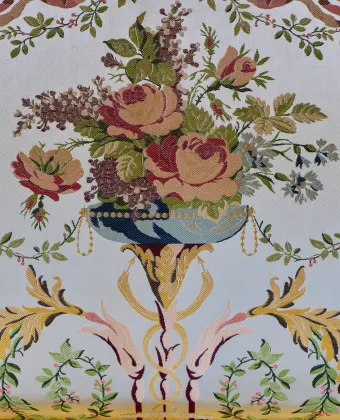
The Museum of Applied Arts provided patterns for the tapestry of Elisabeth’s suite as well. A fine silk damask tapestry piece was purchased at the 1873 Vienna World's Fair. In this pattern, thin vines with delicate designs enclose a vase-shaped space. The small flowers and tendrils are feminine and graceful.
Flóra Remsey designed two colour combinations, and in one of them she achieved an open-work gold effect by using ochre threads. A combinable collection was created from the double-sided fabrics and the borders matched to them.
The tapestries woven with the two versions of the basic colour were placed on the walls, the furniture was covered with their inverted variant, and their golden-effect versions serve as curtains. Thus, a rich composition was created from the different varieties of the same material, which also appears in other interiors and public spaces of the Palace. The aim of the work was determined by the principles of historic building protection and authentic historical reconstruction, so the results are true from this respect as well.
Persons associated:
- Elisabeth, Empress consort of Austria and Queen consort of Hungary (1837-1898)
Flóra Remsey, tapestry artist
Katalin F. Dózsa, art historian
Éva Bakonyiné Schubert, historic building architect
Éva Marianna Kovács, historian and museologist
Bibliographic sources:
Remsey, Flóra, Kastély kárpitok. Függöny, tapéta és bútorszövet rekonstrukciók, Budapest, 2001
Kecskés, József, Kerényi, Eszter B., Őri Nagy, Cecília (ed.), A világ felett. A Remsey család négy generációja, Kiállítási katalógus, Gödöllő, 2016
author
Demeter-Guba Erzsebet
Discover the Royal Palace of Godollo
Royal Silks in Europe