


public textile

© Ernani Orcorte
Name of the residence and name of the room:
Musei Reali di Torino, Royal Palace, State Apartment, Throne Room
Musei Reali di Torino, Palazzo Reale, Appartamenti di rappresentanza, Sala del Trono
Period of creation:
1837-1838
Materials and technique:
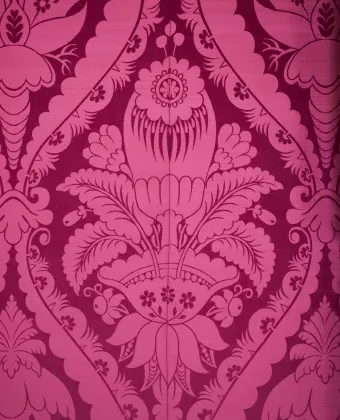
Silk, red yarn, gold laminate yarn with silk core, brocade cannettillé
Pattern unit:
Height: 146cm; Width: 72.5cm
(Edge: 145 x 53cm)
Manufacturing location:
Italy, Turin, Bernardo Solei

© Agata La Spina
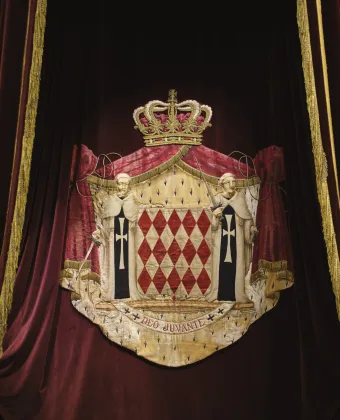
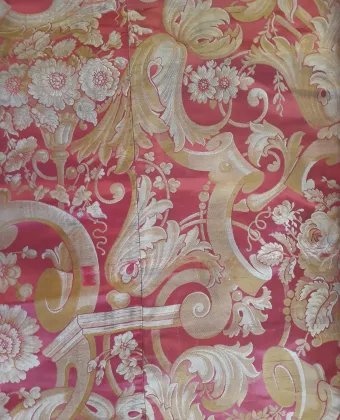
The Throne Room is the most important setting for public ceremonies and audiences at the Royal Palace and is dominated by the intense red colour of the fabrics and the gilding of the furnishings. Used since the 17th century as a Parade Chamber, the room was renovated at the behest of Carlo Alberto of Savoy Carignano, king of Sardinia from 1831 to 1849. The sovereign ordered a new inlaid floor, a grandiose canopy for the throne, gilded boiserie, furnishings, mirrors and doors decorated with the Savoy coat of arms. In 1838-1842, a team of cabinetmakers, plasterers and sculptors executed the works designed by the court architect Pelagio Palagi.
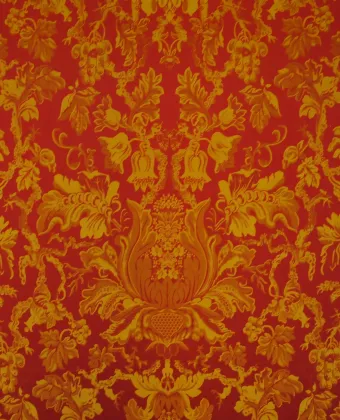
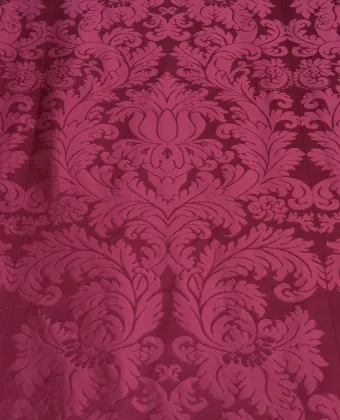
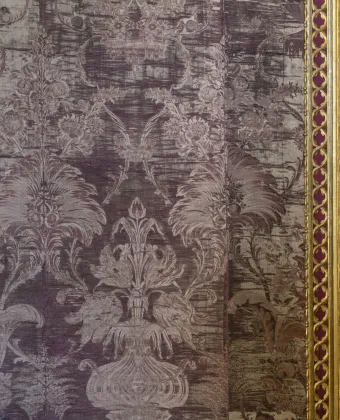
The fabric is a rare testimony of the refined and fine silks purchased in the 19th century to decorate the Royal Palace as most of the fabrics have been replaced and redone over time according to the ancient models in the 1960s. On a red background are designs featuring bouquets of flowers, oak leaves, bay leaves, vines and panicles. The border is decorated with cornucopias, the letters “CA” (the monogram of the sovereign Carlo Alberto of Savoy-Carignano), the Savoy knot and the coat of arms of the House of Savoy.
To purchase the fabric of the Throne Room, the House of Savoy turned to Bernardo Solei, owner of an important factory with offices in Turin, Genoa, Milan, Florence, Naples, Palermo and Paris. For decades Solei supplied fine fabrics (damasks, brocades, textured fabrics, but also trimmings) for the monumental rooms of the Royal Palace, but also to decorate the walls of numerous other Savoy Residences. Solei therefore played a leading role in 19th century artistic commissions and was also an intermediary for the purchase of furniture in Paris. In the Throne Room the canopy today features velvet remade in the 20th century.
Persons associated:
Charles Albert of Savoy King of Sardinia (1798-1849)
Pelagio Palagi, designer (1775-1860)
Bernardo Solei, silk manufacturer
Bibliographic sources:
Bovenzi, Gian Luca, “Tessuti d’arredo”, in Storie di cose. Tre secoli di manifatture piemontesi, a cura di V. Marchis, Torino 2014, p. 98
De Royere, Bertrand, Pelagio Palagi. Décorateur des palais royaux de Turin et du Piémont (1832-1856), Mare & Martin, Paris, 2017, p. 150
Pelagio Palagi. Memoria e invenzione nel Palazzo Reale di Torino, a cura di G. Careddu, F. Gualano, M. Pigozzi, L. Santa, exhibition catalogue (Musei Reale di Torino, Galleria Sabauda, 9 november 2019 – 9 february 2020), Genova 2019
private textile

© Renato Di Gaetano
Name of the residence and name of the room:
Musei Reali di Torino, Royal Palace, Queen Elena Apartment, Piano Room
Musei Reali di Torino, Palazzo Reale, Appartamento della regina Elena, Salone del pianoforte
Period of creation:
Second half of 18th century
Materials and technique:
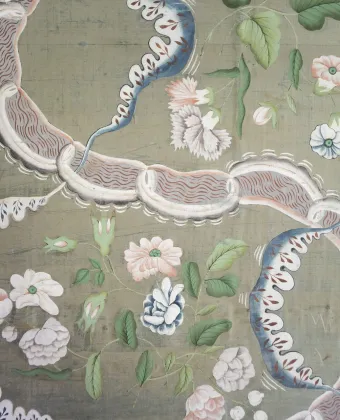
Woven and painted silk tabby
Pattern unit:
Height: 147cm
Manufacturing location:
Italian manufacturing (?)

© Renato Di Gaetano
On the ground floor of the Royal Palace, in the east wing towards the Royal Gardens, there is a splendid apartment inhabited by Princess Maria Felicita of Savoy (1730-1801), sister and advisor of the King of Sardinia Vittorio Amedeo III. In the Bedroom, decorated on the vault by the Viennese painter Daniel Seiter, Maria Felicita is remembered by a valuable portrait set up on the textile.
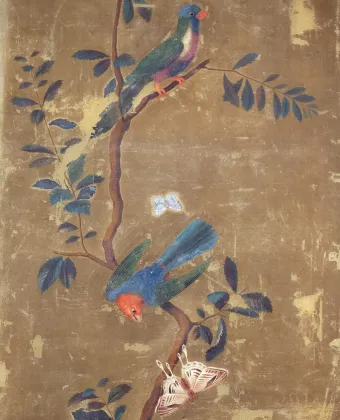
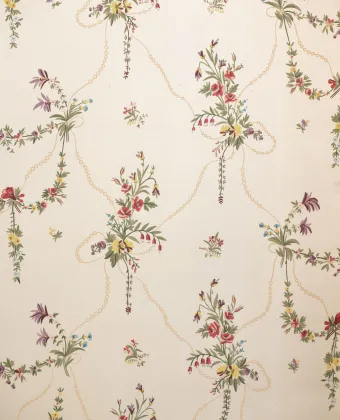
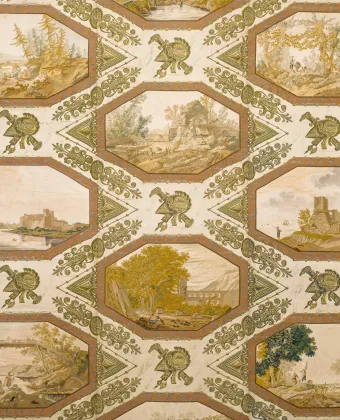
The tabby is now the only example of the wall coverings purchased for the Royal Palace in the second half of the 18th century. In addition to its antiquity, its importance is also linked to the typical taste of the time: the fashion for chinoiserie, widespread throughout Europe. The textile features an elegant naturalistic decoration with bamboo branches with a spiral pattern and filled with leaves and flowers, among which you can see colourful peonies and chrysanthemums. The dominant colours are green, blue and pink. Birds with vivid plumages are painted in flight and resting on branches.
Due to the fragility of the textile, some restorations carried out in the past have revealed the fabric, however using unsuitable materials which over time have heavily altered and darkened the colour of the background. Studies have underlined its proximity with the destroyed one once set up at the Boisierte Kammer of Charlottenburg Palace in Berlin.
In the 20th century, the Apartment hosted Queen Elena of Montenegro, wife of Victor Emmanuel III, who resided here during her stays in Turin. The old Bedroom was thus transformed into a living room with a piano from which it takes its name today.
Person associated:
Maria Felicita of Savoy (1730-1801) and Helena of Montenegro (1873-1952), owners of the Apartment
Bibliographic sources:
Tardito Amerio, Rosalba, Chierici, Umberto, Palazzo Reale di Torino. Appartamento di Madama Felicita, 1971, p. 9, 28
Bertana, C., Cambursano, G. Appartamento della regina detto di “Madama Felicita”. Palazzo Reale, Torino 1985, p. 30-31
D’Agostino, Laura, “Echi d’Oriente nelle tappezzerie della Villa. I documenti d’archivio e le rare sopravvivenze”, in Villa della Regina. Il riflesso dell’Oriente nel Piemonte del Settecento a cura di Lucia Caterina, Cristina Mossetti, Torino 2005, p. 234-235, 239
author
Lorenza Santa
Discover the Royal Palace of Turin
Royal Silks in Europe