


public textile

© The Royal Łazienki Museum in Warsaw, P. Ceraficki / A. Kotlarski
Name of the residence and name of the room:
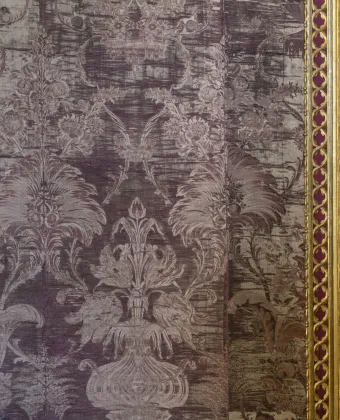
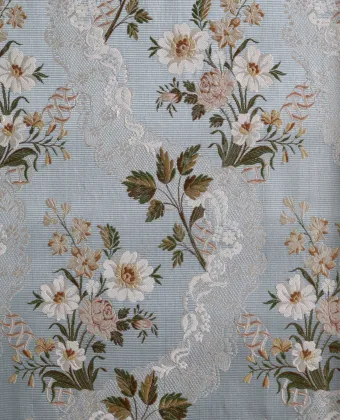
The Royal Łazienki Museum, Palace on the Isle, Solomon’s Hall
Muzeum Łazienki Królewskie, Pałac na Wyspie, Sala Salomona
Period of creation:
1765-1768
Date of the reweaving:
2018
Materials and technique:
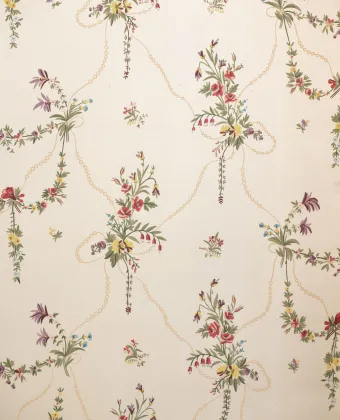
Silk (Liancourt Ivoire)
Pattern unit:
Height: 137 cm; Width: 130 cm
Manufacturing location:
Unknown manufacturer, Lyon, France (for the original textile)
France, Lyon, Tassinari & Chatel (for the rewoven fabric)

© The Royal Łazienki Museum in Warsaw, P. Ceraficki / A. Kotlarski
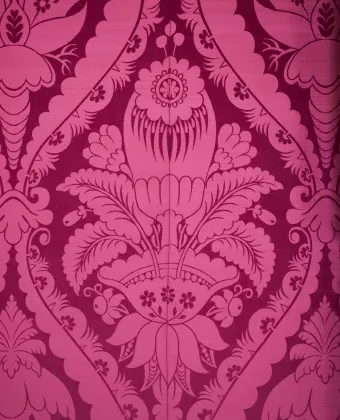
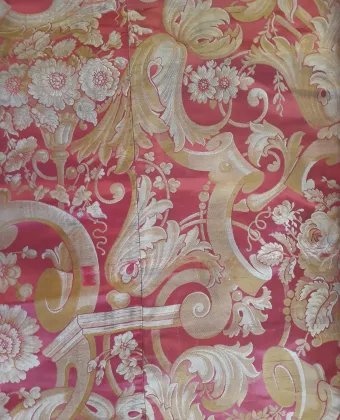
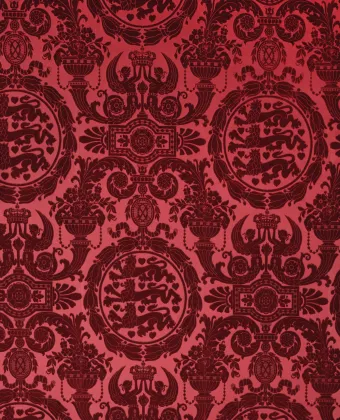
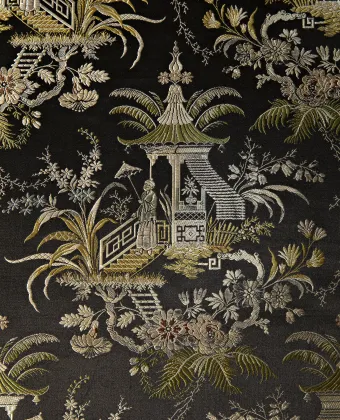
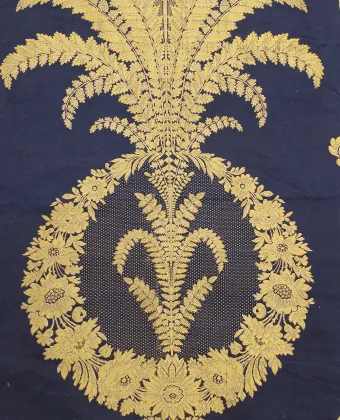
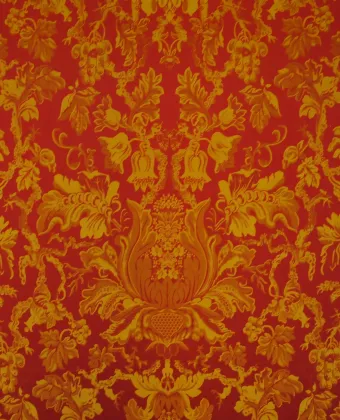
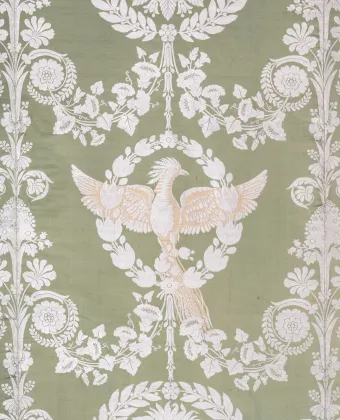
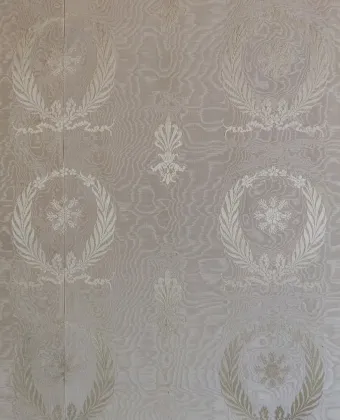
The collection of the Royal Łazienki Museum includes a set of furniture created in 1768 in the Paris workshop of Louis Delanois (1731-1792). The original set consists of eight armchairs and three stools made of wood, gilded, and upholstered. One of the four stools is a later reconstruction. The French furniture was complemented by sofas produced in Warsaw, likely after 1790. This especially valuable set of armchairs and stools was manufactured at the beginning of King Stanislaus Augustus’s reign. It was commissioned from Louis Delanois, a Parisian menuisier specialized in seat furniture, whose work paved the way for the Louis XVI style. The furniture arrived in Warsaw after 1777. In 1792, following the rebuilding of the Palace on the Isle, this furniture was placed in one of the state rooms - the Solomon’s Hall. The upholstered elements can be removed from the gilded frames, allowing for a seasonal change of upholstery, a fashion trend of that era. The original fabric has not survived. In 2017, the team of art restorers from the Royal Łazienki Museum in Warsaw reconstructed the furniture’s cover, based on research into 18th-century inventories of the Palace on the Isle. The furniture is covered with a thick satin silk, produced just as it was in the time of the king, in the workshops in Lyon, where, from 1680 to the present day, without interruption, historical patterns have been continuously manufactured.
Persons associated:
Stanislaus Augustus, king of Poland (1732-1798);
Victor Louis, architect, designer;
Louis Delanois, cabinetmaker (1731-1792)
Bibliographic source:
Bender, Agnieszka, “Louis Delanois – twórca mebli dla króla Stanisława Augusta Poniatowskiego” [“Louis Delanois – producer of furniture for king Stanislaus Augustus”], in Laudator temporis acti. Studia z dziejów sztuki i kultury ofiarowane Księdzu Doktorowi Janowi Niecieckiemu w 65. rocznicę urodzin [Laudator temporis acti. Studies in art and culture dedicated to the Reverend Doctor Jan Nieciecki on His 65th anniversary], Irena Rolska, Krzysztof Gombin, Krzysztof Przylicki (eds.), Lublin: Wydawnictwo KUL, 2015, p. 259–267
private textile

© The Royal Łazienki Museum in Warsaw, P. Ceraficki / A. Kotlarski
Name of the residence and name of the room:
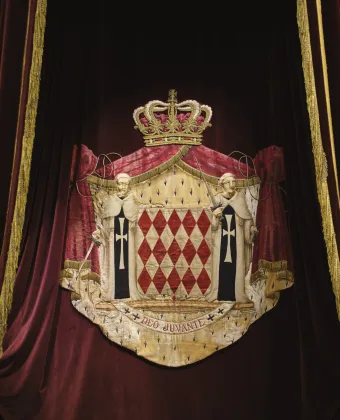
The Royal Łazienki Museum, The White Pavilion, King’s Bedchamber, the royal bed
Muzeum Łazienki Królewskie, Biały Dom, Sypialnia Królewska, łóżko królewskie
Period of creation:
1783-1788 (for the original fabric, now lost);
2025 (for the reconstructed bed covering and baldachin)
Date of the reweaving:
2025
Materials and technique:
Embroidery on muslin and silk, passementerie (Declercq, Collection Palais d’Hiver), double mercerised cotton (DMC)
Manufacturing location:
Unknown manufacturer (for the original fabric);
Poland, Warsaw, ReKonArt Mariola Ratajczyk (for the reconstructed bed covering)

© The Royal Łazienki Museum in Warsaw, P. Ceraficki / A. Kotlarski
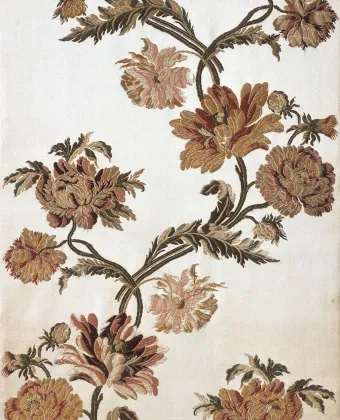
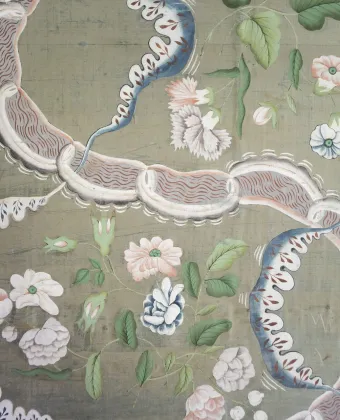
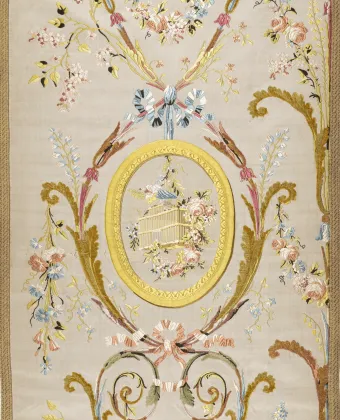
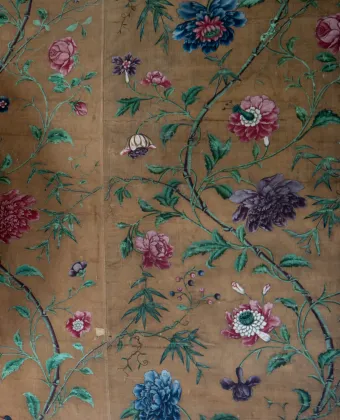
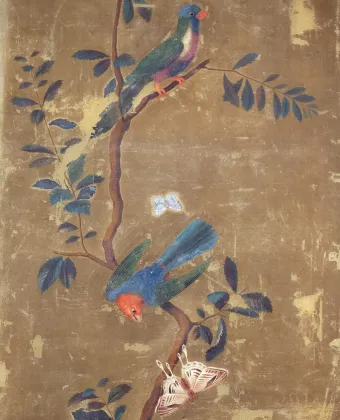
The White Pavilion at the Royal Łazienki Museum in Warsaw features an original 18th century bed made for King Stanislaus Augustus. The wooden, gilded frame, decorated with carved motifs related to love, is an 18th-century remnant of the luxurious furnishings of the royal bedchamber. In 2025, with support from the Starak Family Foundation, the museum initiated a project to recreate the baldachin and coverlet for the bed. Research into 18th-century inventories of the White Pavilion provided some information about the fabric. While records specify the materials used—namely muslin lined with silk—they are less detailed about its decoration. It was noted that the coverlet featured butterflies, birds, and flowers, but no specifics were given about the decorative elements' composition. The team of art curators and restorers designed the fabric anew, drawing inspiration from preserved 18th-century textiles, pattern books by Jean Pillement—Stanislaus Augustus’s court painter—and the motifs of birds and butterflies found on the bedchamber walls. It was decided that the design should be neutral, featuring butterflies, birds, and flowers scattered loosely. The design and numerous iconographic materials were sent to an embroidery studio, where they served as a basis for developing the visual details of each element. The baldachin and coverlet were hand-stitched and installed on the bed in September 2025.
Persons associated:
Stanislaus Augustus, king of Poland (1732-1798)
Unknown designer and manufacturer (for the original textile)
ReKonArt Mariola Ratajczyk (for the reconstructed bed covering)
Bibliographic source:
Inwentarz dobr JKMci dziedzicznych Łazienki zwanych z attynencjami przy Warszawie sytuowanych, na groncie 1788 roku w maju spisany [A register of the hereditary estates of His Royal Highness’s, known as Łazienki, located near Warsaw, including adjacent lands, recorded on site in May 1788], Archiwum Główne Akt Dawnych w Warszawie [The Central Archives of Historical Records in Warsaw], Archiwum księcia Józefa Poniatowskiego i Marii Teresy Tyszkiewiczowej [The Prince Józef Poniatowski and Maria Teresa Tyszkiewicz née Poniatowska Collection], inv. no. 162, pp. 55–56.
author
Dr Izabela Kopania
Discover the Royal Lazienki Museum
Royal Silks in Europe