


public textile

© Archives du palais princier de Monaco-Loïc Repiquet
Name of the residence and name of the room:
Prince’s Palace of Monaco, Throne room
Palais princier de Monaco, Salle du trône
Period of creation:
1881
Wall coverings: 2012
Materials and technique:
Throne: padding in silk velvet embroidered with silver threads
Dome and canopy: Vienna velvet. Decorative velvet frieze with gold embroidery
Coat of arms: satins and silk velvet, painted silk, silver lamé, embroidery with silk thread, golden trimmings
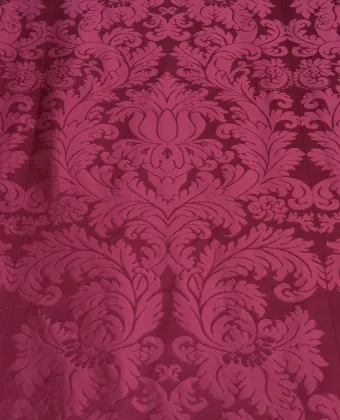
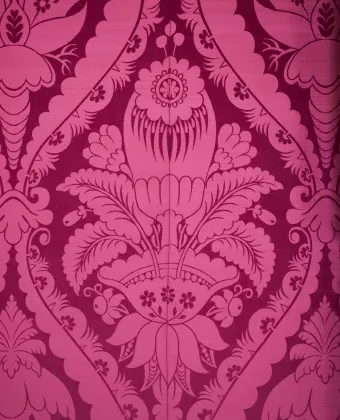
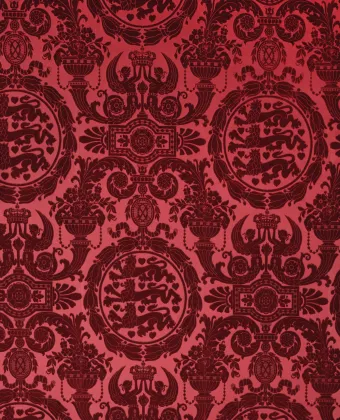
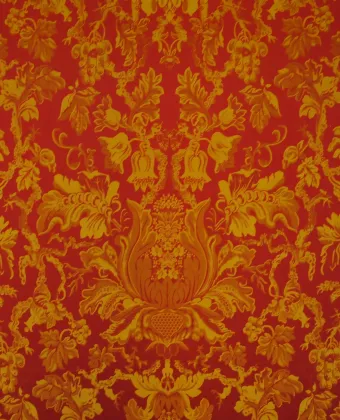
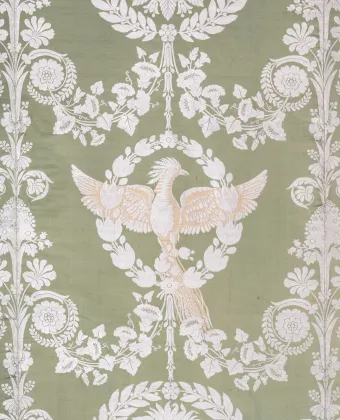
Wall coverings: silk damask
Pattern unit:
Height: 111cm; Width: 85cm

© Archives du palais princier de Monaco-Loïc Repiquet
The first throne of the Palace of Monaco, used under the Ancien Régime, was unfortunately lost during the French Revolution, when the assets of the prince, seized with the entire Palace, were sold. While his power was shaken by the “Printemps des peoples” and the secession of the cities of Menton and Roquebrune in 1848, Prince Charles III (1818-1889) decided to create a new throne in 1881. Commissioned from the upholsterer Félix Alfred Ternisien, a former supplier to the court of Napoleon III, the new set of furniture has been installed during the 25th year of his reign in the centre of the Grimaldi room, the largest public room of the Palace, which later became the "Throne room". It was inspired by the one designed for Napoleon I at the Palace of Fontainebleau. The set was upholstered in crimson silk Viennese velvet. Silver thread embroidery, especially the prince’s monogram, composed of two intertwined and crowned "C"s, the circular back, adorns the armchair as well as the top of the canopy. The canopy is surmounted by the closed golden wooden crown, recalling the dignity of the one who uses it. Inside the mantle, the grandiose royal arms made of silver threads and embroidered or painted silk overlook the throne.
Reinforcing the majesty of the throne and creating harmony with purple, the entire room is covered with red silk lampas from 1863. In 1952, these hangings were replaced by a red silk damask whose pattern is different from the previous one. Sixty years later, to compensate for the deterioration of time and light in a room frequently used for protocol events, a new campaign to restore hangings was launched. The Houlès house, a Parisian family-owned company producing upholstery fabrics, was in charge of reproducing exactly the damask chosen in 1952.
Persons associated:
Charles III, prince of Monaco (1818-1889)
Félix Alfred Ternisien, upholsterer (1817- ?)
Bibliographic sources:
Blanchy, Thomas, Politique de souveraineté et sociabilité de cour dans la Principauté de Monaco, du Printemps des peuples à la mort d'Albert Ier (1848-1922), thèse de doctorat soutenue à l’université Paris-Sorbonne le 25 juin 2024, p. 469-479
Fouilleorn, Thomas (dir.), Princes et princesses de Monaco, catalogue de l’exposition à la Cité interdite de Pékin du 7 septembre au 11 novembre 2018, Monaco, Grimaldi forum de Monaco, 2018, p. 83
private textile

© Archives du palais princier de Monaco-Loïc Repiquet
Name of the residence and name of the room:
Prince’s Palace of Monaco, Royal Chamber, known as the York Chamber
Palais princier de Monaco, chambre royale, dite d’York
Period of creation:
2019
Materials and technique:
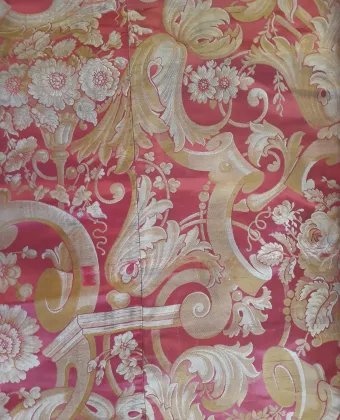
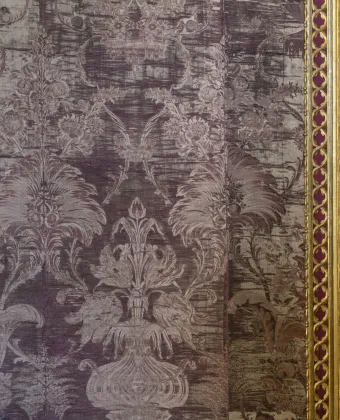
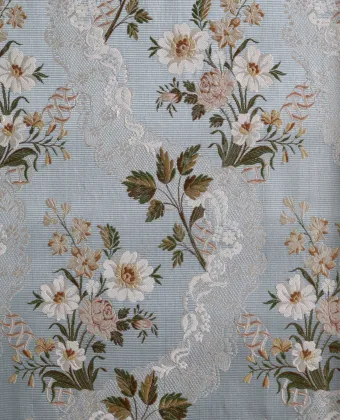
Damask Louis XIV
Pattern unit:
Height: 174cm; Width: 53cm
Manufacturing location:
Lyon, France, manufacture Prelle

© Archives du palais princier de Monaco-Loïc
The Royal Chamber was once part of the royal apartments, a section of the palace built in the 17th century. Embellished by Prince Antoine I (1661-1731), who obtained the rank of foreign prince at the court of King Louis XIV of France, in 1688, on the occasion of his marriage with Marie de Lorraine, daughter of Monsieur le Grand écuyer, the Count of Armagnac, it was lavishly decorated in the style of the time. The walls were lined with red silk damask and gold brocade.
The Royal Chamber is at the heart of the apartments dedicated to the accommodation of high-ranking guests who stayed with the Prince. The Duke Edward Augustus of York, brother of King George III of England, was rushed there, when he could not continue his journey to Genoa because of his sickness. Despite the care given, he died a few days later in this room nicknamed "York’s Chamber" after this event.
During the French Revolution, the Palace was emptied of its collections and furniture, sold as national property. Transformed into a hospital, then into a workhouse, it was heavily degraded. Due to lack of funds, the fundamental restoration work was not carried out until the second half of the 19th century, between 1864 and 1865, during the reign of Prince Charles III (1818-1889). A large four-poster bed and gilding inspired by the bedroom of the King in Versailles were installed there, red velvet draperies were chosen.
All the Grands Appartements underwent restoration in 2019. New red damask draperies were ordered from a silk factory in Lyon.
Bibliographic source:
- Labande, Léon-Honoré, Le palais de Monaco, Paris, Honoré Champion, 1932, p. 192
author
Thomas Fouilleron
Discover the Prince's Palace of Monaco
Royal Silks in Europe