


public textile

© Palazzo Reale, L. Pennati
Name of the residence and name of the room:
Royal Palace of Milan, Hall of Ministers
Palazzo reale di Milano, Sala dei Ministri
Period of creation:
Beginning of the 19th century
Date of the reweaving:
2004-2006
Materials and technique:
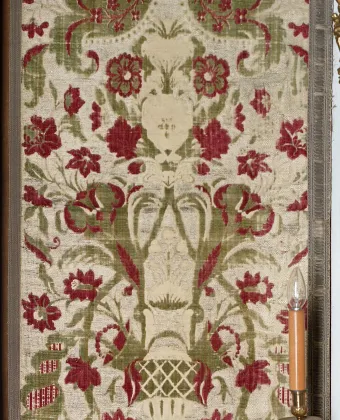
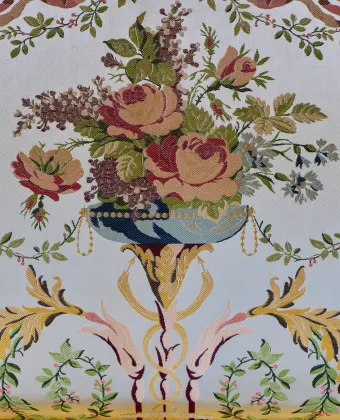
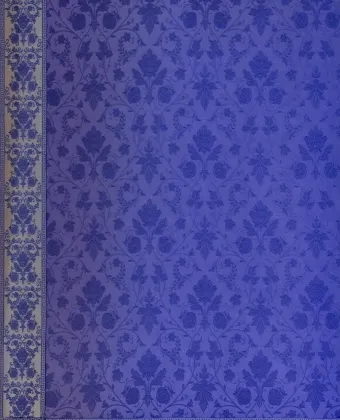
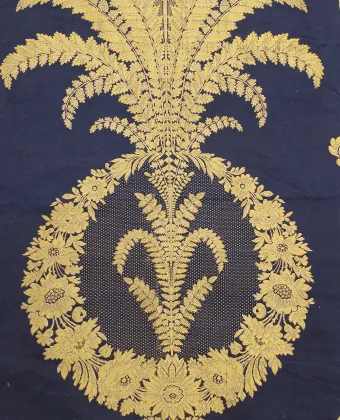
Blue silk in background with fritillaria imperialis, gold thread
Pattern unit:
Height: 150cm; Width: 60cm
Manufacturing location:
Probably France, Lyon, Chuard & Cie (for the original textile)
France, Lyon, Manufacture Prelle (for the rewoven fabric)

© Palazzo Reale
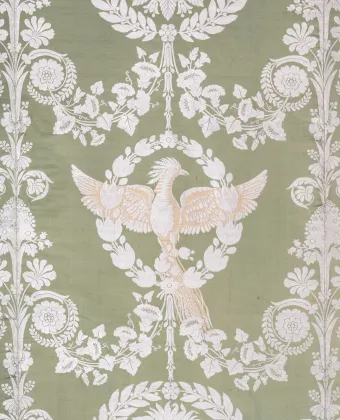
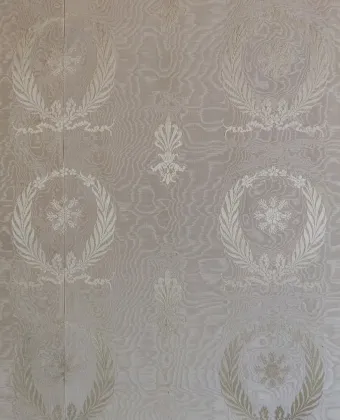
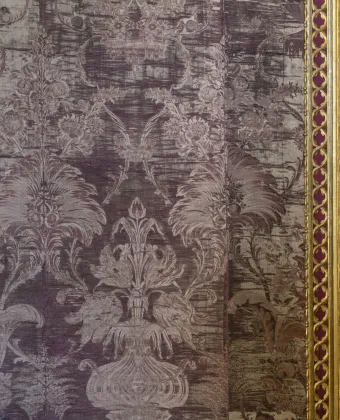
One of the most evocative rooms on the first floor of the Royal Palace restored in the Napoleonic era is the Hall of Ministers. With the Unification of Italy, the room changed its destination and, with some modifications to the fabrics replaced by red silk upholstery, it was transformed into the throne room of the House of Savoia.
The hall was almost destroyed in August 1943, following the bombings of the Second World War and the subsequent fire which affected a large part of the Royal Palace. The version we see today is the result of a reconstructive restoration conducted by the Superintendence and the Municipality of Milan in the years 2004-2006 which, based on specialist studies, photographic documentation and original fragments, allowed the faithful reconstruction of the Hall of Ministers of Napoleonic period.
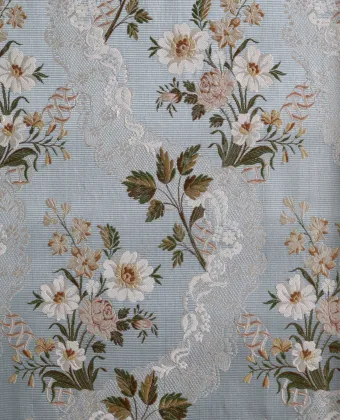
In this regard, it is worth highlighting that, in the correspondence that Napoleon Bonaparte maintained with the Governor in Italy in preparation for what would be his coronation as King of Italy in 1805, the French emperor indicated precisely his requests regarding the decoration of the rooms, in particular the Hall of Ministers whose colours had to be gold, white and turquoise. According to the 1814 inventory, this room was furnished as follows: “the upholstery was of lampas light blue background and flowers.” This type of flower is called “fritillaria imperialis” and it is wanted by Napoleon himself as an imperial symbol to show his power and magnificence.
It wasn’t possible to rebuild everything. Because of the fire, for example, Andrea Appiani's fresco "Peace and Hymen" from 1810, which was in the centre of the vault and which alluded to the wedding between Napoleon and Maria Luisa of Habsburg, was completely destroyed. One of the original elements is the large Empire period mirror with golden oak leaves on a blue background.
Person associated:
Napoleon Bonaparte, Emperor of the French, King of Italy (1769-1821)
Bibliographic sources:
https://www.palazzorealemilano.it/sala-dei-ministri-o-della-rotonda
Gastinel-Coural, Chantal, Soieries de Lyon. Commandes royales au XVIIIe siècle (1730-1800), catalogue d’exposition, Lyon, musée historique des tissus, décembre 1988 – mars 1989, Lyon, imprimerie Sézanne, 1988, p. 126
Samoyault-Verlet, Colombe, « Restitution de la soierie de la chambre de l’impératrice », Revue du Louvre et des musées de France, n°3, 1986, p. 174-178
private textile

© Palazzo Reale
Name of the residence and name of the room:
Royal Palace of Milan, Apartments of the Princes, Dining Room
Palazzo reale di Milano, Appartamento dei principi, Sala da pranzo
Period of creation:
Second half of the 19th century
Date of the reweaving:
2008
Materials and technique:
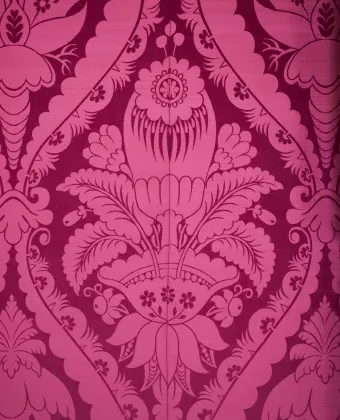
Red satin bottom with 8 shaft 3, yellow background weft which is tied in twill and cloth by the warp
Pattern unit:
Height: 150cm; Width: 54cm
Manufacturing location:
Italy, Florence (for the original textile)
Italy, Venice, Rubelli (for the rewoven fabric in 2008)

© Palazzo Reale
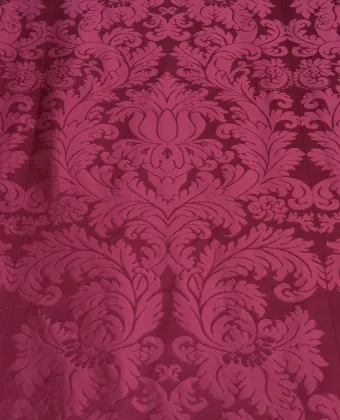
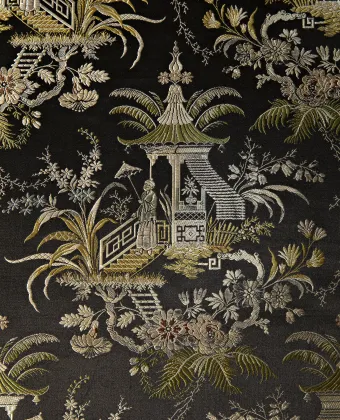
Margherita di Savoia, Queen from 1878 to 1900, was considered an icon of her time and with her personality she was able to influence the taste in fashion and decoration. Indeed, in the role of Queen, she set out to renovate the residences of the Crown in order to strengthen the sense of national identity and, at the same time, emphasize the prestigious and representative role of Italy.
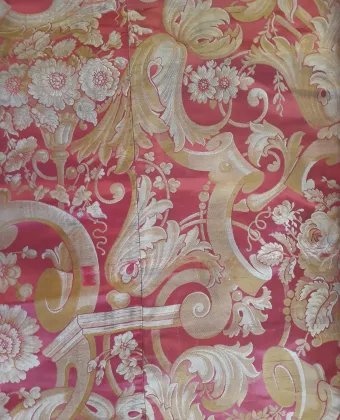
The room here described was intended as a dining room and is illuminated by three windows and heated by a fireplace with mirror. Originally, the walls were covered with silk upholstery and the coordinated curtains had to be in muslin embroidered with light red drapery. The room has three beige lacquered doors with golden friezes; the parquet floors are in dark walnut and white maple. The original textile has been damaged and what appears today is a fabric ornated with yellow-coloured leaf and floral motifs on a red satin background. On the ceiling we can see a grisaille decoration created by Gaetano Vaccani, with pastel colours ranging from grey to pink. Although slight, the chiaroscuro effects create a significant architectural and sculptural design. Rich leaf elements and small flowers are enclosed in simple shapes with flat geometry, while simple decorations frame the reserves.
Person associated:
Margherita di Savoia, Queen of Italy (1851-1926)
Bibliographic sources:
F. Eusebio, L’appartamento di riserva per Principi nel Palazzo Reale di Milano, p. 24-25
Palazzo Reale administrative archives
AUTHORS
Domenico Piraina
Simone Percacciolo
Discover the Royal Palace of Milan
Royal Silks in Europe