


public textile

© Kulturstiftung Dessau-Wörlitz
Name of the residence and name of the room:
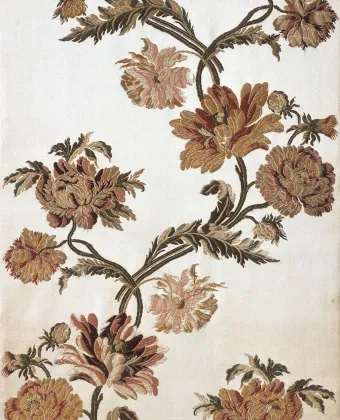
Wörlitz Palace, Chinese Room No. II
Schloss Wörlitz, Chinesisches Zimmer No. II
Period of creation:
ca. 1760/70?
Materials and technique:
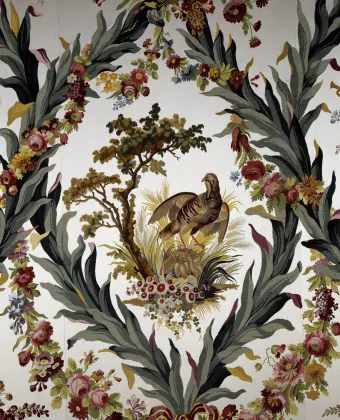
Hand-painted silk in multiple colours
Manufacturing location:
Lyon?

© Kulturstiftung Dessau-Wörlitz
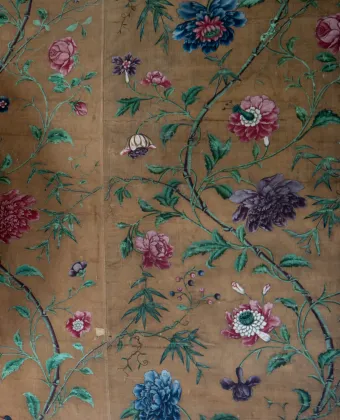
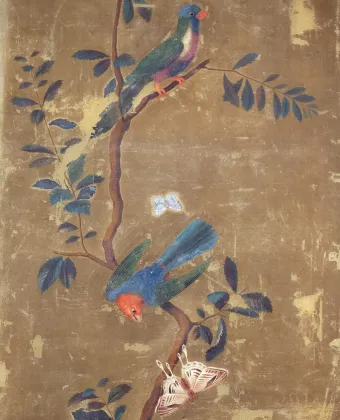
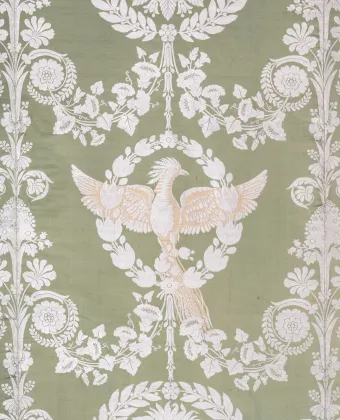
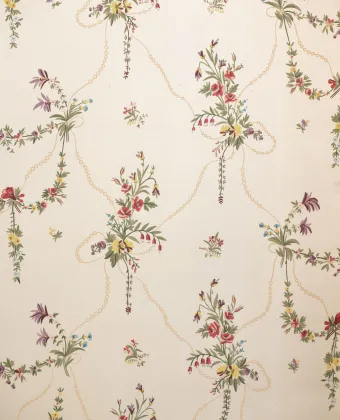
The painted celadon-green silk, recently restored, is located in Wörlitz Palace (Saxony-Anhalt, Germany), in the so-called ‘Chinese Room No. II’. Located in the main floor, the room was furnished in the early 1770s.
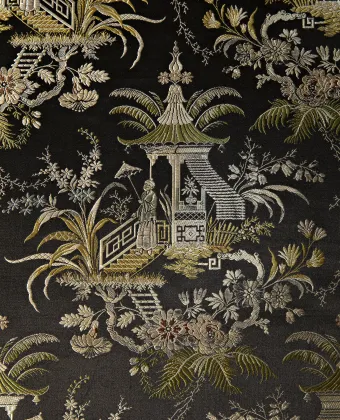
We do not really know anything about this hand-painted silk, in multiple colours. However, it may have been acquired by Louise Wilhelmine Henriette (1750–1811) and Leopold Friedrich Franz of Anhalt-Dessau (1740–1817) in Lyon, where the princely couple visited several silk manufacturers in August 1770 and purchased some silks. Some silks in a similar Chinese style are found in the palaces and collections of Potsdam, some of which were produced in Berlin (however, these are not hand-painted, but woven). Not many wall hangings have survived here, but this one is truly wonderful and it would be interesting to know more about it.
Bibliographic sources:
Evers, Susanne, “Die Verarbeitung französischer Vorbilder in der Berliner Seidenweberei”,in Stiftung Preußische Schlösser und Gärten (ed.), Friederisiko – Friedrich der Große, Die Essays, Munich, 2012, p. 350-355
- Weiss, Thomas (ed.), Der Alltag der Fürstin Louise von Anhalt-Dessau. Ihre Tagebuchaufzeichnungen 1756-1805, zusammengefasst von Friedrich Matthisson, Berlin, 2010, p. 28
author
Dr Anette Froesch
Discover the Kulturstiftung Dessau-Wörlitz
Royal Silks in Europe