


public textile

© The Royal Castle in Warsaw – Museum, P. Klosek
Name of the residence and name of the room:
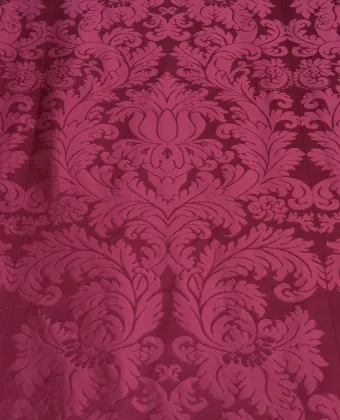
Royal Castle in Warsaw, the Old Audience Room
Zamek Królewski w Warszawie, Pokój Dawny Audiencjonalny
Period of creation:
Before 1789
Date of the reweaving:
1975-1977
Materials and technique:
Silk, damask
Pattern unit:
Height: 30cm; Width: 27cm
Manufacturing location:
France (?), Poland (?) (for the original textile)
Poland, Łódź, Artistic Handicraft Cooperative (Spółdzielnia “Rękodzieło Artystyczne”) (for the reconstructed fabric)

© The Royal Castle in Warsaw – Museum, F. Ćwik, M. Niewiadomska
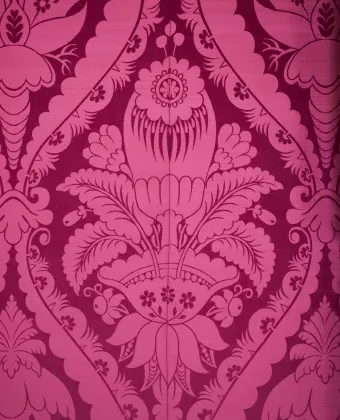
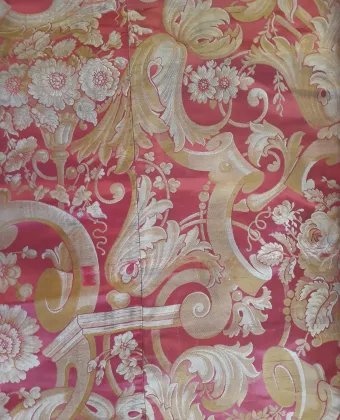
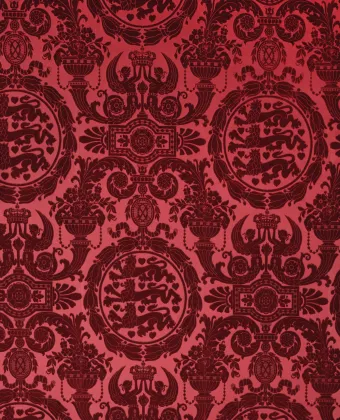
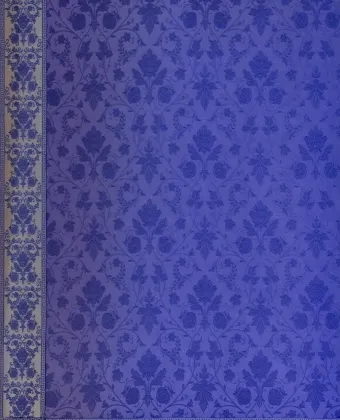
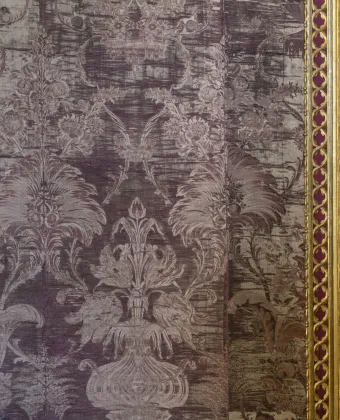
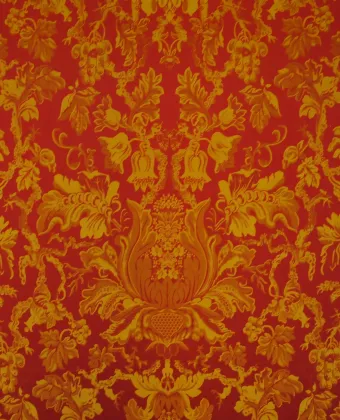
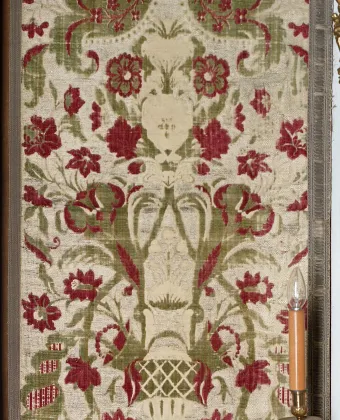
Red damask with a floral pattern dominates the colour scheme of the Old Audience Chamber, complementing the white panelling and the splendour of the gilded wood carved details, appliqués, and gilded bronze clocks. The Audience Chamber formed part of the apartment of King Stanisław August (1732-1798), the last ruler of Poland. Designed between 1776 and 1777 by the court architect Domenico Merlini (1730-1797), it served as the Throne Room until 1786. Today, Stanisław August’s regalia are displayed there: a sword, the chain of the Order of the White Eagle, and an aquamarine sceptre.
During the Second World War, the Royal Castle was looted, devastated, and eventually blown up by the Germans. Some of its furnishings were saved. Paintings, sculptures, furniture, and bronze objects were evacuated, while interior design elements such as doors, fragments of panelling, frescoes, and similar features were removed. Carefully stored, they were later used in the reconstruction and restoration carried out between 1971 and 1984. Those responsible for the reconstruction were fully aware of the importance of luxurious silk fabrics in the furnishings of 18th century royal interiors. Preparatory research for the reconstruction of historic textiles had already begun even before the decision to rebuild the Castle was taken.
The former Audience Chamber was reconstructed in accordance with its pre-1939 appearance, and hundreds of original elements were incorporated into its walls. The throne chair is also original. Unfortunately, the 18th century wall hangings and curtains (more than fifty pieces in total) have not survived, nor has the upholstery of the throne and its backrest, made from a silk fabric specially designed for this Room.
From the preserved inventories of the Castle, it is known that the Audience Chamber, furnished in the 1770s, like the one from the 1760s, was upholstered with crimson damask with gold galloons. As early as 1764 and 1765, the merchant Kazimierz Czempiński imported fabrics, including such damask, from Lyon on behalf of the king. In the following years, Stanisław August continued ordering the most important elements of interior design from France. Among others, the entire textile décor of the new Throne Room was made in Lyon between 1785 and 1786.
For the reconstruction in the 1970s, a fabric was sought that closely matched the descriptions in the inventories and was associated with Stanisław August. Finally, crimson damask was chosen, from which the pennants of the National Guard were made, embroidered with silver thread, metal plates and sequins, and trimmed with silver fringe, dated 1789-1794. Four such pennants have survived, including those in the National Museum in Warsaw and Kraków.
Persons associated:
Stanisław August Poniatowski, King of Poland (1732-1798);
Domenico Merlini, architect of the Old Audience Chamber (1730-1797)
Bibliographic sources:
Żukowska, Maria, Współczesne rekonstrukcje tkanin zabytkowych i ich zastosowanie we wnętrzach pałacowych [Contemporary reconstructions of historic fabrics and their use in palace interiors], Biuletyn Historii Sztuki, 1978, Vol. 40, No. 4, p. 443–460
Inwentarz Zamku Królewskiego w Warszawie z 1795 roku [Inventory of the Royal Castle in Warsaw from 1795], compiled and annotated by N. Ładyka, Warsaw, 1997
private textile

© The Royal Castle in Warsaw – Museum, P. Klosek
Name of the residence and name of the room:
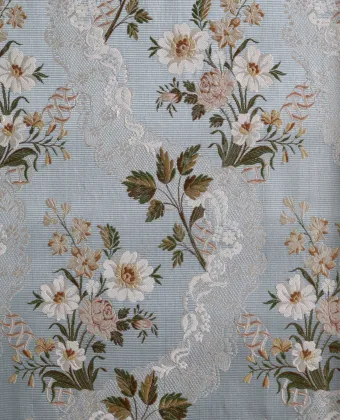
Royal Castle in Warsaw, the King’s Bed chamber
Zamek Królewski w Warszawie, Pokój Sypialny Króla
Period of creation:
1770s-1780s
Date of the reweaving:
1975-1976
Materials and technique:
Silk, satin, painted
Pattern unit:
Height: 36cm
Manufacturing location:
France (?), Poland (?) (for the original textile)
Poland, Milanówek, “Milanówek” Natural Silk Factory (Zakłady Jedwabiu Naturalnego „Milanówek”) (for the reconstructed textile)

© The Royal Castle in Warsaw – Museum, F. Ćwik, M. Niewiadomska
The King’s Bed chamber was part of the private apartments of Stanisław August (1732-1798), who conceived its artistic design. The construction of the Bed chamber in 1772-1774 was supervised by the royal architect Domenico Merlini (1730-1797).
Despite the destruction of the Royal Castle during World War II, a significant part of the original décor of the royal bed chamber survived, including yew panelling, paintings by Marcello Bacciarelli (1731-1818), and Parisian bronzes by Philippe Caffieri (1714-1774). Unfortunately, the original 18th century fabrics, as well as the royal bed, were destroyed or lost in the 19th century.
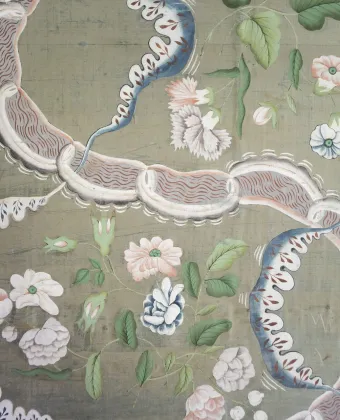
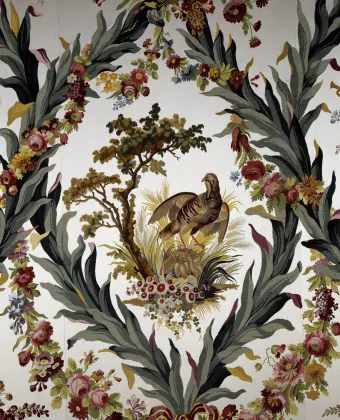
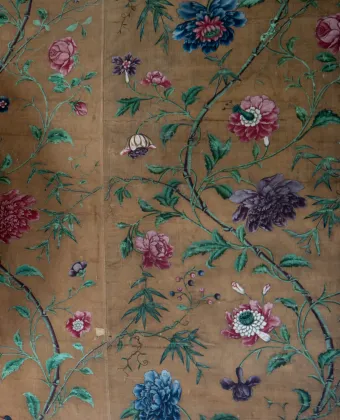
The 1795 inventory records that the wall coverings (six of twenty panels), the furnishings of the á la turque bed, the window curtains, and the upholstery of the furniture (two sofas and eight chairs) were made of Indian straw satin painted with floral twigs (“de satin des Indes, fond couleur de paille et peintes en ramages”). It may have been Chinese satin produced for the European market, painted with colourful floral motifs.
An earlier inventory from 1769 of the royal bedroom mentioned a fabric with similar colours and motifs: white Pékin fabric printed with multicoloured flowers.
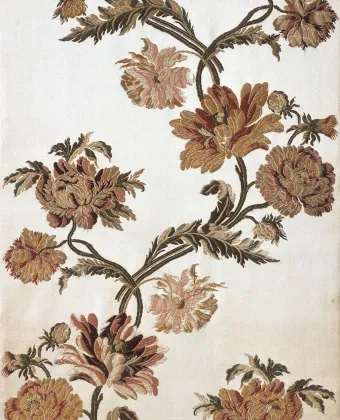
For the reconstruction in the 1970s, the basis chosen was a bed cover preserved in the collections of the National Museum in Warsaw, made of cream-coloured satin with an embroidered floral pattern executed in chain stitch using multicoloured silk yarn and chenille, dating from the 1770s-1780s and presumably associated with King Stanisław August.
In the 1970s, communist Poland sometimes lacked even silk yarn, and various technical problems were encountered during the reconstruction process. As a result, it was decided to replace the embroidery on the satin with a printed pattern, in accordance with the descriptions in the early inventories. The effect achieved appears to be similar to the preserved castle interior designs of that period, particularly reflecting the contrast described in the inventories between the honey-coloured wooden panelling with gilded laurel branches and the pastel silk fabric with its delicate floral pattern.
Persons associated:
Stanisław August Poniatowski, King of Poland (1732-1798);
Domenico Merlini, architect (1730-1797)
Bibliographic sources:
Żukowska, Maria, Współczesne rekonstrukcje tkanin zabytkowych i ich zastosowanie we wnętrzach pałacowych [Contemporary reconstructions of historic fabrics and their use in palace interiors], Biuletyn Historii Sztuki, 1978, Vol. 40, No. 4, p. 443–460
Inwentarz Zamku Królewskiego w Warszawie z 1795 roku [Inventory of the Royal Castle in Warsaw from 1795], compiled and annotated by N. Ładyka, Warsaw, 1997
author
Danuta Szewczyk-Prokurat
Discover the Royal Castle in Warsaw
Royal Silks in Europe